
Solarseeker is proud to announce that our comprehensive engineering research paper, “Engineering Standards for Solar VFD Matching on Deep-Well Submersible Pumps: Mitigating Harmonics, Voltage Drop, and Reflection Waves in Off-Grid Water Schemes,” has been officially published in Kenya Engineer, East Africa’s premier engineering publication.
Authored by the Solarseeker engineering team, this landmark paper establishes concrete, field-tested guidelines for water engineers, EPC contractors, and agricultural irrigation planners deploying high-power solar variable frequency drives (VFDs) across remote, off-grid borehole environments.
Official Journal Citation
Publication: Kenya Engineer (September 2026)
Subject: Deep borehole solar VFD matching, transmission line wave reflection mitigation, and thermal derating compensation.
Addressing the Root Causes of Borehole Motor Failures
Across arid and semi-arid regions in East Africa, the Middle East, and Latin America, solar-powered borehole schemes represent critical lifelines for municipal drinking water, livestock, and commercial agriculture. However, field telemetry and EPC warranty audits reveal an alarming industry-wide statistic: up to 32% of solar submersible pump systems experience premature motor failures, persistent nuisance tripping, or severe insulation degradation within the first 18 months of commissioning.
While field operators frequently attribute these breakdowns to defective motors or poor water quality, the published paper demonstrates that the vast majority of failures stem from three fundamental electrical mismatches between surface-mounted inverters and submerged motors:
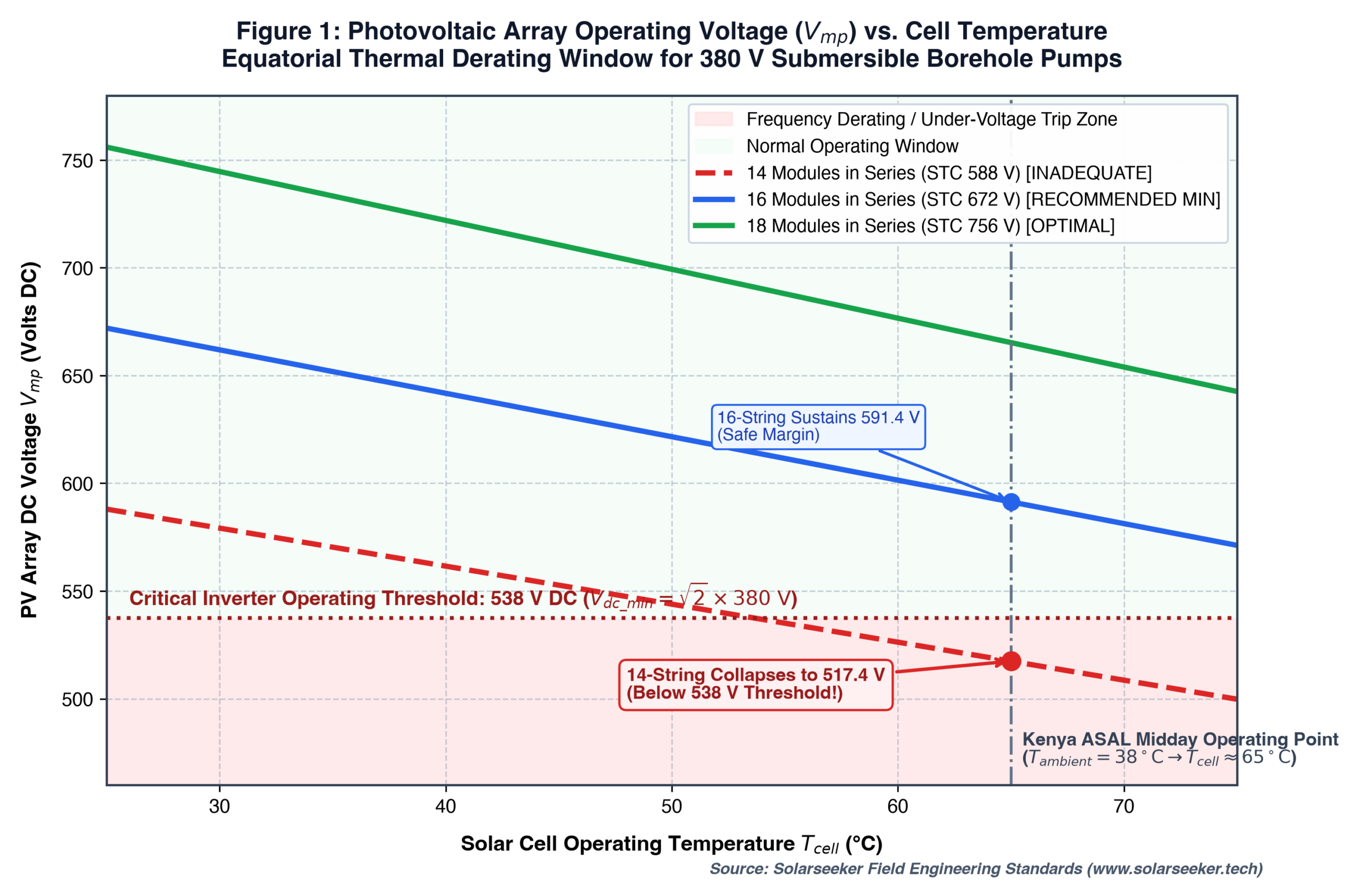
- Equatorial PV Thermal Derating: Midday string voltage collapse under extreme ambient temperatures (>45°C ambient, >65°C cell temperature), leading to low DC bus voltages, motor stalling, and excessive current draws.
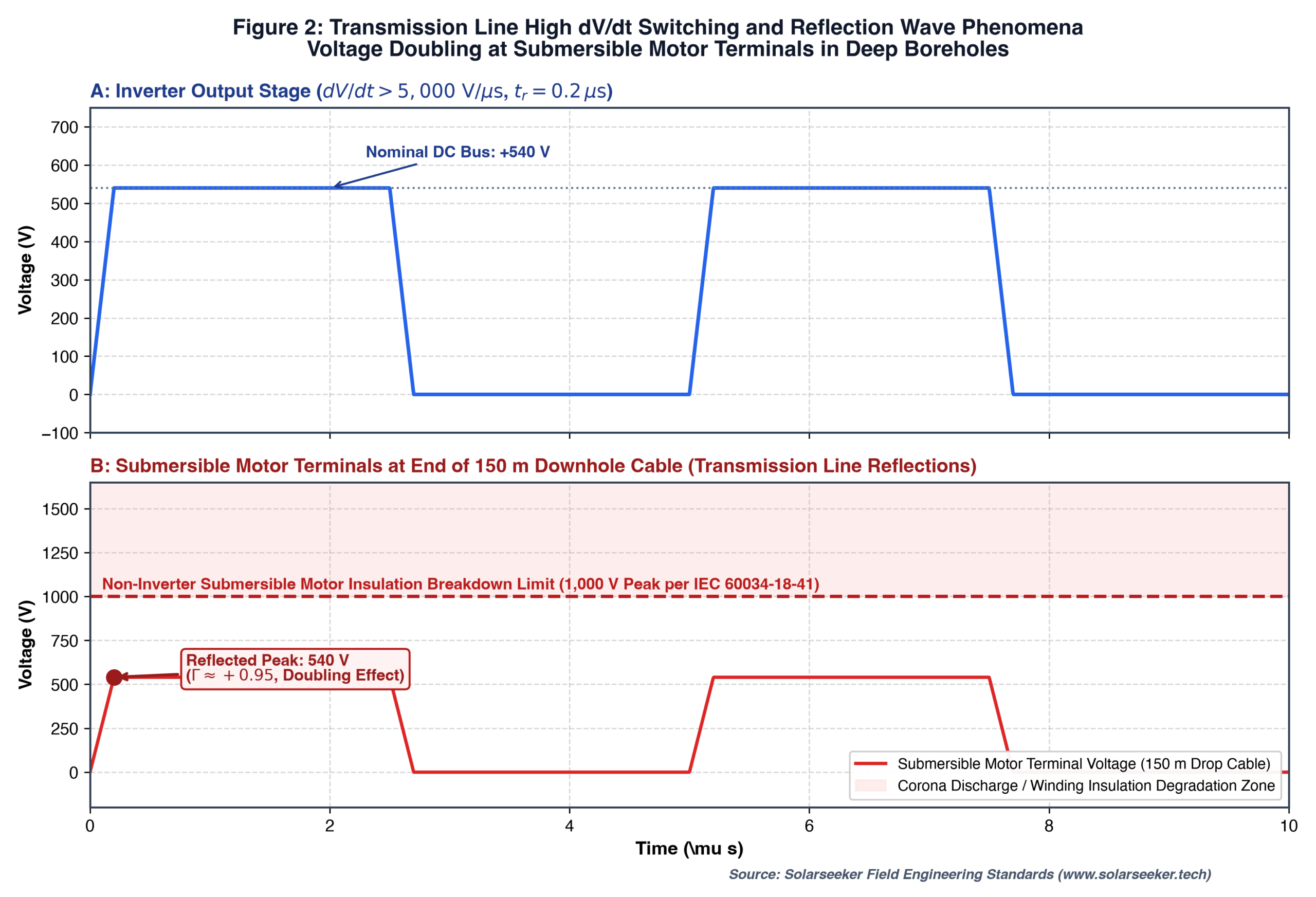
- High dV/dt Transmission Line Reflection: Steep IGBT switching transients traveling through long submerged drop cables (80m to 250m+), causing terminal peak voltage doubling that punctures standard motor winding insulation.
- Hydraulic Water Hammer Shock: Abrupt VFD shutdowns during sudden cloud coverage, inducing destructive pressure transients on borehole check valves.
Core Engineering Standards Established in the Paper
1. Temperature-Compensated PV Array Sizing
Standard PV module datasheets specify performance at Standard Test Conditions (STC: 25°C). However, in equatorial installations, solar panel cell temperatures routinely reach 65°C. Because crystalline silicon panels exhibit a negative temperature coefficient for voltage (≈ −0.35%/°C), array open-circuit and operating voltages collapse by 14% to 18% during peak solar irradiance hours.
For standard 380V three-phase submersible pumps requiring a minimum DC bus voltage of 530V DC, string sizing must be calculated against the maximum hot cell operating point. The paper provides exact string-sizing mathematical formulas to ensure strings operate safely within the 530V–800V DC recommended window of the Solarseeker SP4 380V platform.
2. Transmission Line Reflection & Motor Dielectric Stress (IEC 60034-18-41)
Modern solar VFDs employ fast-switching Insulated Gate Bipolar Transistors (IGBTs) with rise times (tr) as fast as 0.1 to 0.2 microseconds. When these pulse-width-modulated (PWM) square waves enter deep borehole cables, the transmission line reflection coefficient reaches high positive values due to severe impedance mismatch between standard borehole flat cables and submersible motors.
This physical phenomenon doubles the peak voltage at the motor terminals to 1,080V–1,600V, creating continuous partial discharge that rapidly erodes motor turn-to-turn insulation unless appropriate output filtration is integrated.
3. The 4-Tier Output Filtration Selection Matrix
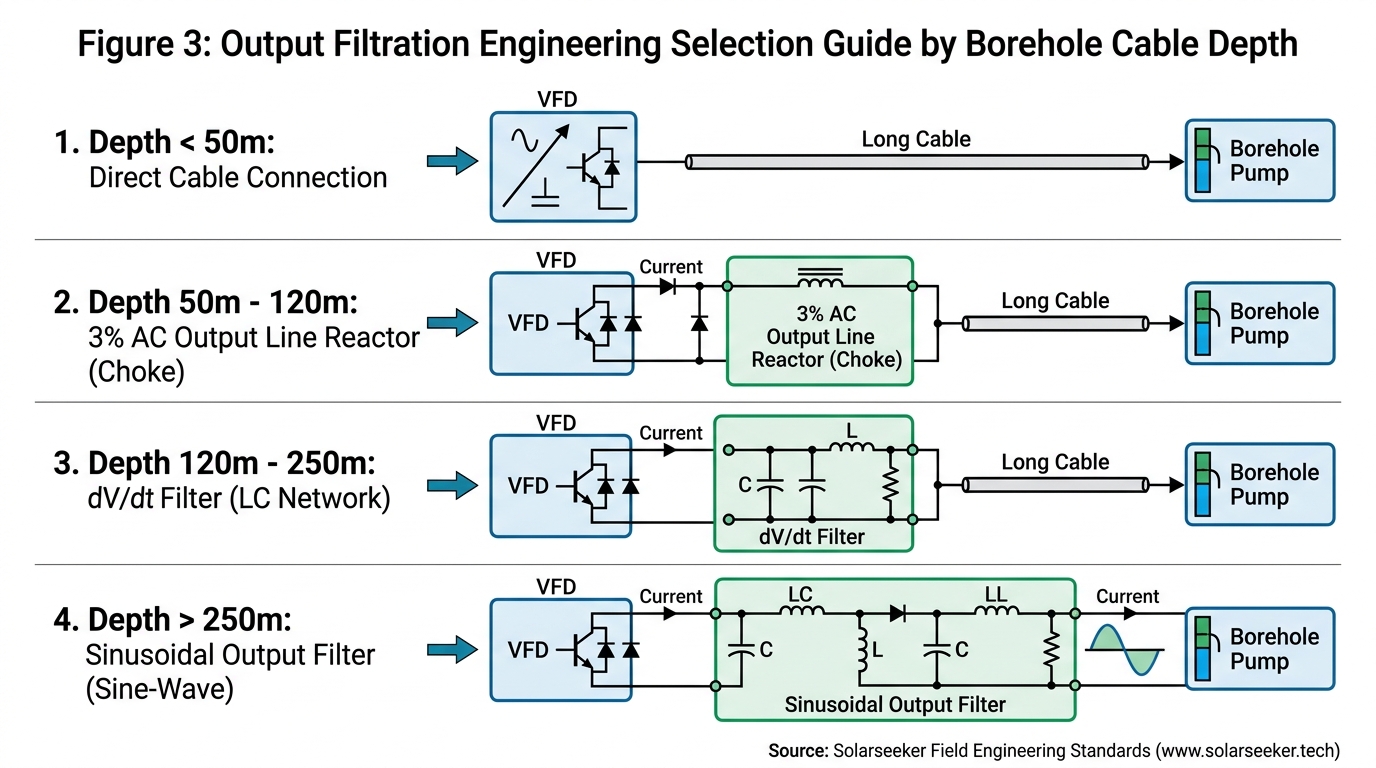
To provide EPC contractors and project designers with practical, foolproof sizing guidelines, the paper formalizes a clear 4-tier output filtration hierarchy based on borehole cable length:
- Tier 1 (<50m Cable Length): Direct inverter-to-motor connection is acceptable for motors rated to IEC 60034-25 Type A standards.
- Tier 2 (50m to 120m Cable Length): A 3% impedance AC Output Line Reactor (choke) is mandatory. It reduces dV/dt slew rates to below 1,000 V/μs, mitigating initial reflection spikes.
- Tier 3 (120m to 250m Cable Length): A specialized dV/dt LC Filter is required to clamp peak terminal voltages to under 1.3 times DC bus voltage and extend rise times beyond 2.0 μs.
- Tier 4 (>250m Cable Length): A full Sinusoidal Output Filter (LC low-pass network) is essential. It completely reconstructs the PWM pulse train into a clean, smooth sinusoidal waveform with total harmonic distortion (THD) below 5%, eliminating cable capacitance charging currents and bearing currents.
4. Hydraulic Water Hammer & Sensorless Dry-Run Protection
In addition to electrical protection, the standards outline critical software algorithms built into the SP4 architecture:
- Controlled Deceleration Ramp (2.5s–4.0s): When solar irradiance drops below operational thresholds, the inverter executes a controlled ramp-down rather than an immediate freewheel coast-to-stop. This maintains backpressure and prevents damaging hydraulic water hammer shocks on non-return check valves.
- Sensorless Under-Load / Dry-Well Protection: Utilizes active motor power factor and current monitoring to detect cavitation or well drawdown in real-time, eliminating the failure-prone physical water level sensor probes traditionally lowered down boreholes.
Implementing the Standards in Your Solar Pumping Projects
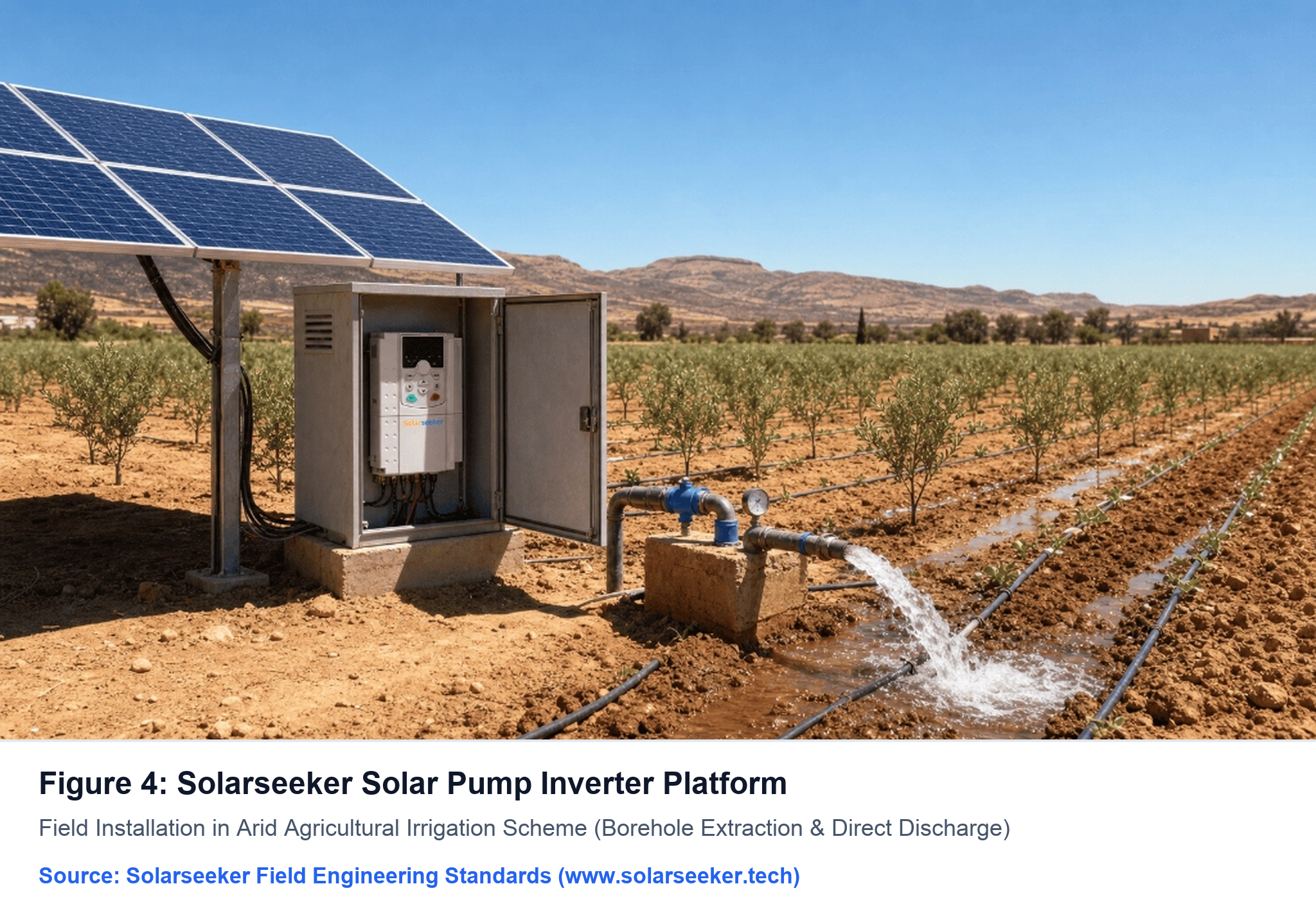
These field-tested engineering methodologies are natively incorporated into Solarseeker’s SP4 380V Three Phase Solar Pump Inverter product line (spanning 2.2 kW to 220 kW) and our pre-engineered solar pump control cabinets.
For water authorities, municipal water boards, agricultural estates, and solar EPCs designing deep borehole extraction systems, adhering to these published standards ensures maximum system uptime, lower life-cycle operational costs, and complete protection for expensive submersible pump assets.
To read the unedited peer-reviewed publication, view full electrical schematics, and access sizing equations, please visit the official publication at Kenya Engineer Magazine.
To consult with our engineering team regarding string configuration, reactor cabinet integration, or pump nameplate matching for your next project, explore our 380V Solar Well Pump Systems or submit an engineering review request.