
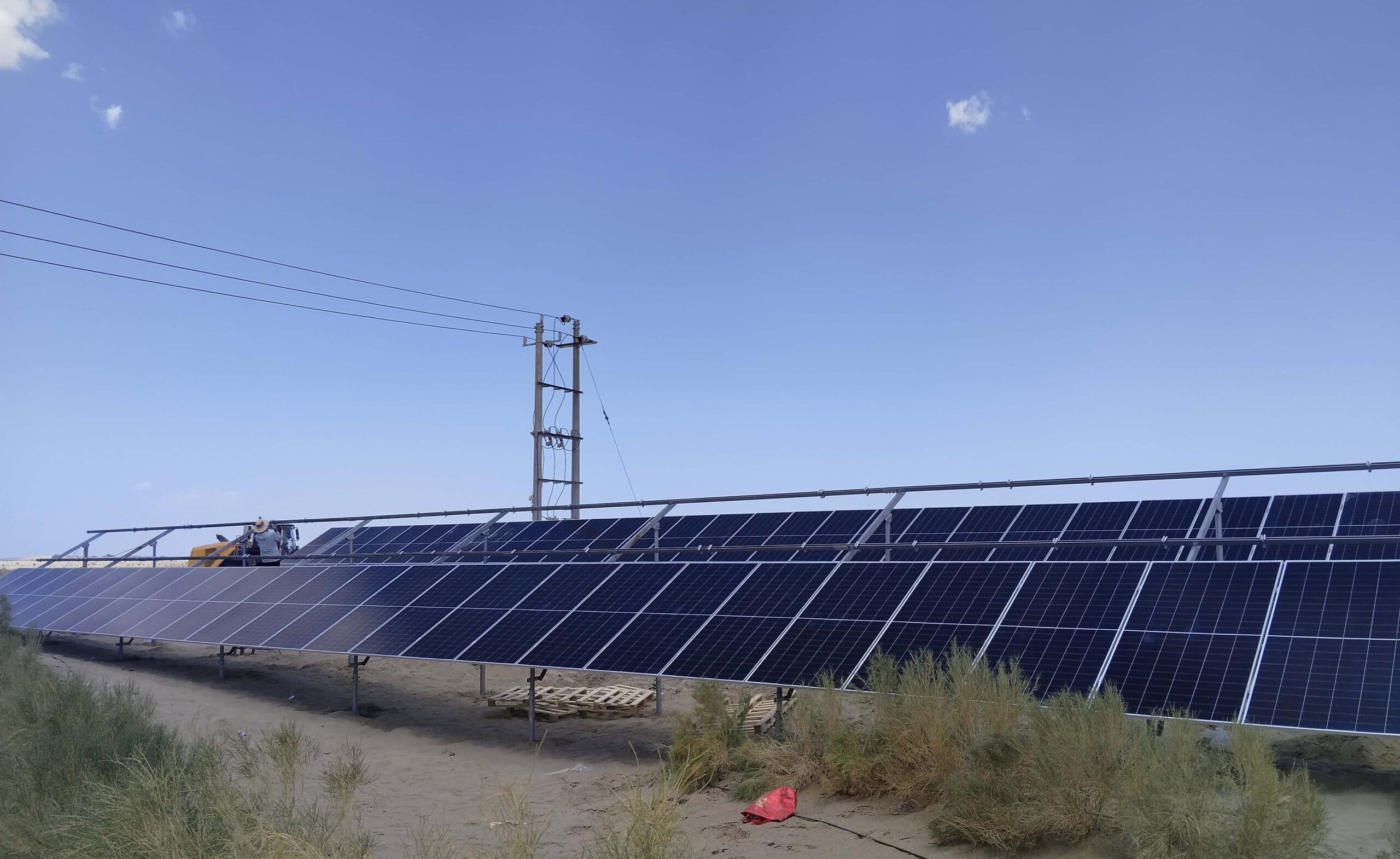
Direct Answer: How Should Distributors Validate a Solar Pump Inverter Sample Order?
A solar pump inverter sample order serves as a structured risk-mitigation gateway for water equipment distributors, electrical wholesalers, and solar pump EPCs prior to committing working capital to full container-load (FCL) inventory. A professional distributor validation plan evaluates sample drives across three structured phases: (1) laboratory bench testing to verify MPPT tracking response, DC reverse polarity protection, and total harmonic distortion (THD); (2) a 30-day controlled field pilot on operational deep-well or surface irrigation pumps to measure thermal performance under 40°C+ ambient heat; and (3) supply chain audit assessing manufacturer firmware localization, spare control board availability, and warranty RMA turnaround times. Establishing quantitative pass/fail benchmarks during the sample phase ensures distributors protect their regional reputation, eliminate recurring field failures, and build high-margin wholesale volume.
The Business Case: Why Distributors Cannot Skip Sample Qualification
In the competitive solar water pumping sector across Africa, South Asia, Latin America, and the Middle East, pump distributors face substantial commercial exposure. When an unproven variable frequency drive fails in the field, the farmer or commercial grower does not hold the overseas factory accountable—they hold their regional distributor responsible. Repeated field warranty service calls, burned motor windings, or slow factory technical support can erode operating margins and destroy distributor credibility.
Ordering a targeted solar pump inverter sample order (typically 2 to 4 units spanning core power ratings such as 2.2kW single-phase to 3-phase, 7.5kW, and 15kW/18.5kW 380V three-phase) allows wholesale technical teams to stress-test hardware durability, verify software logic, and calibrate local installer documentation before placing container-scale purchase orders.
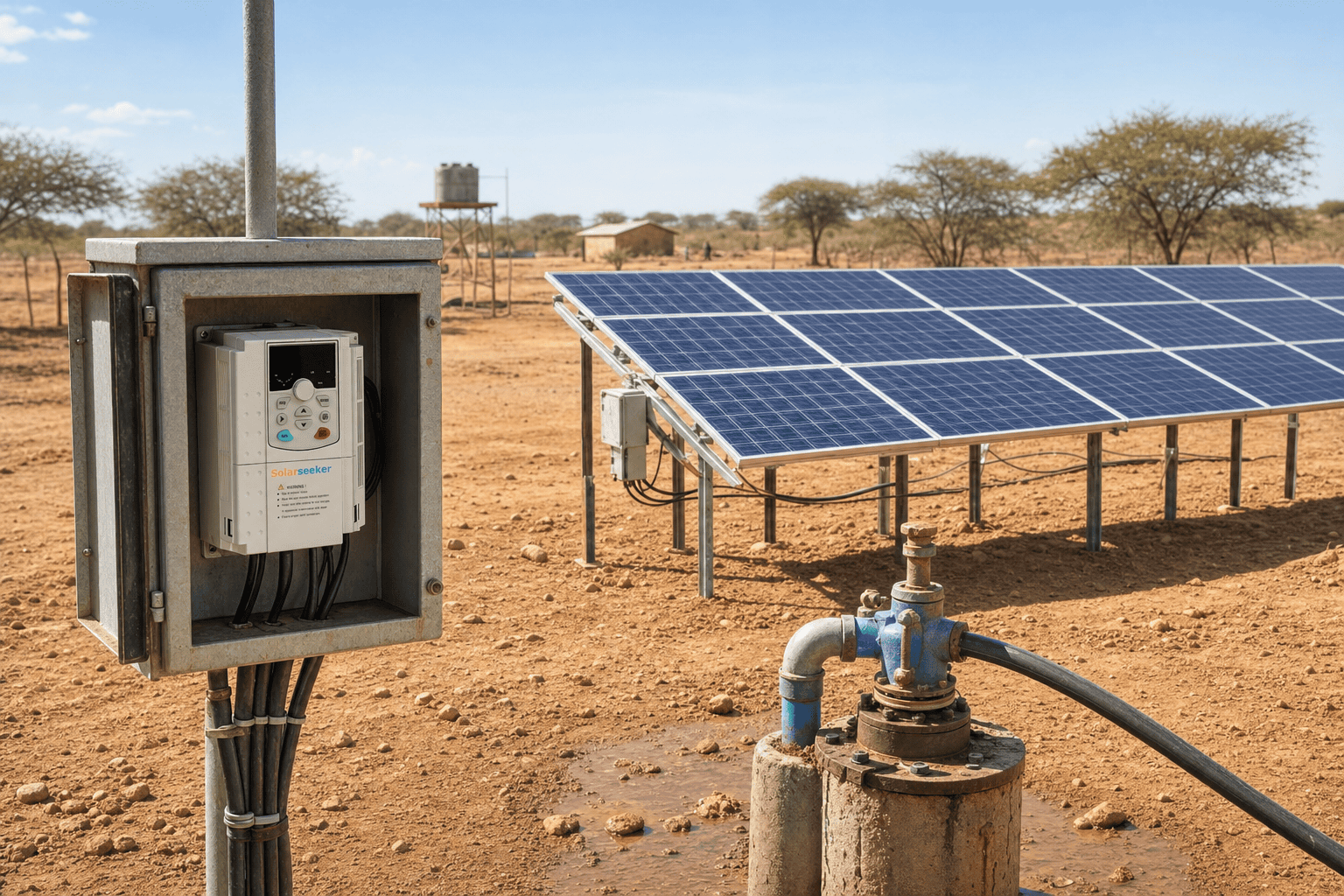
Phase 1: Laboratory & Benchtop Electrical Verification
Before installing sample units on customer farms or municipal wells, distributor engineers should subject sample inverters to a rigorous benchtop inspection in their workshop or technical testing facility.
1. Dynamic MPPT Efficiency & Cold-Morning Tracking
Using a programmable DC solar array simulator or a controlled PV string, test how the inverter responds to sudden irradiance fluctuations. An engineered drive must track the Maximum Power Point (MPPT) with >99% static efficiency and adjust output frequency smoothly without stalling during cloud transitions. Verify cold-morning open-circuit voltage handling up to 800V DC on 380V units to ensure DC bus capacitors and input MOVs (metal oxide varistors) operate with comfortable safety margins.
2. Motor Protection & Fault Simulation
Induce controlled fault conditions to verify that onboard microprocessor protection algorithms trigger reliably within rated microsecond windows:
- Phase Loss Protection: Disconnect one AC motor phase while running under load. The inverter must trip instantly on Phase Imbalance / Output Phase Loss (E.oUt) to prevent motor winding burnout.
- DC Reverse Polarity: Verify reverse polarity protection on the DC input terminals to protect against field installer wiring errors.
- Short-Circuit Protection: Test phase-to-phase and phase-to-ground fault protection response times to ensure IGBT modules are protected against terminal accidents.
- Input Voltage Surges: Measure internal MOV clamping voltage under simulated surge pulses according to IEC 61643 standards.
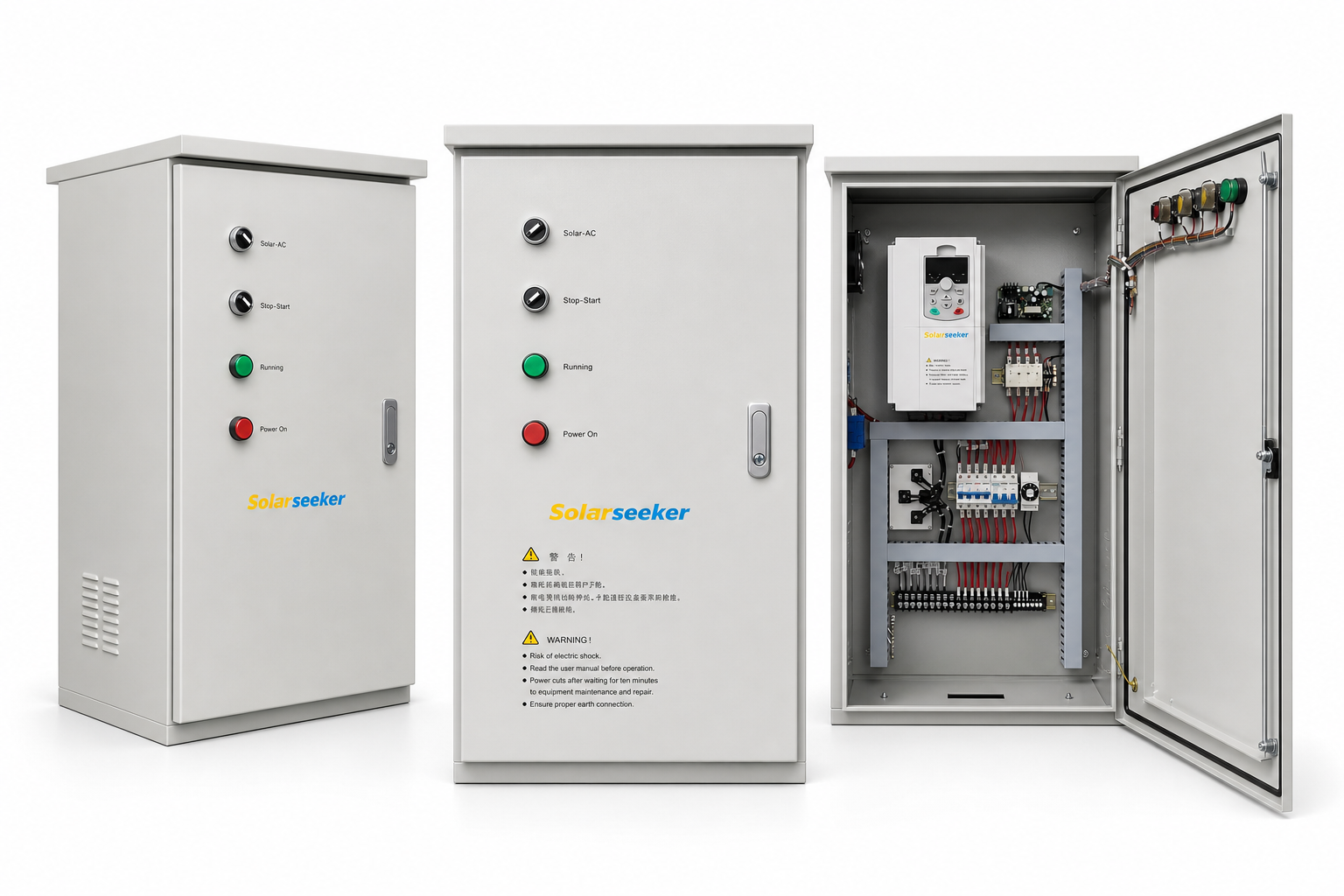
Phase 2: Real-World Borehole & Irrigation Field Trials
Bench testing proves electrical compliance, but field trials prove hydraulic endurance under harsh agricultural operating conditions. Install sample units on representative partner test sites for a minimum of 20 to 30 days.
1. Borehole Dynamic Sump & Dry-Run Detection
In deep submersible boreholes, water levels fluctuate based on seasonal recharge and aquifer drawdown. Test the inverter’s dry-run protection functionality under real well drawdown conditions:
- Sensorless Active Power Detection: Evaluate whether the drive accurately calculates real-time motor power factor ($P = \sqrt{3} \cdot V \cdot I \cdot \cos\phi$) to detect pump unpriming without requiring downhole water level probes.
- Automatic Restart Cycling: Verify that the recovery restart timer (programmable from 10 to 180 minutes) successfully resets the system once well recharge occurs, eliminating manual site interventions.
2. Ambient Thermal Endurance Under Peak Irradiance
Field installations frequently expose drive enclosures to ambient temperatures exceeding 42°C with full solar radiation. Monitor heatsink temperatures at 13:00 midday when the solar array delivers peak kilowatt output. The drive should maintain rated continuous output current without entering premature thermal derating or overheating faults.
3. Hybrid Dual-Supply & Generator Integration
For commercial irrigation and continuous livestock watering, test hybrid operation. Connect the AC auxiliary input to a diesel genset or rural single/three-phase utility grid. Verify that the automatic changeover logic switches seamlessly between PV solar power and auxiliary power without creating line feedback or breaker nuisance trips.
Phase 3: Commercial & Supply Chain Risk Assessment
Distributor profitability depends as much on the manufacturer’s commercial discipline and warranty responsiveness as it does on hardware engineering.
| Commercial Assessment Area | Key Evaluation Criteria | Distributor Risk Level if Unverified |
|---|---|---|
| RMA & Warranty Policy | Documented factory warranty terms (standard 24 to 36 months); board replacement vs whole-unit exchange; local warranty authorization. | High: Slow overseas warranty return policies force distributors to fund warranty replacements out-of-pocket. |
| Critical Spare Parts Stocking | Availability of spare main control boards, power boards, cooling fans, and terminal blocks at pre-negotiated wholesale rates. | High: Lack of modular spare boards turns a 30-minute field repair into weeks of downtime for farming clients. |
| Firmware & Software Localization | Keypad multi-language options; factory pre-set application macros; RS485 Modbus RTU documentation for IoT/GPRS integration. | Medium: Complex menu navigation increases technical support call volume from regional pump installers. |
| Packaging & Sea Freight Protection | Heavy-duty dual-wall corrugated export packaging, moisture-absorbing desiccant, corner drop impact protection. | Medium: Damaged chassis and dented heat sinks during container transit create unsellable B-stock. |
| MOQ Flexibility & Mixed Containers | Willingness of manufacturer to consolidate mixed kW ratings (e.g., 2.2kW, 5.5kW, 11kW, 22kW, 37kW) within initial 20GP container orders. | High: Rigid single-SKU container minimums tie up excess distributor working capital in slow-moving models. |
Distributor Sample Qualification Scorecard
Wholesale procurement committees should adopt this standardized 100-point scoring matrix to objectively rate manufacturer samples:
| Evaluation Category | Weight | Specific Test Metric & Target | Minimum Pass Threshold |
|---|---|---|---|
| 1. Electrical Performance | 25% | MPPT Tracking >99%; Cold VOC margin >15%; Output waveform THD <4.5%; Power factor >0.96. | 22 / 25 points |
| 2. Hydraulic Pumping Output | 25% | Flow rate ($m^3/h$) and total dynamic head ($H$) matched within ±3% of rated pump curve at varying irradiance (300W/m² to 1000W/m²). | 22 / 25 points |
| 3. Thermal & Environmental Durability | 20% | Full-load operation at 45°C ambient without thermal fault; IP55 or conformal-coated IP20 board inspection; zero particulate ingress. | 17 / 20 points |
| 4. Usability & Field Commissioning | 15% | Setup time under 5 minutes using pump macros; clear LCD/LED display; simple keypad parameter lock for end-users. | 12 / 15 points |
| 5. Commercial Terms & Support | 15% | 24+ month warranty; local RMA spare board kits; technical support engineer response <4 hours via direct messaging. | 13 / 15 points |
| TOTAL QUALIFICATION SCORE | 100% | Composite Distributor Evaluation Index | >= 85 Points for Container Rollout |
Scaling from Trial Order to Container Rollout: Optimal Inventory Mix
Once sample validation hits the 85-point benchmark, distributors should structure their first 20ft (20GP) or 40ft (40HQ) container order using a balanced power-mix formula based on regional agricultural profiles:
- Smallholder & Surface Irrigation (25% Volume): 1.5kW to 4.0kW single-phase 220V in / three-phase 220V out drives. These cater to shallow wells, river abstractions, and drip irrigation systems on 1 to 5-acre smallholdings.
- Commercial Deep Boreholes (50% Volume): 5.5kW, 7.5kW, 11kW, and 15kW three-phase 380V/480V inverters. This forms the bread-and-butter inventory for agricultural cooperatives, borehole drilling contractors, and institutional drinking water installations.
- High-Capacity Pivot & Mine Dewatering (20% Volume): 22kW, 37kW, 45kW, and 75kW high-power units for large-scale pivot systems and industrial drainage schemes.
- Distributor Spare Board & Maintenance Packs (5% Volume): Dedicated maintenance inventory containing complete spare CPU control cards, IGBT driver boards, and cooling fans to provide instant local service support.
Partnering with Solarseeker for Distributor Wholesale Growth
Solarseeker is dedicated to long-term OEM and distributor partnerships across global agricultural and water management markets. We eliminate distributor risk through transparent trial order support:
- Dedicated Trial Order Kits: Order single-unit sample evaluation kits with expedited air freight, dedicated WhatsApp engineering support, and full technical documentation.
- Flagship Hardware Architecture: Explore our flagship Solarseeker SP4 Solar Pump Inverter, engineered with high-efficiency MPPT tracking algorithms, modular board construction, native generator ATS control, and rugged industrial enclosures.
- OEM & Private Label Branding: For established regional distributors, Solarseeker provides private label customization, localized keypad faceplates, tailored packaging, and custom firmware defaults.
- Manufacturing Transparency: Learn more about our factory quality standards, ISO-certified burn-in testing chambers, and direct engineering access on the Solarseeker Manufacturer Overview Page.
Ready to validate our drives in your test laboratory or field projects? Contact the Solarseeker distributor relations desk today via Solarseeker Contact Page to request our comprehensive B2B wholesale pricing schedule and sample order dispatch package.