
Yes—you can make one solar pump inverter drive two pumps (or even three identical pumps) in parallel, provided you size the inverter’s rated power and output current at 1.5 times or more the combined pump load, wire an AC output reactor on U / V / W, start and stop all pumps simultaneously, and fit separate thermal overload relays on each motor branch. However, if the two pumps sit in wells with different water levels or need independent flow control, buying two dedicated drives is almost always cheaper and far safer than risking burned IGBTs.
Contractors usually ask about sharing one drive when quoting twin booster pumps or adjacent shallow boreholes. Before wiring two motor cables under one set of output lugs, check what happens electrically when one pump lags behind the other.
Three Non-Negotiable Rules for Running Multi-Pump Loads on One Drive
A standard variable-frequency solar water pump inverter tracks total output current across U, V, and W—it cannot see how much current goes down Cable A versus Cable B. When an installer connects two pumps to an undersized drive without output filtering, instantaneous current spikes destroy power modules fast.
If a project genuinely calls for a single-drive multi-pump setup, Solarseeker application engineers enforce three hard rules:
- Size Inverter Power at >= 1.5x Combined Motor Power: Add the rated kW and rated full-load amps (FLA) of every pump connected to the bus, then multiply by 1.5. For example, two 4kW three-phase 380V pumps (8kW combined) require at least a 12kW-class or 15kW Solarseeker SP4 380V inverter (
SP4015), never an 7.5kW or 11kW unit. - Install a Mandatory AC Output Reactor: Parallel motor cables double stray line capacitance at the inverter terminals. Even on modest cable lengths, two cables firing together create sharp current ringing that trips
888overcurrent alarms or damages IGBTs unless a 3% AC output choke sits immediately afterU / V / W. - Start and Stop Both Pumps Together—Never Hot-Switch: Never close a magnetic contactor to bring a second stationary pump onto an inverter that is already running at 45Hz. Dropping a dead rotor onto a live 45Hz VFD output creates a massive across-the-line inrush surge that trips or blows the inverter instantly. Both pumps must ramp up from 0Hz together and ramp down together.
Organized panel distribution inside a Solarseeker control cabinet leaving clearance for branch motor protection and output chokes.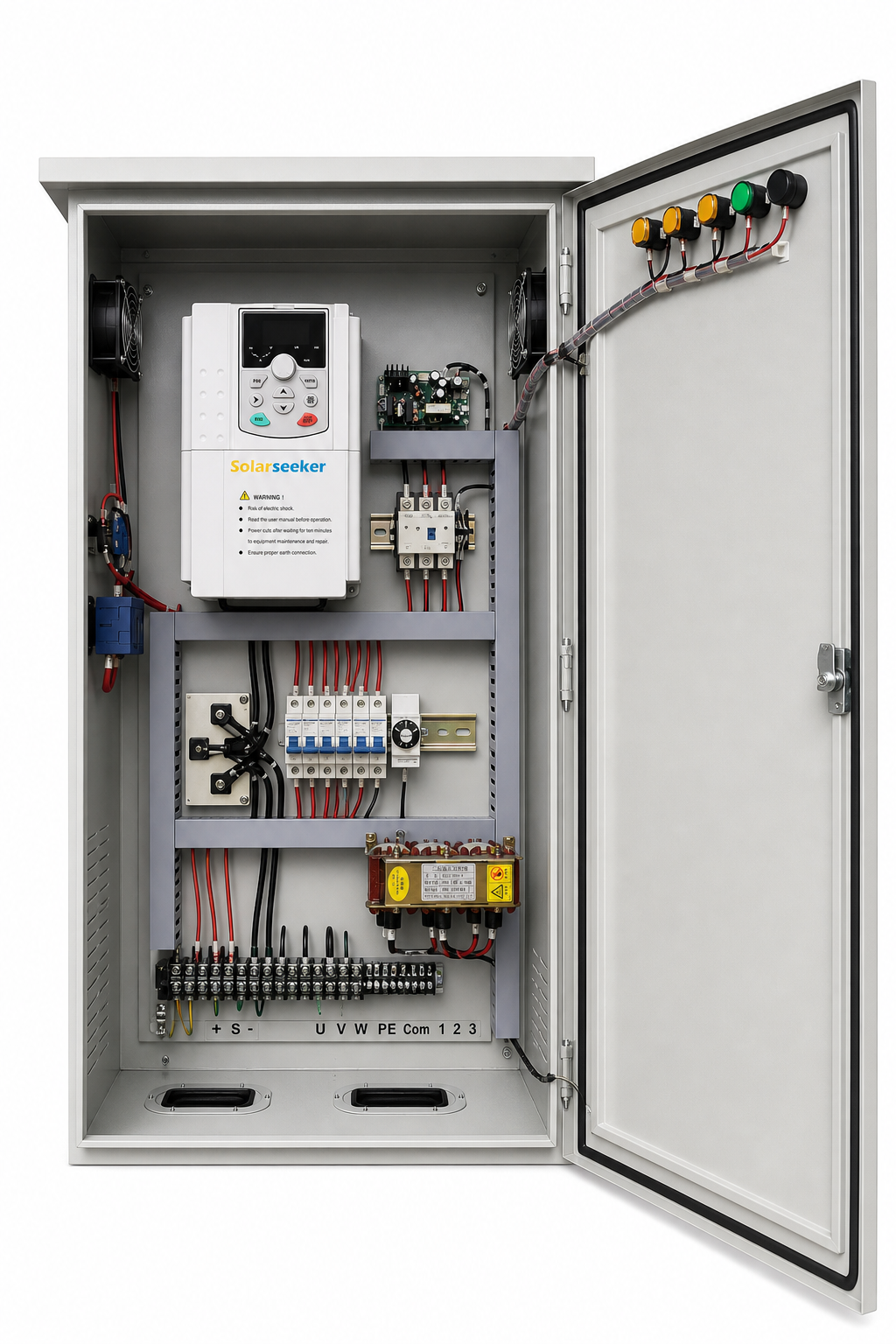
Decision Matrix: One Oversized Inverter vs. Two Dedicated Inverters
Many EPC buyers assume one large inverter costs less than two smaller ones. Once you add the 1.5x upsizing margin, output reactor, and branch overload hardware, compare both quotes side by side:
| Engineering & Commercial Factor | One Oversized Inverter Driving Two Pumps | Two Dedicated Inverters (One per Pump) |
|---|---|---|
| Drive Sizing Requirement | >= 1.5x sum of both pumps’ rated kW and amps | Standard single-pump match per motor nameplate |
| Independent Speed / Flow Control | None—both motors receive the exact same frequency | Full independent MPPT and Hz control per borehole |
| Dry-Run Sensorless Protection | Unreliable if one well runs dry while the other stays full | Accurate per-well dry-run and underload detection |
| Redundancy During Maintenance | Single point of failure shuts down 100% of water supply | One pump keeps irrigating if the second well is serviced |
| Required Branch Hardware | Output reactor + two separate thermal overload relays | Standard DC/AC input breakers per drive |
| Best-Fit Application | Identical surface booster twins on a shared header pipe | Separate boreholes, unequal pump sizes, or critical water supply |
The Branch Thermal Overload Detail Most Panel Builders Miss
Here is the hidden failure mode when you let one solar pump inverter drive two pumps: suppose two 3kW pumps (about 7A each at 380V) run off a single 11kW inverter set for an 22A overload threshold. If sand jams Pump #1 so it draws 16A while Pump #2 spins lightly at 4A, total inverter current is 20A—below the inverter’s 22A trip point. The inverter stays happy while Pump #1 roasts its stator windings underground.
Because of this blind spot, multi-motor VFD branches must include individual thermal overload relays wired downstream of the output reactor, with each relay’s auxiliary fault contact wired back to the inverter’s stop/fault control input (COM / digital input terminal) so either stalled motor halts the drive safely. International low-voltage switchgear practices under IEC 60947-4-1 motor branch coordination require individual overload protection whenever multiple motors share a single power converter. Always have a licensed electrical engineer or qualified panel technician verify branch coordination and local code compliance.
Heavy-duty power terminal access on the SP4 platform; multi-pump setups route U/V/W through an external reactor to branch thermal relays.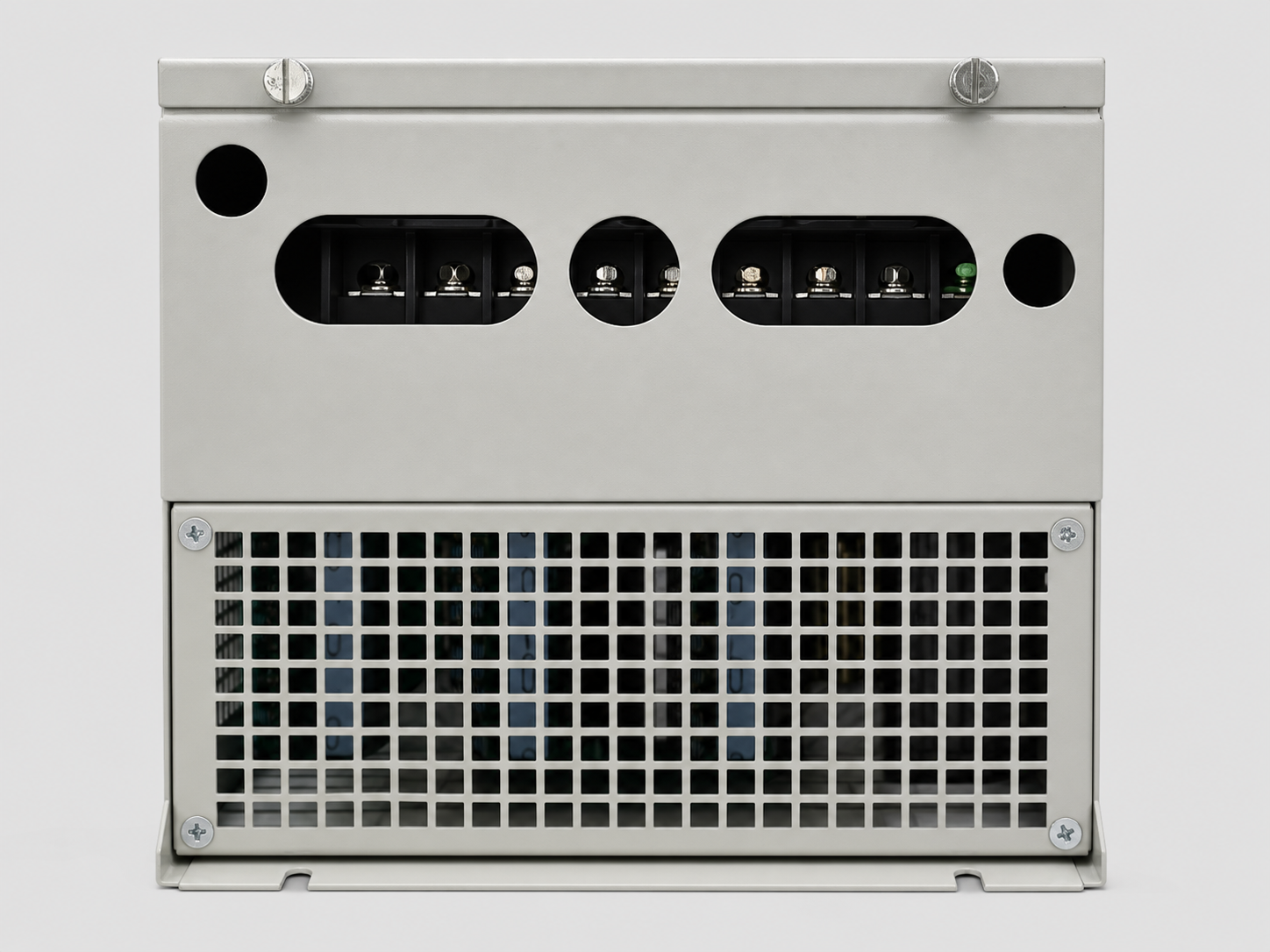
When Shared Control Makes Sense—and How to House It Safely
Sharing one drive works reasonably well on twin surface transfer pumps drawing from the same canal basin into a single manifold, where head, pipe friction, and motor models match. By contrast, on two separate boreholes—even drilled 30 meters apart—dynamic water drawdown rarely matches, and two smaller drives mounted inside a dual-bay Solarseeker IP65 Solar Pump Control Cabinet give cleaner dry-run protection and built-in redundancy. For single-motor baseline rules, see our Solar Pump Selection Guide.
Send Both Pump Nameplates Before Finalizing Your Panel BOM
Before quoting a solar pump inverter drive two pumps cabinet—or deciding whether dual drives save money—send photos of both motor nameplates, pump types (submersible vs. surface centrifugal), cable lengths, and PV array wattage via the Solarseeker Engineering Contact Page. Our engineering team will review whether a 1.5x single-drive reactor package or a dual-inverter cabinet gives your client lower risk.