
The classic deep-well commissioning headache looks the same on almost every continent: the inverter passes a no-load check at the shop, yet trips on overcurrent (888 or OC) within two seconds of starting a submersible pump 140 meters underground. On a solar pump inverter long cable run exceeding 80 to 100 meters, the culprit is rarely a defective drive or a seized impeller—it is high-frequency capacitive charging current and PWM voltage wave reflection along the drop cable, which you fix by installing an AC output reactor, lowering the carrier frequency, and sizing copper for under 3% voltage drop.
Pulling a deep submersible pump costs a crane truck, a full crew day, and bruised pipe threads. Run the electrical checks at the surface first.
Why Long Drop Cables Trigger Instantaneous Overcurrent
Every variable-frequency solar pump drive synthesizes AC motor power from fast IGBT switching pulses. Over a short 25-meter well cable, those pulses reach the motor cleanly. Stretch that jacketed three-core cable down a 120-meter borehole plus another 40 meters horizontally from the solar array rack, and two physical effects stack up at once:
- Phase-to-Phase and Phase-to-Water Capacitance: Submerged drop cables surrounded by groundwater act like a long capacitor. Every time the IGBTs switch, they must charge that cable capacitance before spinning the rotor. Those sharp charging spikes register on the drive’s current sensors as an instantaneous short or overcurrent fault (
888). - Reflected Peak Voltage (
dV/dt) at Motor Windings: Because cable surge impedance differs from submersible stator impedance, fast voltage edges bounce at the motor splice. Peak terminal voltage can approach double the DC bus voltage, heating wet-wound motor insulation and eventually punching a pinhole to earth.
PWM switching reflections along long submersible drop cables elevate peak voltage at the motor splice and create nuisance overcurrent spikes.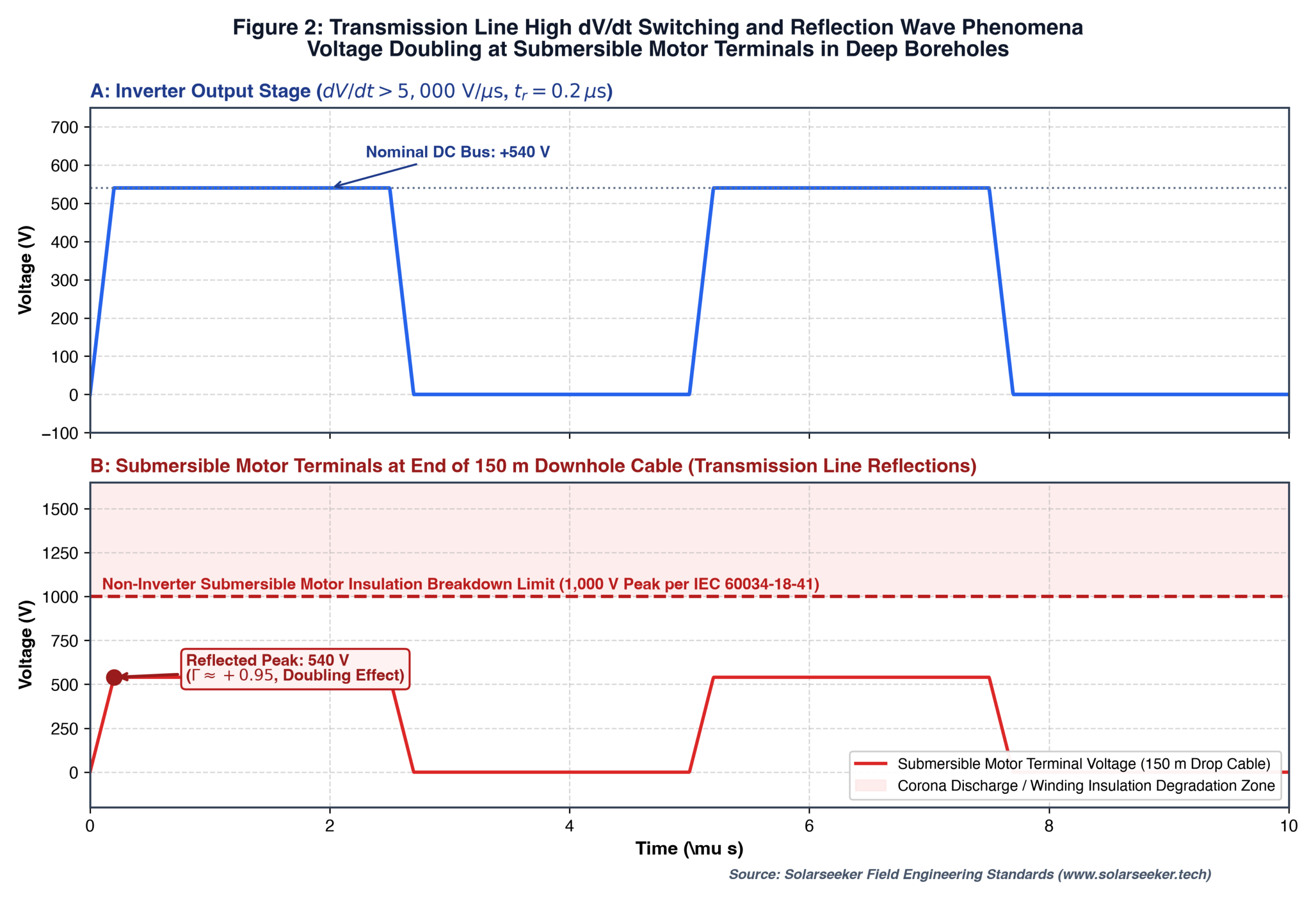
Cable Run vs. Output Filter and Carrier Frequency Rules
Do not guess on filter hardware when quoting deep wells. Match total wire length—borehole depth plus surface trench distance from the solar water pump inverter to the wellhead—against this field table:
| Total Inverter-to-Motor Cable Length | Required Output Hardware | Carrier Frequency Target | Primary Protection Goal |
|---|---|---|---|
| Under 50 meters | Direct U / V / W connection |
Default (4.0kHz – 6.0kHz) | Normal shallow-well operation |
| 50 to 100 meters | 3% AC output line reactor recommended | Lower to 2.5kHz – 3.0kHz | Cuts capacitive charging current and nuisance trips |
| 100 to 200 meters | Mandatory AC output reactor or dV/dt filter |
Set to 2.0kHz – 2.5kHz | Dampens reflected voltage spikes per motor insulation limits |
| Over 200 meters | Sine-wave filter + upsized copper cross-section | Set to 2.0kHz | Converts PWM output toward smooth sinusoidal waveform |
For engineering limits on how converter voltage rise times affect stator windings, review IEC 60034-25 guidance for converter-fed AC machines.
Four Surface Checks Before Pulling the Pump Out of the Well
Before calling a rig back to the farm on a solar pump inverter long cable complaint, have a qualified technician verify four items at the wellhead panel:
- Disconnect the Motor Leads and Megger the Drop Cable: Isolate
U,V, andWcompletely from the inverter terminals (never apply a megohmmeter to inverter IGBTs). Test phase-to-ground insulation at 500V DC and confirm balanced phase-to-phase winding resistance. A nicked underwater heat-shrink splice mimics a long-cable trip. - Remove Any Breaker or Contactor Between
U/V/Wand the Pump: Installers trained on grid starters often place a miniature circuit breaker on the inverter output. Opening or closing a breaker while PWM output is active arcs the contacts and triggers888overcurrent orSPOphase-loss alarms. WireU / V / Wstraight through the output reactor to the motor cable. - Drop the Carrier Frequency Parameter: Lowering the drive carrier frequency (such as parameter
00.14on applicable Solarseeker firmware) reduces how many thousands of times per second the cable capacitance charges and discharges. That also lowers IGBT heat inside the enclosure, though motor acoustic hum rises slightly—which does not matter 150 meters down a borehole. - Audit Copper Cross-Section for Voltage Drop: Long cables lose voltage as well as reflecting pulses. As a quick field check, keep current density conservative (roughly
1 mm²per4Aonly on short runs, stepping up cross-section on deep wells so total drop stays under 3%). Undersized wire starves starting torque, forcing the motor to draw higher amps at low frequency and triggering overload (999).
Matching output chokes, dV/dt filters, and sine-wave filters to submersible cable distance and motor voltage class.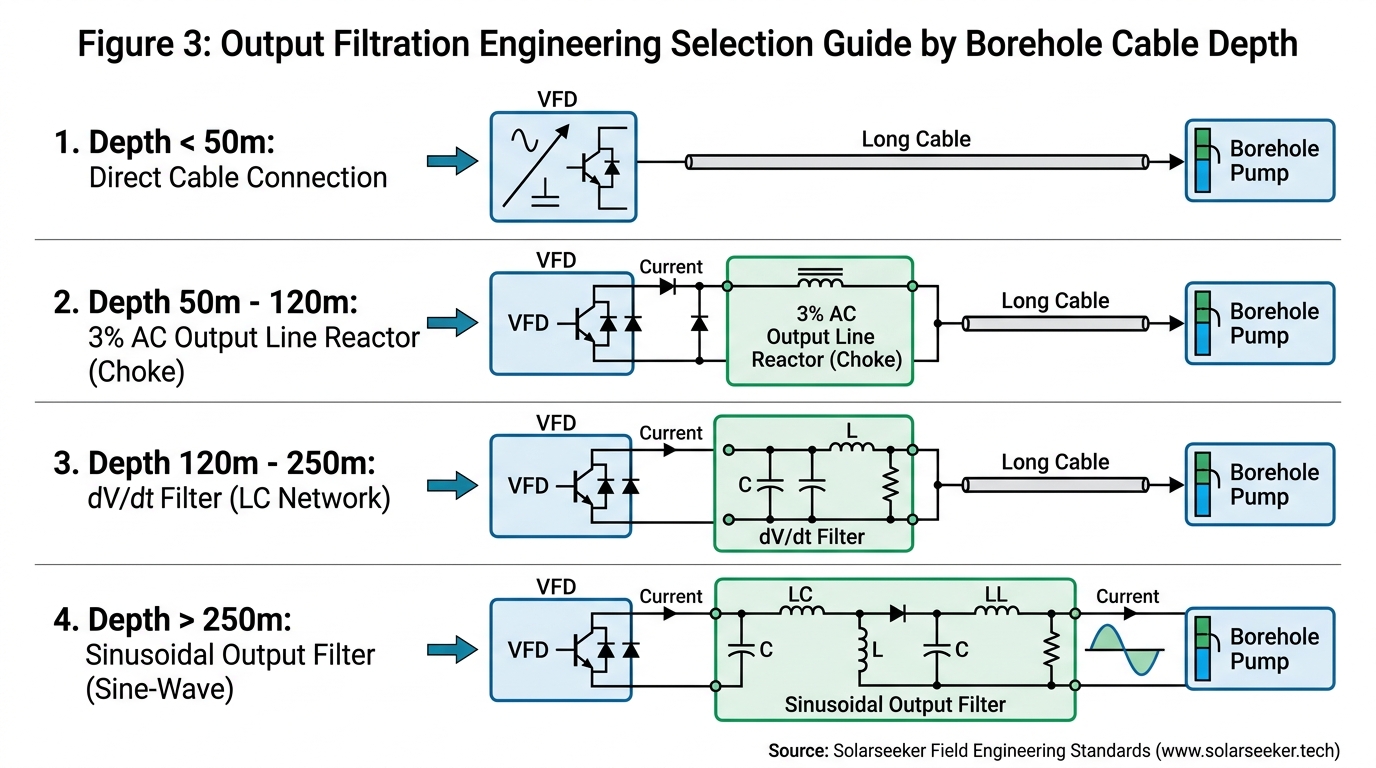
Enclosure Space Mistake When Adding Reactors on Site
One practical lesson from desert and tropical boreholes: an iron-core AC output reactor is heavy and sheds real heat under continuous midday amps. Stuffing an aftermarket reactor into a tight plastic box right underneath an IP20 Solarseeker SP4 380V inverter cooks the drive intake air and trades overcurrent faults for midday OH2 over-temperature alarms.
When a borehole spec already shows 100+ meters of motor cable, specify the reactor inside a ventilated Solarseeker IP65 Solar Pump Control Cabinet from the start so din-rail clearance, copper lug sizing, forced-air fans, and grounding bars are laid out at the factory. You can also check grounding and terminal torque rules in our Solar Pump Inverter Installation Guide. All high-voltage DC and submersible AC tests must follow local electrical safety codes.
Send Cable Distance and Motor Amps Before Ordering Filters
If an existing deep-well site is tripping at startup—or if you are quoting a new solar pump inverter long cable borehole over 100 meters—do not guess between a standard choke and a sine-wave filter. Send your pump motor nameplate (kW, voltage, rated amps), well depth, surface cable run, and wire gauge (mm² or AWG) via the Solarseeker Engineering Contact Page for an output reactor and drive match check.