
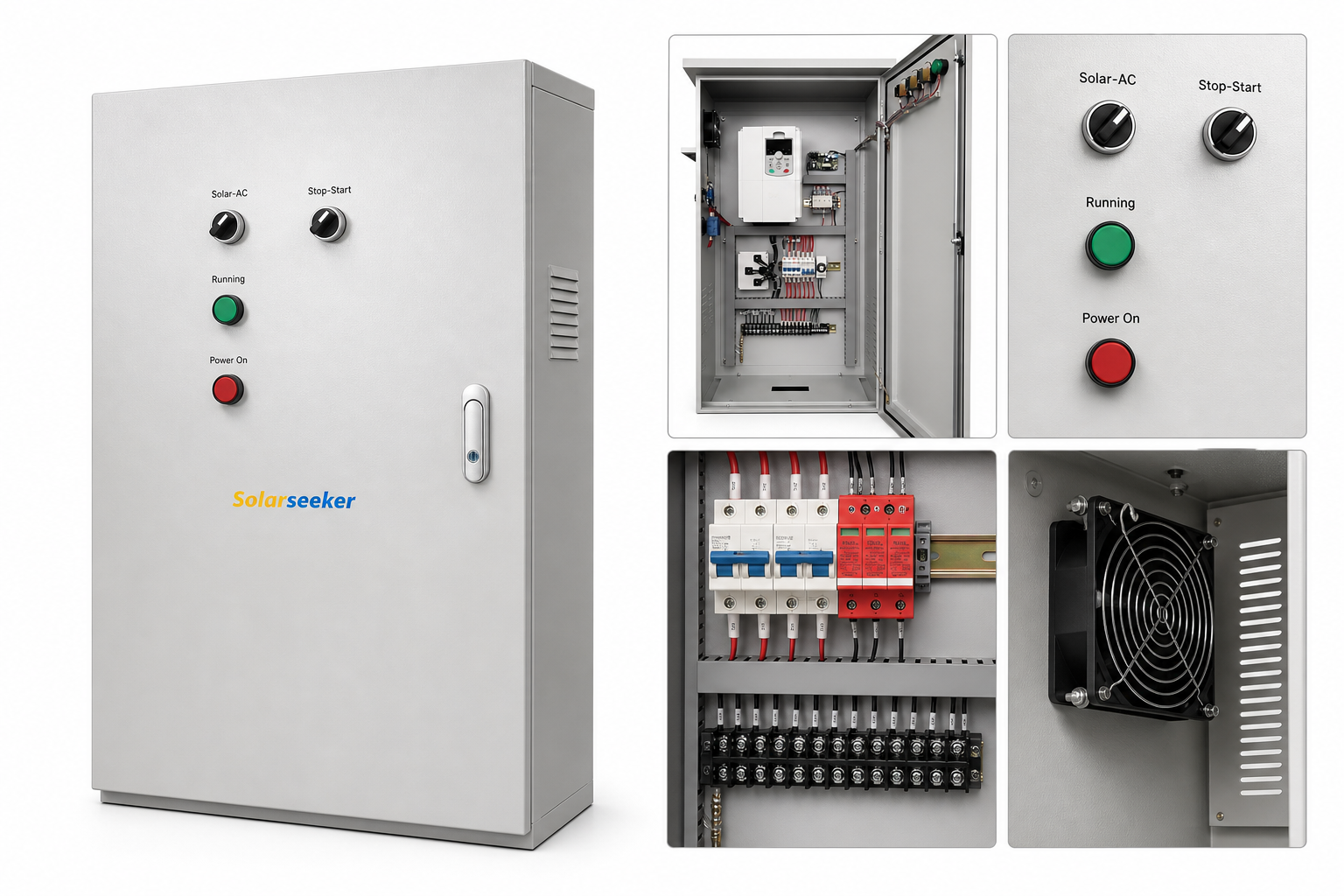
Commercial borehole sizing, electrical protection, and switchgear guide for agricultural irrigation EPCs, solar electrical contractors, and pump distributors specifying 380V three-phase pumping systems from 25HP to 50HP (18.5 kW to 37 kW).
Direct Engineering Answer: When calculating 30hp solar water pump sizing, design the solar PV array at 1.4 to 1.5 times motor rated capacity (33.0 kWp to 34.0 kWp) and step up the drive by one nominal frame to a 30 kW / 60A VFD (such as the Solarseeker SP4 series) to handle deep-well submersible magnetizing current and vertical cable drop.
For a standard 380V three-phase 30HP borehole motor (FLA ~45A), combine four parallel strings of 14 to 15 series-connected 550W–600W modules to keep loaded operating voltage between 530 VDC and 620 VDC. Because multi-string arrays above 25HP generate 40A to 80A DC current and high fault energy, field engineers must house the system inside a pre-wired outdoor Solarseeker IP65 Solar Pump Control Cabinet equipped with dedicated 1000V/1500V string fuses, DC disconnect breaker, Type II surge protection, and an AC output line reactor for borehole cable depths exceeding 80 meters.
Core Engineering Rules for 30HP Solar Water Pump Sizing and Commercial Boreholes (25HP–50HP)
Sizing small 3HP to 7.5HP domestic farm pumps allows generous margins of error. However, when stepping up to commercial scale—such as 25HP (18.5 kW), 30HP (22 kW), 40HP (30 kW), or 50HP (37 kW) boreholes supplying pivot irrigation, pivot rings, or municipal booster reservoirs—small design oversights multiply into costly field outages. Accurate 30hp solar water pump sizing requires engineering the complete electrical string and protection path rather than guessing module totals.
If your current project involves smaller 2.2 kW to 5.5 kW installations, review our companion walkthrough on how many solar panels you need for a 3HP, 5HP, or 7.5HP water pump. For mid-tier 7.5 kW to 15 kW systems, refer to our detailed sizing breakdown for 10HP, 15HP, and 20HP boreholes. When power crosses the 25HP threshold, three strict physical constraints govern system reliability:
- Submersible Motor Magnetizing Amps: Deep-well submersible pump motors run slender rotors with small air gaps to fit inside 6-inch, 8-inch, or 10-inch borehole casings. Their power factor (cos φ ~0.78–0.83) is noticeably lower than standard foot-mounted industrial motors. In practical terms, full load current (FLA) on a 30HP submersible motor routinely reaches 45A to 48A at 380V, demanding higher continuous drive current margins.
- The One-Step-Up VFD Sizing Rule: To prevent continuous overcurrent nuisance trips during scorching midday hours, field engineers always step up the inverter one nominal kilowatt tier above the motor rating. A 30HP (22 kW) motor pairs with a 30 kW / 60A inverter (SP4030); a 40HP (30 kW) motor pairs with a 37 kW / 75A inverter (SP4037); and a 50HP (37 kW) motor pairs with a 45 kW / 91A inverter (SP4045).
- Enclosure & Ingress Protection Reality: Standard high-performance solar pump inverters—including the Solarseeker SP1 and SP4 series—are built with an industrial IP20 chassis designed for clean indoor cabinet mounting. They are never cabinet-free outdoor units. Placing a bare IP20 drive near a rain-swept or dusty wellhead guarantees premature component failure. Commercial projects require an outdoor factory-assembled Solarseeker IP65 Solar Pump Control Cabinet to safeguard switchgear and electronics.
Heavy-Duty Sizing Matrix: 25HP, 30HP, 40HP & 50HP Solar PV Array and Drive Specifications
A reliable solar pumping station must start early in the morning, sustain full 50Hz rated motor speed during midday heat, and ramp down smoothly without abrupt hydraulic water hammer. To achieve this, maintain a 1.4× to 1.5× DC-to-AC over-panelling ratio. This cushion absorbs module thermal derating (-0.35%/°C when solar cell temperatures exceed 55°C), optical dust accumulation, and drop cable resistive losses.
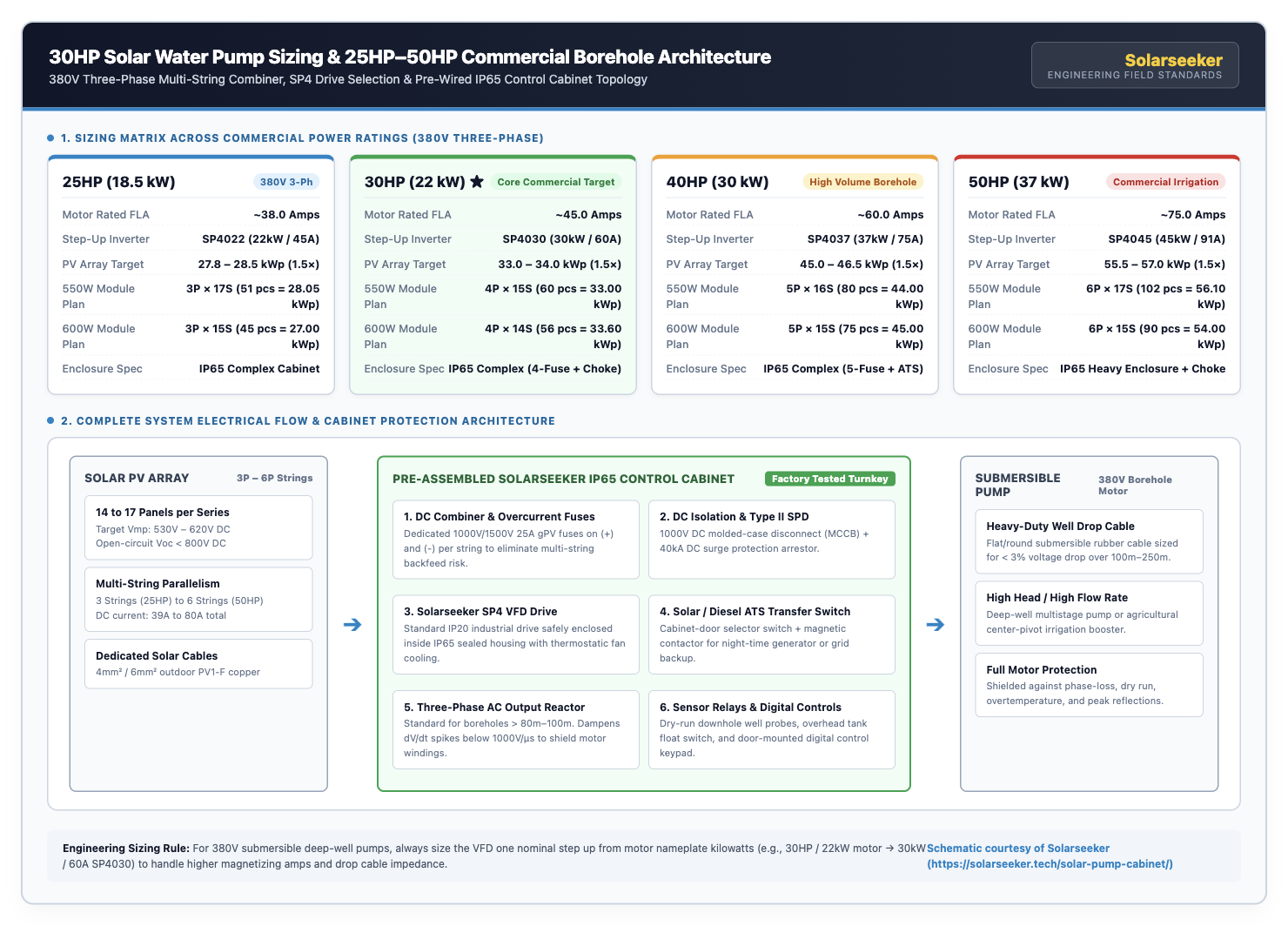
For agricultural contractors calculating 30hp solar water pump sizing alongside 25HP and 50HP deep wells, the engineering matrix below outlines verified PV array layouts, drive models, and enclosure configurations using standard Tier-1 550W (144-half-cell) and 600W (120-half-cell) monocrystalline modules:
| Pump Rating (380V 3-Ph) | Motor FLA & Step-Up VFD | Target PV Array (1.5×) | 550W Module Array Plan | 600W Module Array Plan | Turnkey Outdoor Enclosure |
|---|---|---|---|---|---|
| 25HP (18.5 kW) | FLA ~38A → SP4022 (22 kW / 45A) | 27.8 – 28.5 kWp | 3P × 17S (51 pcs = 28.05 kWp) | 3P × 15S (45 pcs = 27.00 kWp) | IP65 Complex Cabinet |
| 30HP (22 kW) ★ | FLA ~45A → SP4030 (30 kW / 60A) | 33.0 – 34.0 kWp | 4P × 15S (60 pcs = 33.00 kWp) | 4P × 14S (56 pcs = 33.60 kWp) | IP65 Complex (4-Fuse + Choke) |
| 40HP (30 kW) | FLA ~60A → SP4037 (37 kW / 75A) | 45.0 – 46.5 kWp | 5P × 16S (80 pcs = 44.00 kWp) | 5P × 15S (75 pcs = 45.00 kWp) | IP65 Complex (5-Fuse + ATS) |
| 50HP (37 kW) | FLA ~75A → SP4045 (45 kW / 91A) | 55.5 – 57.0 kWp | 6P × 17S (102 pcs = 56.10 kWp) | 6P × 15S (90 pcs = 54.00 kWp) | IP65 Heavy Cabinet + Choke |
Combiner Architecture: Managing Multi-String DC Power (3P to 6P) and String Overcurrent Protection
When working on 30hp solar water pump sizing, the sheer size of the array changes basic electrical safety requirements. A 33 kWp PV array cannot run as a single string. Standard 550W panels have an open-circuit voltage (Voc) of roughly 49.8V. In series strings of 15 modules, string Voc reaches 747V under standard test conditions, and can surge above 810V on freezing winter mornings if strings are lengthened further.
To prevent voltage overshoot and catastrophic reverse currents, commercial arrays are split into 3 to 6 parallel strings (3P to 6P), producing total DC currents of 40A to 80A. Under international standards (IEC 62548 and NEC 690.9), whenever three or more strings are connected in parallel, each string must have dedicated overcurrent protection:
- The Backfeed Fire Hazard: If a ground fault or diode failure occurs in String 1 of a 4-string array, Strings 2, 3, and 4 will backfeed up to 40A of fault current into the damaged string. Standard module bypass diodes cannot clear this current, leading to thermal runaway, arc flash, or module fires.
- Dedicated DC gPV Fuses: Inside the Solarseeker IP65 control cabinet, each string passes through certified 1000V/1500V 25A gPV fuses on both positive (+) and negative (-) conductors before entering the main DC bus.
- DC Molded Case Circuit Breaker (MCCB): Unlike small residential systems that use miniature circuit breakers (MCBs), 30HP to 50HP arrays require heavy-duty DC MCCBs rated for 1000V DC breaking capacity to safely isolate load current during emergencies.
- Type II DC Surge Protection: Because ground-mounted irrigation arrays span large agricultural acreage, lightning-induced voltage surges are frequent. A Type II 40kA DC Surge Protective Device (SPD) clamps transient spikes before they reach the drive’s DC link capacitors.
Downhole Motor Protection: When 100m+ Submersible Cable Runs Require an AC Output Reactor
One of the most frequent causes of premature motor failure in commercial deep-well solar pumping is inverter PWM pulse reflection. Solar pump drives utilize high-speed IGBT transistors switching at frequencies between 2 kHz and 12 kHz to generate variable-frequency AC power.
Each switching pulse produces a sharp voltage rise rate (dV/dt > 3000 V/μs). When this fast pulse travels down 100m, 150m, or 200m of submerged borehole drop cable, an impedance mismatch occurs at the motor terminals. The pulse reflects back, causing constructive wave interference that doubles the peak voltage up to 1200V–1600V at the motor windings.
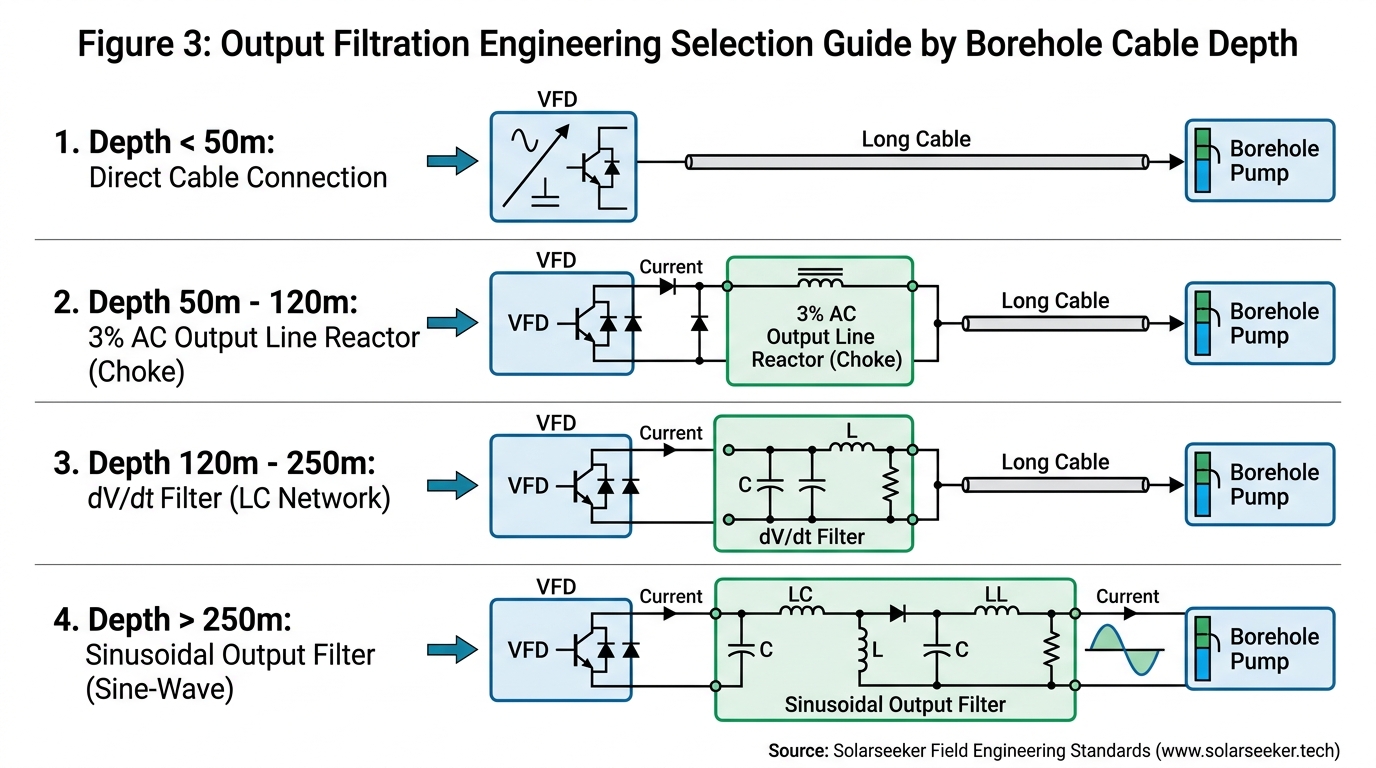
Over time, these peak spikes exceed the dielectric strength of standard submersible winding enamel, puncturing motor winding insulation. In commercial installations executing 30hp solar water pump sizing, avoiding premature motor burnouts requires following verified international engineering standards (IEC 60034-25):
- Cable Run < 50 Meters: Direct cable connection is acceptable for shallow surface pumps.
- Cable Run 50m to 120 Meters: Install a 3-Phase AC Output Reactor (Line Choke) inside the control enclosure. This dampens dV/dt to < 1000 V/μs and limits peak voltage spikes below 1000V.
- Cable Run > 120 Meters: Heavy-duty AC reactor is mandatory; for extreme runs exceeding 200m–300m, an LC or dV/dt filter is strongly advised.
In addition to peak voltage reflection, long vertical borehole cables introduce resistive voltage drops that starve the motor of operating torque. Use the engineering cable sizing table below to verify drop cable conductor sections:
| Pump Rating (380V) | Rated Current (FLA) | Well Depth ≤ 100m Cable | Well Depth 150m Cable | Well Depth 200m+ Cable | Output Reactor Status |
|---|---|---|---|---|---|
| 25HP (18.5 kW) | ~38 A | 10 mm² (1.9% drop) | 16 mm² (2.1% drop) | 25 mm² (2.3% drop) | Recommended at 80m+ |
| 30HP (22 kW) | ~45 A | 16 mm² (1.6% drop) | 25 mm² (1.8% drop) | 35 mm² (2.0% drop) | Mandatory (45A–60A Choke) |
| 40HP (30 kW) | ~60 A | 25 mm² (1.4% drop) | 35 mm² (1.7% drop) | 50 mm² (1.9% drop) | Mandatory (75A Choke) |
| 50HP (37 kW) | ~75 A | 35 mm² (1.3% drop) | 50 mm² (1.5% drop) | 70 mm² (1.8% drop) | Mandatory (90A Choke) |
Turnkey BOM Architecture: Inside the Pre-Wired Solarseeker IP65 Solar Pump Control Cabinet
Attempting to mount an indoor VFD in an exposed outdoor environment leads to frequent warranty disputes. Dust clogs heat sink cooling fins, humidity corrodes PCB traces, and crawling insects create dead-short circuits across high-voltage DC terminals.
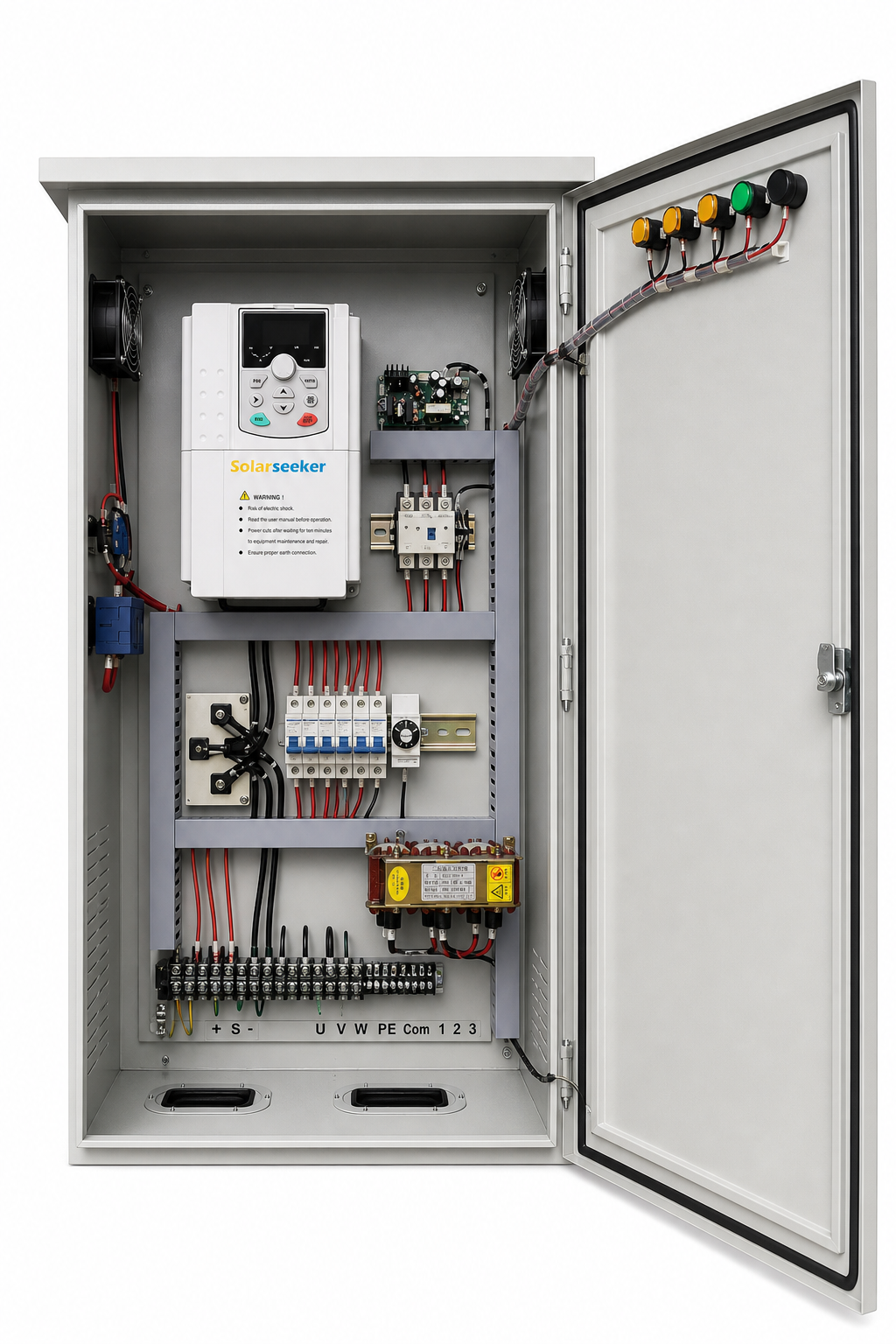
To deliver dependable operation for 30hp solar water pump sizing projects, the Solarseeker IP65 Solar Pump Control Cabinet integrates all necessary protection, cooling, and power-conversion electronics into a single pre-assembled, factory-tested outdoor housing:
| Subsystem / BOM Item | Technical Specification | Engineering Role & Field Protection |
|---|---|---|
| Enclosure Shell | 1.5mm–2.0mm Galvanized Steel, IP65, RAL 7035 Powder Coat | Prevents ingress of blowing sand, tropical torrential rain, and agricultural pests. |
| Thermal Management | Thermostatic forced cooling fans + labyrinth louvers | Maintains internal cabinet air temperature below 45°C during ambient 45°C heat. |
| Solar Pump VFD | Solarseeker SP4 Series (SP4022 to SP4045) | MPPT efficiency >99%, dynamic water tracking, dry-run protection, and soft-ramp logic. |
| DC String Combiner | 3 to 6 Pairs 1000V DC Fuses (25A–32A gPV) | Isolates faulted parallel strings; prevents reverse-current module meltdown. |
| Surge Arrestors (SPD) | Type II 1000V DC (40kA) + Type II 380V AC (40kA) | Shields power electronics against lightning transients from field arrays and grid lines. |
| Dual-Power ATS Switch | Door-mounted Solar / Generator selector + interlocking contactors | Allows manual or automatic switchover to diesel generator for nighttime irrigation. |
| AC Output Reactor | 3-Phase Copper Choke (45A to 90A, 1.5%–2% impedance) | Dampens motor terminal reflected peak voltages to <1000V on deep boreholes. |
| Sensor Interface | Well water low-level probes + storage tank overflow float | Automates autonomous well draw-down protection and reservoir overflow shutoff. |
For large-scale agricultural projects and irrigation cooperatives, explore our verified utility-scale installation report on the Paraguay 200kW Solar Irrigation Project, demonstrating multi-cabinet operation under demanding field conditions.
Field Commissioning Case: Commercial 30HP Pivot Irrigation in High Ambient Heat
To examine how these sizing guidelines function in practice, review this field commissioning example from a commercial grain and citrus farm in an arid river valley:
- Site Conditions: 30HP (22 kW) 380V submersible pump in a 140m deep borehole, discharging directly into a 4-span center pivot operating at 3.5 bar pressure. Ambient summer midday temperatures regularly reach 42°C.
- Contractor Challenge: The initial installer used an unventilated tin shed housing an indoor 22kW VFD connected to a 26 kWp solar array. The drive experienced persistent over-temperature trips (
OH) at 11:30 AM every morning and suffered repeated motor trip codes caused by vertical cable voltage drops. - Solarseeker Retrofit Solution: The engineering desk deployed a pre-assembled Solarseeker IP65 Solar Pump Control Cabinet containing an SP4030 (30 kW / 60A) drive, a 4-string DC combiner with 33.6 kWp PV array (4 parallel strings of 14 × 600W modules), and a factory-integrated 60A AC output reactor for the 140m drop cable.
- Commissioning Outcome: The system achieved 8.5 hours of uninterrupted daily pumping at full 50Hz design speed, delivering an average of 65 m³/h without a single thermal derating shutdown. Diesel generator usage dropped by over 92% across the six-month irrigation season.
Frequently Asked Technical Questions: 25HP to 50HP Commercial Solar Pumping
Can I connect a 30HP solar water pump using a single DC string?
No. Standard Tier-1 550W–600W solar modules produce open-circuit voltages (Voc) around 49.5V to 50.5V. Sizing a 33 kWp array in a single string would require over 60 panels in series, generating more than 3,000 VDC. This exceeds the maximum 800V–1000V DC input ceiling of industrial drives and violates electrical safety codes. Sizing a 30HP pump requires 4 parallel strings of 14 to 15 panels each.
Why does an SP4 drive need a Solarseeker IP65 control cabinet for field installation?
Solarseeker SP1, SP2, SP3, and SP4 drives are manufactured with an industrial IP20 chassis. An IP20 enclosure protects against accidental human finger contact with terminals, but offers zero protection against rain, high ambient humidity, agricultural pesticide mist, or airborne dust. Housing the SP4 inside a pre-wired Solarseeker IP65 Solar Pump Control Cabinet provides complete environmental isolation, thermal regulation, and structural protection.
How should I size a diesel generator for backup on a 30HP solar pump?
Because the Solarseeker SP4 drive incorporates programmable soft-starter acceleration ramps, motor starting inrush current is limited to 1.1× to 1.2× rated FLA (unlike direct-on-line starters that draw 6× to 7× inrush). For a 30HP (22 kW) motor, a standard 40 kVA to 45 kVA three-phase diesel generator provides sufficient capacity when coupled via the cabinet’s dual-power ATS switch.
When is an output sine-wave filter required instead of a standard AC reactor?
For standard deep-well submersible borehole applications with drop cables between 80m and 200m, a heavy-duty 3-phase AC output reactor (line choke) provides complete protection by reducing dV/dt below 1000 V/μs. If your vertical drop cable and horizontal surface pipe run exceeds 300 meters, or if you are running an older vintage motor with degraded winding insulation, upgrading to a full LC sine-wave filter transforms the PWM wave into a smooth sinusoidal curve.
Request an Engineering Review & Customized Cabinet BOM Schedule
Planning a 25HP, 30HP, 40HP, or 50HP commercial irrigation borehole tender? Ensure your design delivers reliable water output under extreme field temperatures while protecting expensive downhole pumps from electrical stress.
Contact our engineering desk with your pump nameplate parameters and borehole depth to receive an electrical single-line schematic and customized cabinet schedule:
Turnkey Commercial Solar Pumping Solutions (25HP to 50HP+)
Pre-assembled, factory-tested IP65 outdoor control enclosures engineered with Solarseeker SP4 high-power drives, multi-string DC combiner protection, AC line reactors, and generator dual-power transfer switches.

About the Author:
Andy (known professionally as Solar Pumping System Specialist Andy) is the Founder and Chief Application Engineer at Solarseeker. With extensive field-commissioning experience across deep-well extraction, commercial irrigation, and municipal water schemes, he is dedicated to building simpler, reliable solar water pump solutions for real field conditions. His technical work focuses on off-grid MPPT drive dynamics, high-ambient thermal derating, and outdoor pre-assembled control enclosure engineering.
For technical inquiries, complete cabinet schematics, and engineering guides, visit:
https://solarseeker.tech/solar-pump-cabinet/