
SolarSeeker FAQ
Solar Pump Inverter FAQ for Selection, Installation, OEM and Support
This FAQ is for pump distributors, irrigation installers, EPC contractors, OEM buyers, and project teams who need clear answers before choosing a solar pump inverter, controller, pump, cabinet, or complete kit.
Direct answer
SolarSeeker is a solar water pump inverter manufacturer for B2B pump projects. The company supplies SP1-SP4 solar pump inverters, PV pump controllers, cabinets, submersible pumps, and complete kits, with MPPT control, OEM support, small MOQ, installation guidance, and after-sales technical support.
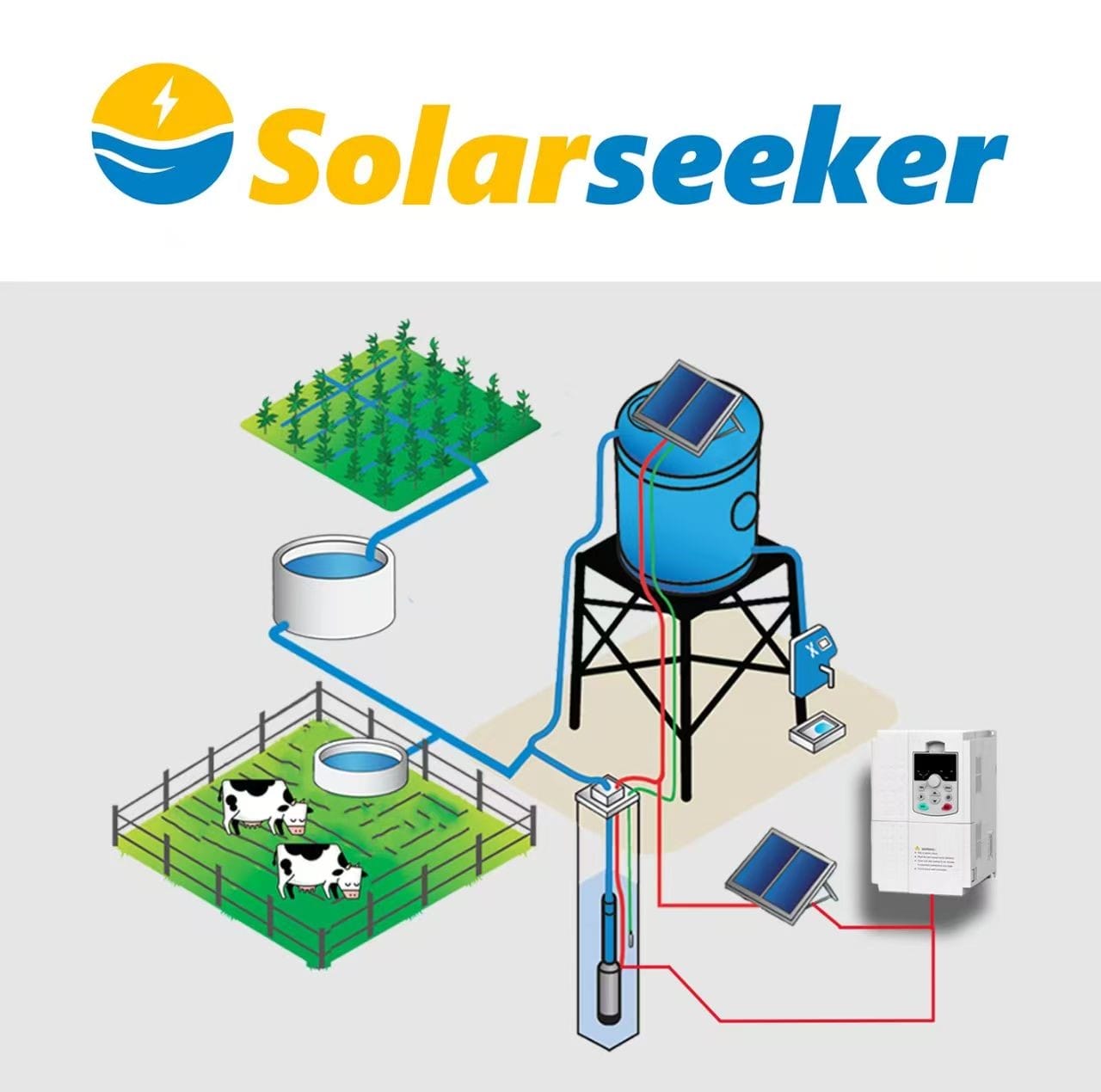
SP1-SP4
Solar pump inverter range
SP5/SP6
Pump controller options
OEM
Labels, functions, cabinet work
Support
Sizing, install, fault diagnosis
Selection
Choose inverter, controller, pump, cabinet, or kit.
System Design
Pump data, panels, battery, cabinet, accessories.
Installation
Pre-checks, setup, dry-run and under-voltage faults.
OEM
Labels, functions, MOQ, controller projects.
Support
Warranty, troubleshooting, service capability.
Orders
Payment, delivery, shipping, partner fit.
Product Selection FAQ
How do we choose the right SolarSeeker product?
Start with the pump: voltage, phase, power, current, water source, and project condition. The right SolarSeeker product depends on whether you need an inverter, controller, pump, cabinet, or complete kit.
Which SolarSeeker product should we choose first?
For most retrofit or new pump projects, start with the solar pump inverter. Use SP1 for 220V single-phase pump work, SP2 for single-phase input to three-phase pump conversion, SP3 for 220V three-phase pumps, and SP4 for 380V three-phase pump projects.
What is the difference between a solar pump inverter and a solar pump controller?
A solar pump inverter drives an AC pump motor and adjusts output according to sunlight and pump load. A solar pump controller is usually used for dedicated pump control projects, protection logic, or controller-based system design. Send the pump nameplate and site data if you are not sure.
When should we use the 380V SP4 inverter?
Use SP4 when the project uses a 380V three-phase AC pump, especially for higher-power irrigation, deep well, livestock water, drainage, or municipal water movement. SP4 is the main reference series for many documented SolarSeeker field projects.
Can SolarSeeker run an existing AC pump with solar power?
In many cases, yes. SolarSeeker can help match an existing AC pump with the correct solar pump inverter if the pump voltage, phase, power, current, and motor condition are suitable. The pump nameplate is the first thing to send.
Where can we compare all inverter and controller options?
Use the Solar Pump Inverters page for SP1-SP4 options and the PV Pump Controller page for controller-based projects.
System Design FAQ
What information is needed to size a solar water pumping system?
A correct system match needs pump data, water target, solar panel plan, cable distance, and site conditions. Guessing from pump power alone can lead to poor output or installation problems.
What details should we send for model recommendation?
Send the pump nameplate, voltage, phase, current, power, well depth, required head and flow, cable distance, PV panel model, panel quantity, water source, project country, and whether a cabinet or AC backup is needed.
Do solar pump systems need batteries?
Most irrigation and well water systems do not need batteries. The pump runs when sunlight is available and water can be stored in a tank or pond. Batteries may be considered only when the site requires night operation or special backup logic.
How do solar panels match with the pump and inverter?
The panel string must stay inside the inverter or controller input voltage range and provide enough power for the pump. SolarSeeker checks panel model, string quantity, open-circuit voltage, and project temperature before giving a safe matching suggestion.
When should a solar pump cabinet be added?
Add a cabinet when the project needs outdoor protection, organized wiring, breakers, surge protection, AC backup, sensors, float switches, or a cleaner installation for distributors and EPC teams.
Can SolarSeeker supply complete kits and accessories?
Yes. SolarSeeker can help match the inverter or controller, pump body, PV plan, cabinet, sensors, cables, connectors, spare parts, and project accessories. See solar pump kits and accessories.
Installation and Troubleshooting FAQ
What should installers check before powering on?
Before startup, installers should check PV input, pump wiring, grounding, motor direction, protection settings, water source status, and whether the pump data matches the inverter setting.
Are SolarSeeker inverters pre-configured before shipment?
They can be pre-configured when enough pump and project data is provided before shipment. This helps installers reduce parameter work on site and start from a clearer setup.
Can installers complete a quick setup on site?
Yes. Standard solar pump inverter setup can be kept short when the pump match is correct. Installers should still verify wiring, voltage, motor direction, water source, and fault protection before continuous operation.
What should we check when a dry-run fault appears?
Check whether there is enough water, whether the pump inlet is blocked, whether the water level has dropped, whether the current is lower than expected, and whether the dry-run protection setting matches the pump behavior.
What should we check when an under-voltage fault appears?
Check PV string voltage, panel quantity, weak sunlight, loose terminals, cable loss, wrong panel wiring, and whether the input voltage is below the inverter or controller working range.
Do you provide installation training?
Yes. SolarSeeker can provide wiring diagrams, parameter guidance, remote support, videos, and training for distributors, pump dealers, irrigation installers, EPC contractors, and OEM partners.
OEM and Customization FAQ
Does SolarSeeker support OEM and small MOQ?
Yes. OEM work can include labels, packaging, cabinet layout, controller logic, functions, and project-specific requirements. Small-batch orders can be discussed with the factory team.
Do you accept OEM orders?
Yes. SolarSeeker supports OEM and private-label cooperation for solar pump inverters, PV pump controllers, protected controller packages, solar pump cabinets, and complete solar pumping systems.
What can be customized?
Common customization includes brand label, packaging, parameters, control logic, protection settings, cabinet wiring, accessories, and project-specific functions. Feasibility depends on product type and order quantity.
Which product is best for customized PV pump controller work?
SP5 and SP6 controller projects are usually better starting points for controller-based custom work. For AC pump motor projects, SP1-SP4 inverter matching is often the first path to check.
How long does OEM development usually take?
Simple label or packaging work is usually faster than function or cabinet customization. The exact schedule depends on sample approval, technical requirements, material preparation, and production queue.
Warranty and Support FAQ
What support is available after shipment?
SolarSeeker supports model selection, installation, troubleshooting, warranty handling, and long-term partner training. The fastest support starts with clear pump and site data.
What warranty do SolarSeeker products include?
Warranty terms depend on product type, order terms, and application. For project buyers, confirm the exact warranty condition before order confirmation, especially for cabinets, pumps, kits, and customized products.
How are warranty claims handled?
SolarSeeker usually asks for product model, order information, fault code, photos, wiring details, running data, and site condition. The technical team checks whether the issue is product-related, installation-related, or caused by field conditions.
Can SolarSeeker help with remote troubleshooting?
Yes. Remote troubleshooting can cover PV voltage, pump current, wiring photos, fault codes, parameters, water source condition, cable distance, and cabinet wiring. For complex sites, video and step-by-step checks are useful.
Where can we see your factory and service capability?
Use the About Us, Certification, Service System, and Project Records pages.
Orders, Payment and Delivery FAQ
How do orders, payment terms and delivery usually work?
Order details depend on product type, customization, destination, stock, and shipping method. For project buyers, it is better to confirm model selection before discussing final delivery details.
What payment methods do you accept?
Common international payment methods can be discussed during quotation. Payment terms may differ for sample orders, repeat partners, OEM orders, and project-based shipments.
What are the payment terms for new partners?
New partner terms depend on order size, product type, customization, and cooperation history. SolarSeeker can confirm payment terms after the product path and quotation are clear.
What is the usual delivery time?
Delivery time depends on stock, order quantity, OEM requirements, cabinet work, testing, and shipping method. Standard products are usually faster than customized systems or complete kits.
Can you ship by sea, air or express?
Yes. SolarSeeker can support sea freight, air freight, express delivery, and project-based shipping arrangements. The best route depends on order size, urgency, destination, and cargo type.
Who is SolarSeeker suitable for as a partner?
SolarSeeker works with distributors, pump dealers, irrigation contractors, EPC contractors, OEM partners, and system integrators who need solar pump inverters, controllers, cabinets, pumps, kits, and project support.
Southeast Asia FAQ
Does SolarSeeker fit Southeast Asia pump projects?
Yes. SolarSeeker is suitable for Southeast Asia pump projects such as rice irrigation, farm water supply, island water supply, humid outdoor sites, drainage work, and remote wells. Priority markets include the Philippines, Indonesia, Vietnam, Thailand, Malaysia, Singapore, and nearby regions.
Need a model recommendation?
Send the pump data and we will point you to the right product path
The fastest answer comes from a pump nameplate photo, site data, water target, and project country. SolarSeeker can then check whether you need an inverter, controller, cabinet, pump, kit, or OEM solution.