
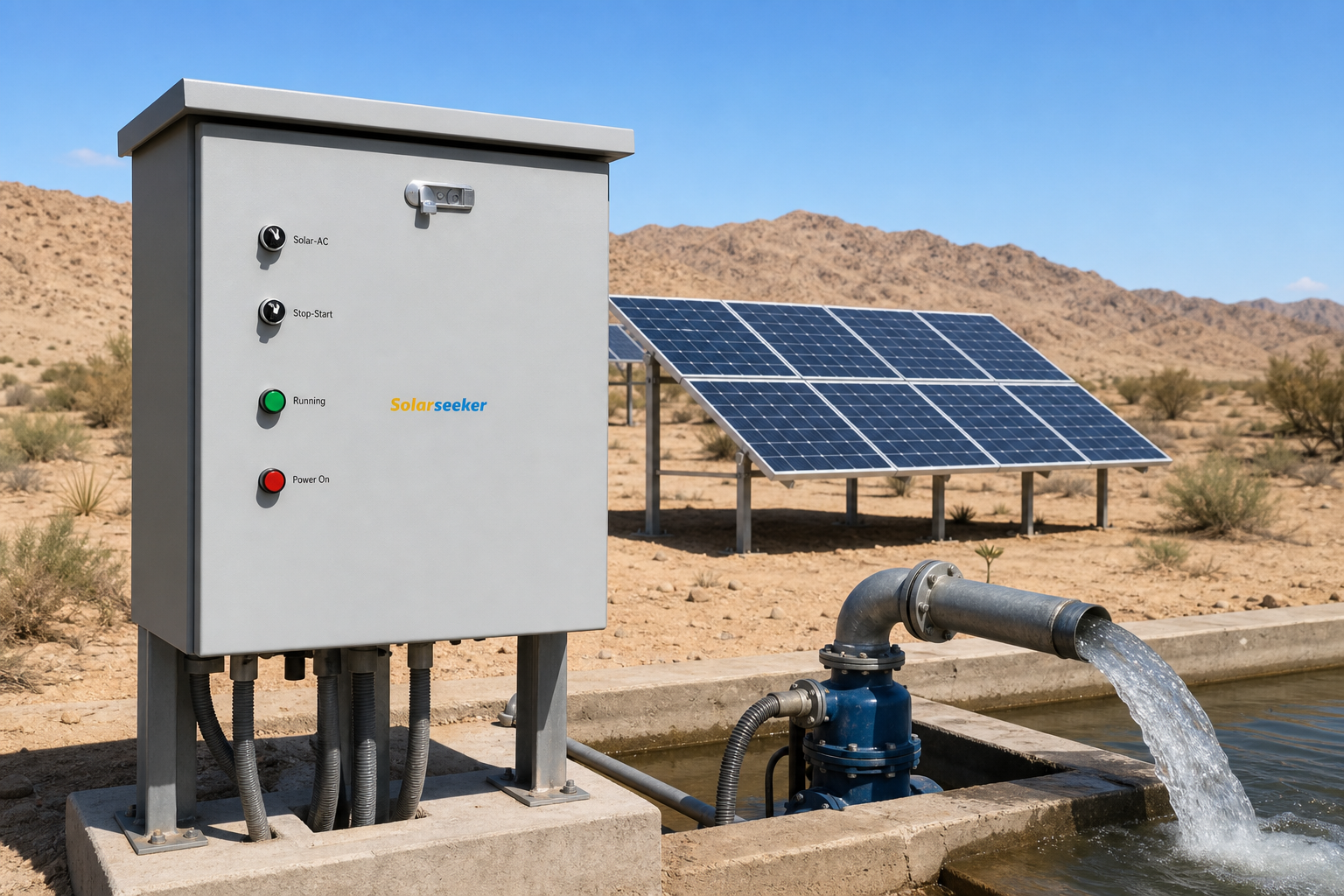
Direct Answer: What Changes Between IP20 and IP55 Solar Pump Inverters in Outdoor Projects?
An IP55 solar pump inverter is built in a hermetically sealed, corrosion-resistant enclosure certified under IEC 60529 to withstand dust deposits and low-pressure water jets, enabling direct outdoor pole or wall mounting adjacent to solar arrays without an auxiliary enclosure. In contrast, an IP20 solar pump inverter has an open-ventilation chassis that only protects against solid objects greater than 12.5mm (such as fingers) with zero moisture protection; deploying IP20 drives in outdoor agricultural or deep-well projects strictly requires housing them inside a secondary weatherproof control cabinet (IP54/IP65) equipped with louvered vents, dust filters, and cooling fans. While IP20 inverters offer a lower base unit cost, the added expense of the secondary enclosure, maintenance labor, and replacement filter pads increases the total installed Balance of System (BOS) cost by 35% to 50% over a 5-year project cycle.
Ingress Protection Ratings: IEC 60529 Applied to Agricultural Pumping
Solar water pumping systems operate under some of the most aggressive environmental conditions in industrial automation. Whether deployed in desert irrigation schemes across Sub-Saharan Africa, pivot irrigation projects in the Middle East, or humid river delta farming across Southeast Asia, drive electronics face persistent exposure to airborne particulates, ambient thermal swings, and precipitation.
The International Electrotechnical Commission standard IEC 60529 classifies degrees of protection provided by electrical enclosures through two characteristic numerals:
| Ingress Rating | First Digit: Solid Particle Protection | Second Digit: Liquid Ingress Protection | Outdoor Suitability Without Secondary Enclosure |
|---|---|---|---|
| IP20 | Protected against solid objects >12.5mm (fingers). No protection against fine dust or sand. | 0: No protection. Moisture, rain, condensation, or water sprays cause immediate dielectric short circuits. | Strictly Prohibited. Must be housed inside an external climate-controlled or ventilated enclosure. |
| IP54 | Dust protected (limited ingress permitted; cannot interfere with safe equipment operation). | Protected against water splashing from any direction. | Marginal. Requires rain hoods and overhead shelter; vulnerable to wind-driven heavy rain. |
| IP55 | Dust protected (full barrier against abrasive sand and mineral dust ingress). | Protected against low-pressure water jets (6.3mm nozzle at 12.5 L/min from any angle). | Fully Certified. Direct outdoor installation on PV racking, wellhead steel columns, or brick pump houses. |
| IP65 / IP66 | Dust tight (complete vacuum seal; zero particulate ingress). | Protected against high-pressure water jets (12.5mm nozzle at 100 L/min). | Industrial Grade. Heavy wash-down zones, coastal marine environments, or deep mine dewatering. |
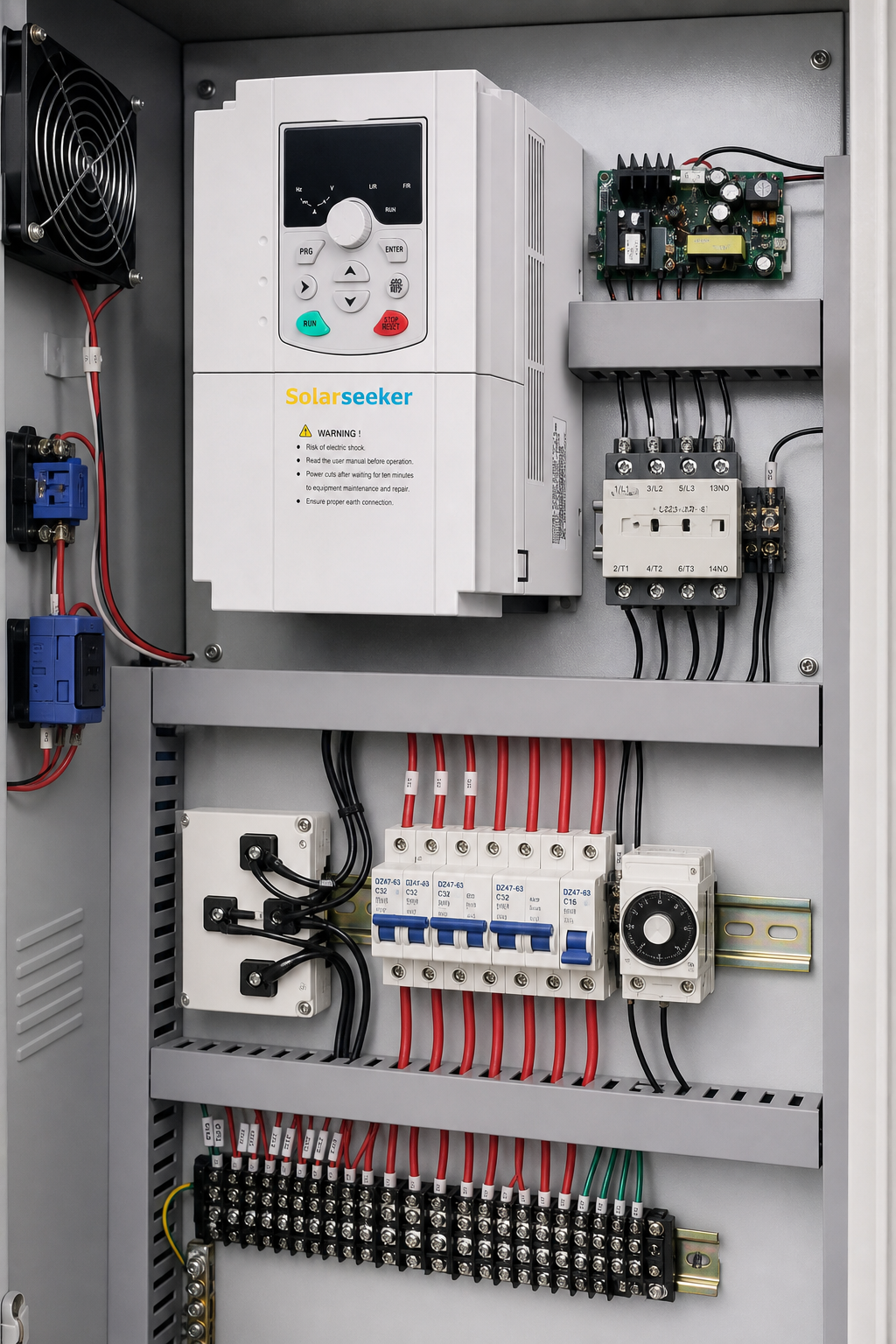
Thermal Management & Cooling Topologies Compared
Heat dissipation is the single largest engineering divergence between IP20 and native IP55 variable frequency drives. Solar pump inverters operate at maximum output during peak solar irradiance (11:00 to 14:00), which directly coincides with peak daily ambient temperatures (frequently 40°C to 48°C in arid regions).
1. IP20 Forced-Air Ventilation Mechanics
Standard IP20 inverters draw ambient air directly across their internal printed circuit boards (PCBs), DC bus electrolytic capacitors, and IGBT power modules via internal high-speed DC cooling fans. While this convective method offers rapid heat transfer in clean indoor equipment rooms, outdoor deployment creates severe vulnerabilities:
- Air Intake Clogging: External cabinet intake louvers with dust filters become clogged with airborne loam, silty sand, and crop dust within 2 to 6 weeks. Once airflow drops below 0.8 m/s, internal temperatures escalate rapidly, triggering VFD thermal derating or over-temperature (OH) shutdown faults.
- Fan Mechanical Wear: Cooling fans operating in dusty 45°C environments suffer bearing seizure within 12 to 18 months, leading to sudden IGBT thermal runaway and catastrophic semiconductor failure.
- Conductive Dust Accumulation: Fine hygroscopic dust settling onto gate drive circuits can absorb morning humidity, forming conductive tracking paths that cause phase-to-ground flashovers.
2. Native IP55 Natural Convection & Isolated Air Duct Mechanics
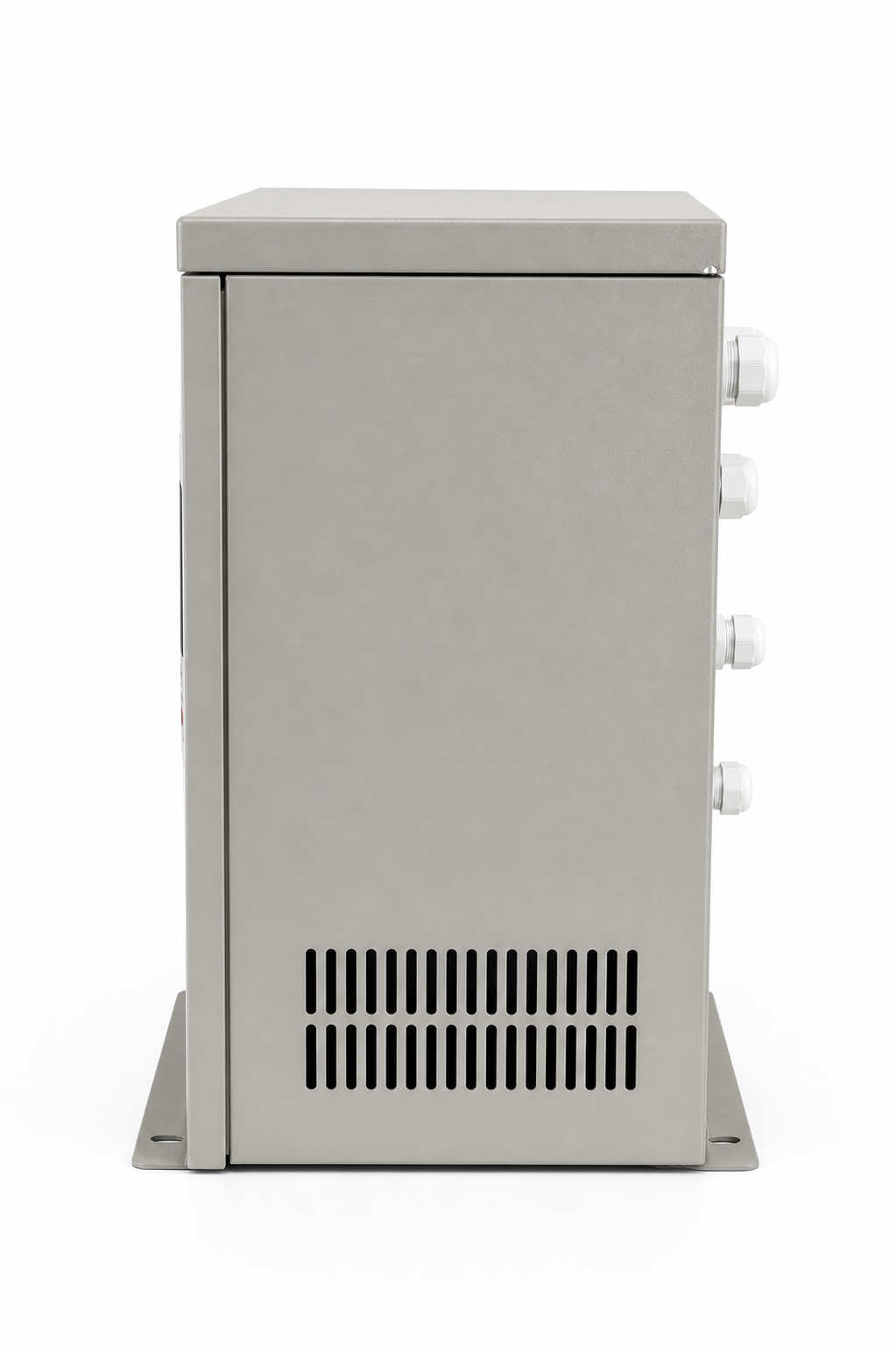
An engineered IP55 solar pump inverter isolates sensitive control electronics from the ambient environment. The internal housing is divided into two distinct zones:
- Hermetically Sealed Electronics Compartment: The microprocessor control board, gate drivers, and DC bus capacitors are sealed behind vulcanized silicone gaskets. Critical electronic assemblies receive conformal coating compliant with IEC 60721-3-3 Class 3C2 / 3S2 to prevent chemical oxidation and moisture penetration.
- Isolated External Heat Sink Channel: The IGBT power semiconductors are mounted directly onto a heavy-duty die-cast aluminum heat sink whose cooling fins project outside the sealed enclosure. External air passes exclusively over passive aluminum fins without ever contacting internal electrical components.
BOS Total Cost of Ownership (TCO): 5-Year Financial Analysis
Distributors and EPC contractors often compare inverter quotation prices on a simple dollar-per-kilowatt ($/kW) basis. However, an accurate engineering procurement assessment must evaluate total Balance of System (BOS) capital expenditure (CAPEX) alongside 5-year operating expenditure (OPEX).
The financial model below evaluates a typical 15kW (20HP) deep-well agricultural pumping installation over a 5-year operational lifecycle:
| Cost Category | Option A: IP20 Inverter + Secondary Cabinet | Option B: Native IP55 Solar Pump Inverter | Variance & Engineering Rationale |
|---|---|---|---|
| Base Inverter Unit Price | $480.00 | $680.00 | IP20 inverter initial unit purchase is ~$200 lower. |
| Weatherproof Outdoor Cabinet (IP55/IP65) | $320.00 | $0.00 | Double-door powder-coated steel cabinet, rain canopy, lockable handle. |
| Internal Cabinet Ventilation & Fans | $85.00 | $0.00 | Dual 120mm exhaust fans, intake filter grills, thermostat controller. |
| Cabinet Internal BOS Wiring & Assembly | $90.00 | $0.00 | DIN rails, terminal blocks, wiring labor, internal cable ducting. |
| Freight & Volume Shipping Surcharge | $110.00 | $35.00 | Heavy metal cabinet quadruples package volume and air/sea freight weight. |
| Field Installation Labor & Mounting | $140.00 | $60.00 | IP55 mounts directly onto PV rack with 4 bracket bolts; cabinet requires concrete pad or heavy unistrut frame. |
| 5-Year Filter & Fan Replacement (OPEX) | $150.00 | $0.00 | Scheduled replacement of 4 cooling fans and 10 filter sets over 5 years. |
| Estimated Field Service Truck Rolls (OPEX) | $250.00 | $50.00 | Cleaning clogged filters and resetting thermal trips at remote farm sites. |
| TOTAL 5-YEAR LIFECYCLE COST | $1,625.00 | $825.00 | Native IP55 delivers $800.00 (49.2%) Net Savings per Wellhead. |
As the lifecycle data proves, what initially appears to be a $200 savings on the inverter invoice transforms into an $800 cost penalty across 5 years of field operation.
Environmental Failure Modes in Outdoor Solar Pumping
1. Desert Sand Ingress and Abrasive Erosion
In arid farming belts, dust storms mobilize quartz and silicate micro-particles ranging from 5μm to 50μm in diameter. In IP20 cabinets with forced ventilation, these abrasive particles bypass standard foam filters. Over months of exposure, high-velocity sand impinges on internal cooling fan blades, eroding blade pitch and unbalancing rotor shafts, which triggers mechanical seizure.
2. Diurnal Condensation and Tropical Humidity
Outdoor agricultural locations undergo extreme diurnal temperature differentials—from 42°C during peak midday sunlight to 12°C at midnight. When warm, humid air cools rapidly inside a non-hermetic metal cabinet, internal dew point is reached, causing moisture condensation across terminal blocks and PCB tracks.
An IP55 solar pump inverter prevents condensation through pressure-equalizing breathable waterproof membranes (such as ePTFE vents). These specialized vents allow water vapor molecules to escape while preventing liquid water droplets and dust particulates from entering.
3. Insects, Vermin, and Reptiles
In rural environments, warm electrical cabinets attract geckos, lizards, wasps, and rodents seeking shelter. Ingress through cabinet louver vents is the primary cause of sudden short circuits across 540V DC bus terminals. Native IP55 enclosures eliminate all openings larger than 1.0mm, completely sealing against biological intrusion.
Engineering Selection Matrix: Which Inverter Architecture to Specify?
| Project Parameter & Site Condition | Recommended Architecture | Primary Technical Justification |
|---|---|---|
| Dedicated Indoor Pump House Available | IP20 Inverter (Wall Mounted) | Protected from precipitation, direct solar UV, and extreme sand storms; minimizes equipment CAPEX. |
| Remote Borehole / Direct Wellhead Mounting | Native IP55 Solar Pump Inverter | Eliminates external cabinet footprint; directly attaches to solar array mounting rails. |
| High Ambient Heat (>45°C) Desert Climate | Native IP55 with Sunshade | External extruded aluminum heat sink avoids trapped hot-air pockets common in metal cabinets. |
| Tender Specifications Mandating IP54/IP55 | Native IP55 Solar Pump Inverter | Guarantees 100% compliance with multilateral bank and government agency tender terms without complex cabinet engineering submittals. |
| High-Power Utility Pumping (>75kW / 100HP) | Custom IP54 Air-Conditioned Enclosure | Extreme thermal dissipation (>2,500W losses) requires forced industrial heat exchangers or closed-loop AC. |
Field Installation Best Practices for IP55 Solar Pumping Systems
To ensure 10-year trouble-free operation of an IP55 solar pump inverter, EPC installers should enforce the following installation guidelines:
- Solar Radiation Canopy (Sunshade): While an IP55 enclosure is 100% waterproof and UV-stabilized, installing a small metal sunshade shield prevents direct solar radiative heat gain, preserving inverter efficiency and extending electrolytic capacitor life by up to 300%.
- Bottom Cable Glands Sealing: Always route PV DC input, motor AC output, and sensor signal cables through bottom-entry IP68 cable glands. Tighten gland compression nuts firmly around round exterior cable sheathing. Never drill top or side cable entries.
- Drip Loops on Field Cabling: Form a downward drip loop on all flexible conduits before entering the gland plate. This ensures rainwater running along external cables drips off harmlessly before reaching the sealing gasket.
- Borehole Motor Surge & Long-Cable Protection: When operating deep-well submersible pumps with cable runs exceeding 50 meters, always pair the inverter with a 3% impedance AC output line reactor. Learn more about pump protection and sizing parameters in our dedicated engineering guide on Solarseeker SP4 Solar Pump Inverters.
Solarseeker High-Reliability Outdoor Pumping Solutions
Solarseeker manufactures robust, utility-grade solar water pump inverters engineered specifically for harsh agricultural, mining, and municipal installations:
- Solarseeker SP4 Series (0.75kW to 110kW): High-efficiency solar pump inverter featuring an ultra-wide MPPT tracking voltage range (150V–800V DC), integrated dry-run detection, dual AC/DC automatic generator changeover, and optional factory-assembled outdoor control cabinet configurations.
- Solarseeker SP6 Series (Native IP55): Heavy-duty die-cast aluminum enclosure designed for direct outdoor mounting under extreme climates (-20°C to +60°C). Zero internal air circulation, conformal-coated electronics, and maintenance-free natural convection cooling eliminate filter replacements forever.
For distributors planning regional inventory stock or contractors preparing public water tender submissions, contact our technical engineering team at Solarseeker Contact Page or speak directly with an application engineer via WhatsApp.