
Direct Answer: How Should Distributors Stock Solar Pump Inverter Spare Parts?
Pump distributors should maintain a solar pump inverter spare parts stock equal to 3% to 5% of their total installed field volume. A balanced distributor inventory consists of: 40% main control and power boards, 30% IGBT power modules, 15% high-speed cooling fan assemblies, 10% DC surge protection boards (SPDs), and 5% removable LCD keypad units. Maintaining this modular buffer enables same-day field repairs, minimizes farmer irrigation downtime, and secures high recurring margin.
The Strategic Importance of Spare Parts for Solar Pump Distributors
In agricultural and municipal solar pumping, irrigation schedules cannot tolerate extended equipment downtime. If a 15kW or 37kW solar drive stops during peak summer heat in Morocco, Punjab, or northern Peru, farmers risk catastrophic crop desiccation within 48 to 72 hours.
For regional solar equipment wholesalers and pump distributors, relying on 4-to-6 week factory air shipments for replacement components erodes customer loyalty. Planning an organized solar pump inverter spare parts inventory transforms after-sales service from a reactive cost center into a powerful commercial differentiator. When local installers know a distributor stocks factory-original boards and modules on the shelf, they routinely choose that brand over cheaper unserviced imports.
Recommended Distributor Spare Parts Stocking Ratio Matrix
Based on field failure distributions across 10,000+ deployed agricultural pump inverters, distributors should size their spare parts buffer using this verified 3%–5% operational ratio:
| Spare Part Category | Critical Components Included | Typical Field Stress Cause | Recommended Buffer (% of Fleet) | Target Field Replacement Time |
|---|---|---|---|---|
| Main Control & Driver Boards | Central DSP control PCB, gate drive circuitry, optocouplers | Grid switching transients, close lightning strikes, control wiring faults | 1.5% – 2.0% of active units | 20 minutes (Plug-and-play ribbon swap) |
| IGBT Power Modules & Rectifiers | 1200V three-phase IGBT bridge, input diode rectifier block | Severe pump locked-rotor current, extreme borehole phase imbalance | 1.0% – 1.5% of active units | 45 minutes (Heatsink paste renewal) |
| Forced Air Cooling Fans | Dual-bearing IP54/IP55 brushless DC cooling fans | Fine abrasive desert dust accumulation, prolonged 45°C ambient heat | 0.8% – 1.0% of active units | 15 minutes (Quick-release bracket) |
| DC/AC Surge Protective Boards | Varistors (MOVs), gas discharge tubes, DC bus snubber capacitors | Atmospheric lightning induced surges across open agricultural PV arrays | 0.5% – 0.8% of active units | 10 minutes (Terminal block screw replacement) |
| LCD Keypad & Display Panels | IP65 front-door digital programming display, RS485 communication cable | Harsh outdoor UV degradation, accidental physical impact by field operators | 0.3% – 0.5% of active units | 5 minutes (Hand-tightened bezel clip) |
4 Rules for Optimizing Spare Parts Inventory and Cash Flow
1. Enforce Platform Commonality Across Horsepower Ranges
Distributors often make the expensive mistake of purchasing unique spare parts for every pump model. Leading manufacturers design unified hardware architectures where key driver boards and keypads are shared across multiple horsepower ratings.
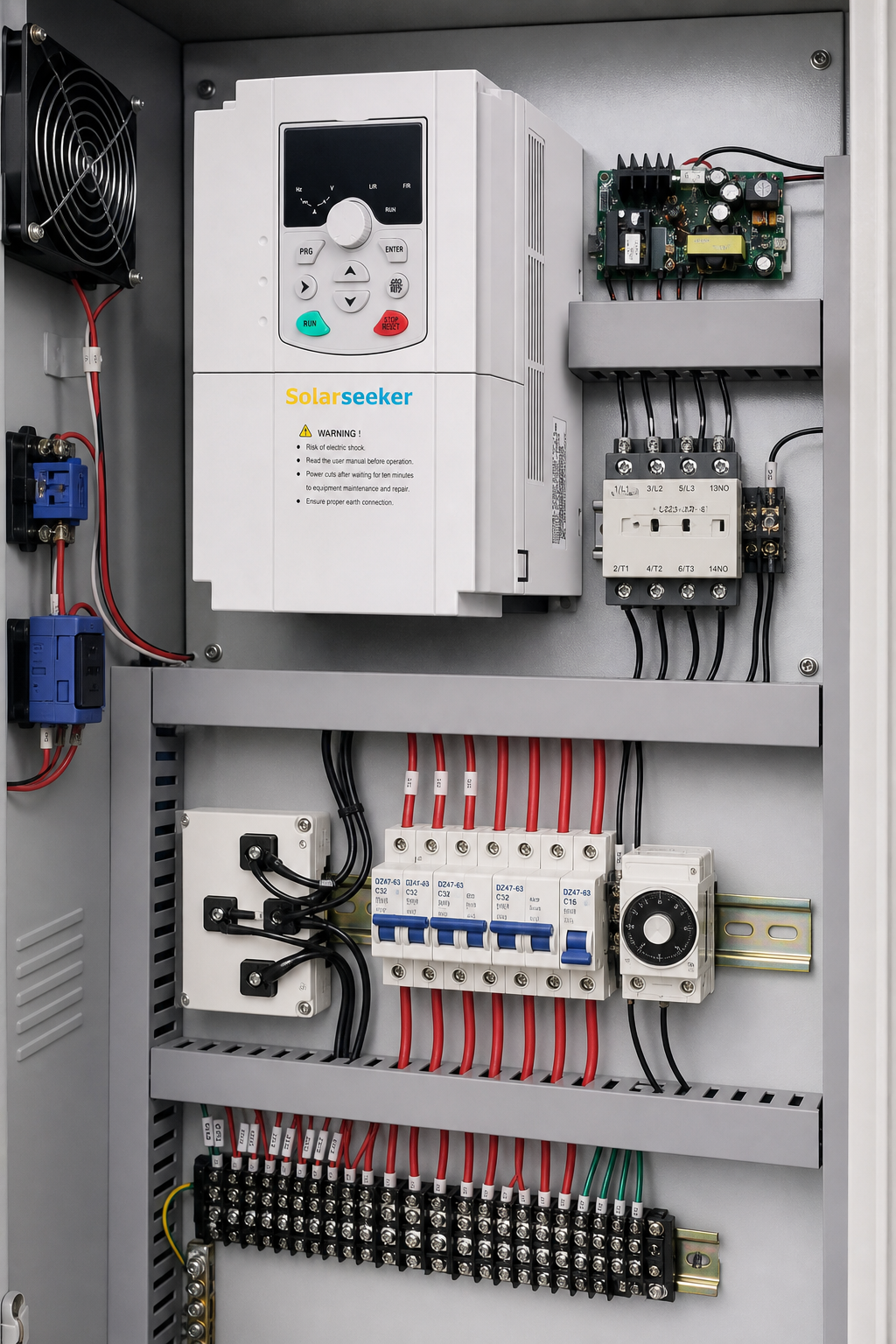
For instance, across the Solarseeker SP4 Inverter platform, the DSP programming keypad and control processing cards are 100% interchangeable from 4kW up to 37kW. This modularity reduces distributor inventory capital requirements by over 40% while preserving complete field emergency coverage.
2. Differentiate Between First-Line Consumables and Depot-Level Assemblies
Distributors should train field technicians on two distinct service tiers:
- Tier 1 (On-Site Truck Stock): Replacement cooling fans, DC fuses, plug-in LCD keypads, and terminal screws. These parts should be carried in every technician van to resolve 75% of minor nuisance calls immediately.
- Tier 2 (Depot Bench Stock): Complete power boards and IGBT blocks maintained at the distributor’s central regional warehouse for bench repair.
For standards on bench repair testing and electrical insulation safety after board replacement, technical managers must follow the guidelines established in IEC 60204-1 Safety of Machinery – Electrical Equipment.
3. Climate-Controlled Storage for Stored Capacitors
Aluminum electrolytic capacitors on standby power boards degrade if stored unpowered in tropical heat (above 40°C) for several years. Distributors must store electronic solar pump inverter spare parts in an air-conditioned, low-humidity storage area. Boards held on inventory shelves beyond 24 months should undergo standard slow DC voltage reforming before field deployment.
4. Leverage OEM Warranty Reclamation Programs
Reputable manufacturers do not force distributors to absorb the financial burden of factory defects. Partnering with a manufacturer offering automated advance warranty replacement ensures that whenever a technician swaps out a failed board under warranty, a fresh replacement board is immediately dispatched from the factory without waiting for lengthy return shipping audits.
Building a Profitable Service and Maintenance Contract Model
Stocking spare parts unlocks high-margin preventive maintenance contracts for agricultural distributors. Rather than simply selling inverters as a one-off commodity, forward-thinking distributors offer commercial farms and irrigation schemes an Annual Maintenance Contract (AMC):
- Pre-Season Inverter Cleaning and Torque Verification: Inspecting cooling channels and verifying terminal tightness before the dry pumping season begins.
- Guaranteed 24-Hour Swap-Out SLA: Providing farmers with absolute operational peace of mind during critical planting cycles.
- Firmware Updates and MPPT Calibration: Maintaining optimal solar harvest parameters as PV modules age.
Partner With Solarseeker for Distributor After-Sales Support
At Solarseeker, we engineer our high-reliability agricultural platforms specifically to empower independent distributors. Our modular native IP55 enclosures are designed for rapid field maintenance without requiring cleanroom disassembly.
Review our complete technical after-sales framework in the Solar Pumping Service System Guide or consult the Solar Pumping System Selection Guide to size appropriate systems for your regional distribution territory.
To request an authorized distributor spare parts starter package or inquire about regional stock financing, Contact Solarseeker Channel Engineering today.