
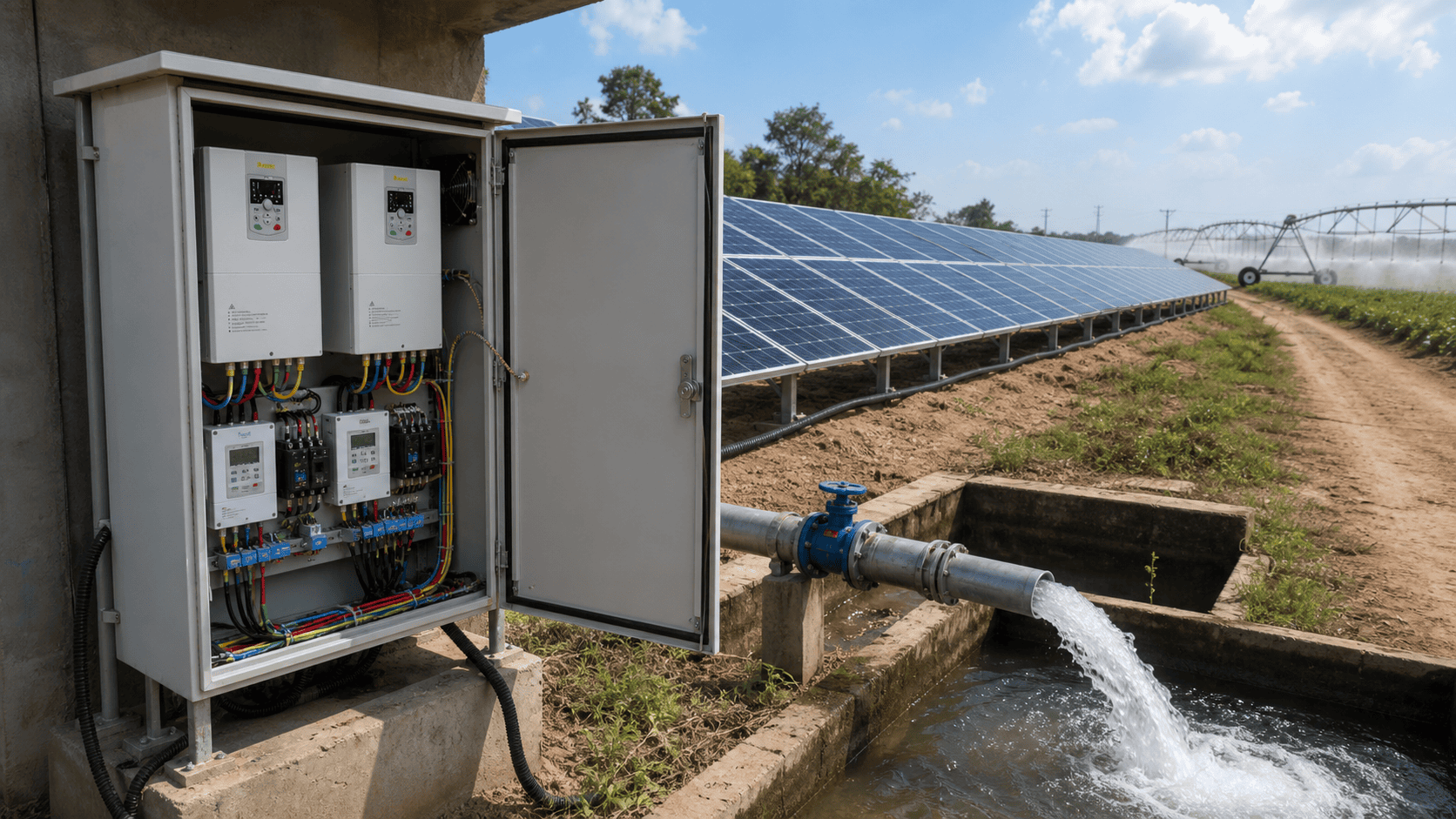
A practical selection guide for EPC teams, distributors, and irrigation buyers matching crop water demand to pump type, voltage, PV array, and inverter path.
If you choose a solar pump inverter only by crop type, the model can still be wrong. Crop type tells you the irrigation method. The irrigation method tells you flow, pressure, and operating hours. The final inverter choice must match the pump nameplate, voltage, phase, current, head, flow, and PV string plan.
Engineering Priority: Technical Verification Before Quoting
Rice, vegetables, orchards, and pasture do not fail in the same way.
A rice field may need high flow at lower pressure. A drip orchard often needs steadier pressure and filtration. A greenhouse may run shorter cycles, while a deep-well farm may need stronger three-phase pumping.
Because of this, crop type is only the first filter.
The better selection path is simple:
- Identify the irrigation method.
- Confirm the water source.
- Calculate total head and flow.
- Check the pump nameplate.
- Match inverter output voltage and phase.
- Check PV array power and working voltage.
That sequence protects buyers from a common mistake: choosing a neat inverter size while ignoring the real pump duty point.
For the basic product role, Solarseeker’s solar water pump inverter page explains how the inverter converts PV DC input into controlled AC motor output for solar pumping.
Crop Irrigation Selection Table
Use this table as a starting point before model selection. The final model still depends on the pump and site data.
| Crop or application | Common irrigation method | Main selection pressure | Inverter path to check first |
|---|---|---|---|
| Rice paddy or flood irrigation | Basin flooding, canal supply, high-volume pumping | Flow volume and daily water window | 380V three-phase path for larger pumps |
| Fruit orchard or vineyard | Drip, micro-sprinkler, filtered water | Stable pressure and longer daily operation | Match pump voltage first; SP4 for larger 380V systems |
| Vegetable greenhouse | Drip, misting, nutrient solution circulation | Pressure stability and frequent start-stop cycles | Smaller 220V path when pump nameplate supports it |
| Ranch or pasture water supply | Tank filling, borehole pumping, pivot or hose-reel irrigation | Service distance, lift, and pump reliability | 380V three-phase path for deep wells or large flow |
| Desert or dry-zone farms | Drip, subsurface drip, well pumping | PV derating, dust, heat, and water-source risk | Check enclosure, PV voltage, and dry-run protection |
| Retrofit farm with existing AC pump | Existing pump from grid or diesel generator | Compatibility with motor voltage, phase, and current | Nameplate-based solar pump inverter selection |
This table should not be used as a price list.
It is a way to ask better questions. If the crop points to a high-flow or high-head system, the buyer should collect pump and site data before requesting a model.
The Three Checks Before Choosing a Model
The first check is the pump nameplate.
Look for rated power, voltage, phase, current, and frequency. A 380V three-phase pump needs inverter output that supports that motor. A 220V single-phase pump follows a different selection path.
The second check is total head and flow.
Well depth alone is not enough. Add static lift, pipe loss, elevation change, filter pressure, valve loss, and required outlet pressure. The pump must reach the duty point before the inverter can do its job.
The third check is the PV array.
Panel watts matter, but working voltage matters too. A system with enough total watts can still start late if Vmp is too low. In cold weather, Voc may rise. In hot weather, Vmp may fall. Both conditions affect the inverter’s input window.
For a broader selection workflow, the solar pump selection guide is the natural page to review before quoting.
PV Array Starting Rule for Pump Matching
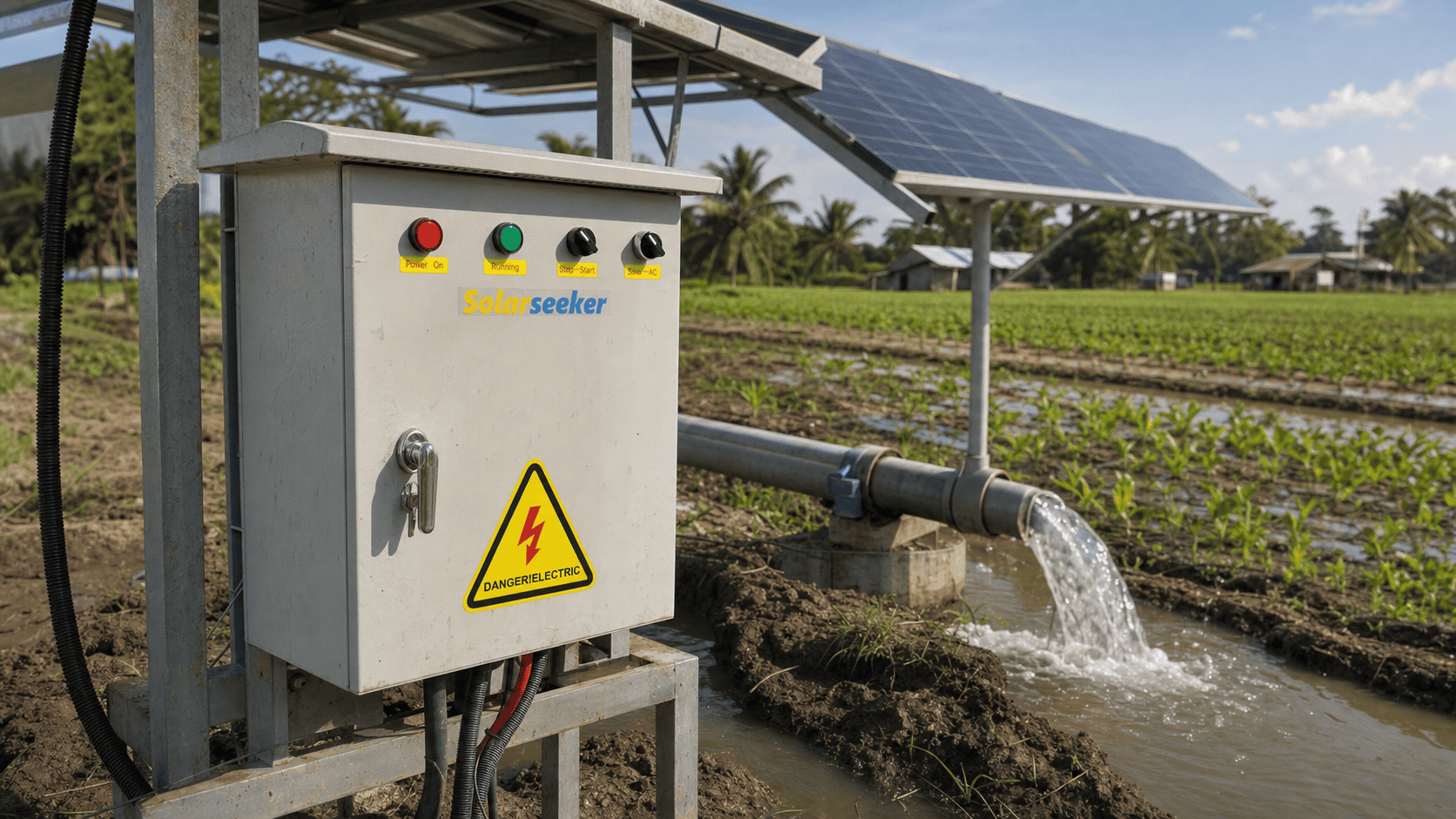
When the topic includes pump voltage, inverter sizing, or PV matching, use the PV array as part of the selection. Do not treat panels as an afterthought.
| Pump system | PV array power starting rule | Useful Vmp target |
|---|---|---|
| 220V single-phase pump | PV Array Power >= Pump Rated Power x 2.0 | Around 320V DC Vmp |
| 380V three-phase pump | PV Array Power >= Pump Rated Power x 1.3 to 1.5 | Around 540V DC Vmp |
These are starting rules, not final engineering drawings.
The final string plan still needs panel Voc, Vmp, site temperature, cable distance, inverter input range, and water schedule. For this reason, EPC teams should check the PV design before panels are shipped to the site.
Where SP4, SP1, and Retrofit Paths Fit
For large irrigation, deep wells, pasture pumping, and high-power orchard projects, a 380V three-phase path is often the safer direction. Solarseeker’s SP4 solar pump inverter is the product path to check first for many 380V three-phase pump systems.
For smaller 220V single-phase pumps, the SP1 solar pump inverter path may be a better fit. This is common in smaller farms, light irrigation blocks, tank filling, and simple water supply applications.
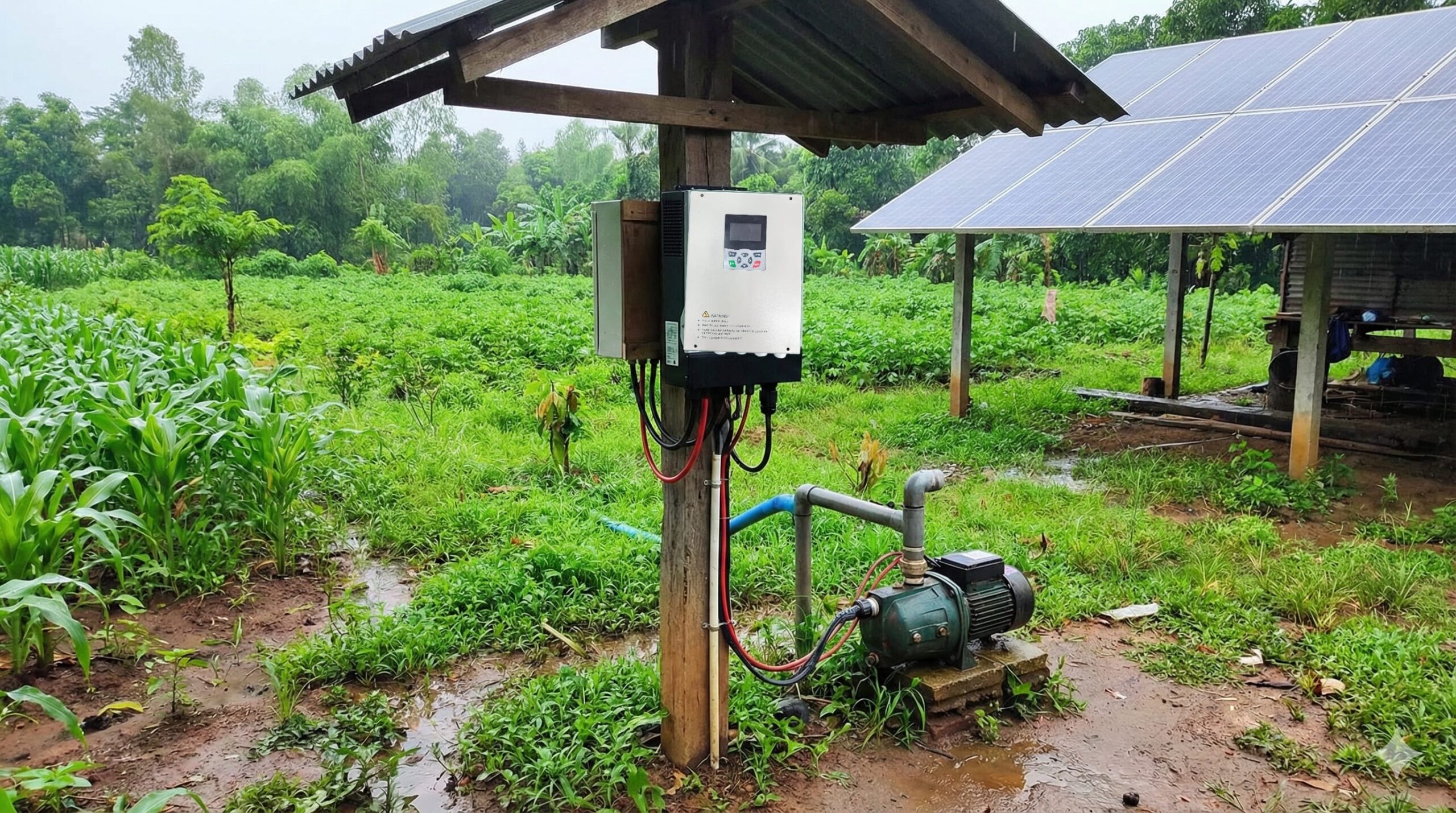
Some farms already own AC pumps. In that case, the buyer should not rush to replace the motor. First, check whether the existing pump can be driven by a properly matched solar pump inverter. The nameplate, pump condition, and motor current decide whether a retrofit is practical.
The product path should follow the pump. It should not be forced by the crop name.
Field Example: Orchard Irrigation With an Existing Pump
Consider an orchard buyer who wants to move daytime irrigation from diesel or grid power to solar.
The crop tells us the site may need stable pressure for drip or micro-sprinkler lines. However, it does not tell us the pump voltage, rated current, pipe loss, or filter pressure.
The buyer sends a pump nameplate photo. It shows a three-phase AC motor. The site also has a long pipe route, filters, and several irrigation zones.
In this case, the supplier should not quote from the crop name alone.
The engineer needs total head, required flow, irrigation schedule, panel model, planned string layout, and cable distance. With a 380V three-phase pump and high water demand, SP4 becomes a serious path to check. A smaller pump may need another route.
For project-style references, the solar water pump projects page can help buyers see how different sites need different configurations.
Common Mistakes When Matching Crops and Inverters
The first mistake is using crop water demand as a direct inverter size.
Crop water demand helps calculate daily volume. It does not replace pump curve matching. A pump must meet the duty point at the required head and flow.
The second mistake is ignoring pressure.
Drip irrigation, micro-sprinklers, misting, and pivots all behave differently. A low-head surface pumping system is not the same as a filtered drip system with pressure requirements.
Another mistake is copying a PV string plan from another farm.
Panel model, climate, cable distance, and pump load can change the voltage window. A copied string plan may work in one field and fail in another.
The last mistake is treating enclosure choice as decoration.
Dust, heat, humidity, and cabinet location affect service life and callbacks. Outdoor installations should be checked by qualified technicians and protected according to local electrical codes, grounding rules, and product manuals.
FAQ
Can I choose a solar pump inverter by crop type alone?
No. Crop type helps estimate irrigation method and water demand, but inverter selection depends on pump nameplate, voltage, phase, rated current, head, flow, PV array, and site conditions.
Which inverter path fits rice or flood irrigation?
Rice and flood irrigation often need higher flow. For a larger 380V three-phase motor, the SP4 path is usually worth checking first. The final model still depends on head, flow, current, and PV design.
What should I check for orchard drip irrigation?
Check pump voltage, phase, rated current, filter pressure, irrigation zones, total head, required flow, and daily watering hours. Drip systems usually need stable pressure, so pump curve and inverter control should be reviewed together.
Can I use an existing AC pump for crop irrigation with solar?
Yes, when the pump condition, voltage, phase, rated current, and water duty match the solar pump inverter. Send the pump nameplate and site data before deciding whether to reuse or replace the pump.
How many solar panels are needed for crop irrigation pumps?
Panel count depends on pump power, pump voltage, PV module Voc and Vmp, inverter input range, site temperature, cable distance, and irrigation schedule. As a starting rule, 220V single-phase pumps need stronger PV oversizing than 380V three-phase pumps.
What to Send Before Model Selection
Before quoting a crop irrigation project, collect the data in one message.
Send Solarseeker the crop type, irrigation method, pump nameplate, pump power, voltage, phase, rated current, total head, required flow, pipe route, water source, PV panel model, and planned string layout. Use the contact page to ask for a model and panel matching check before ordering.