
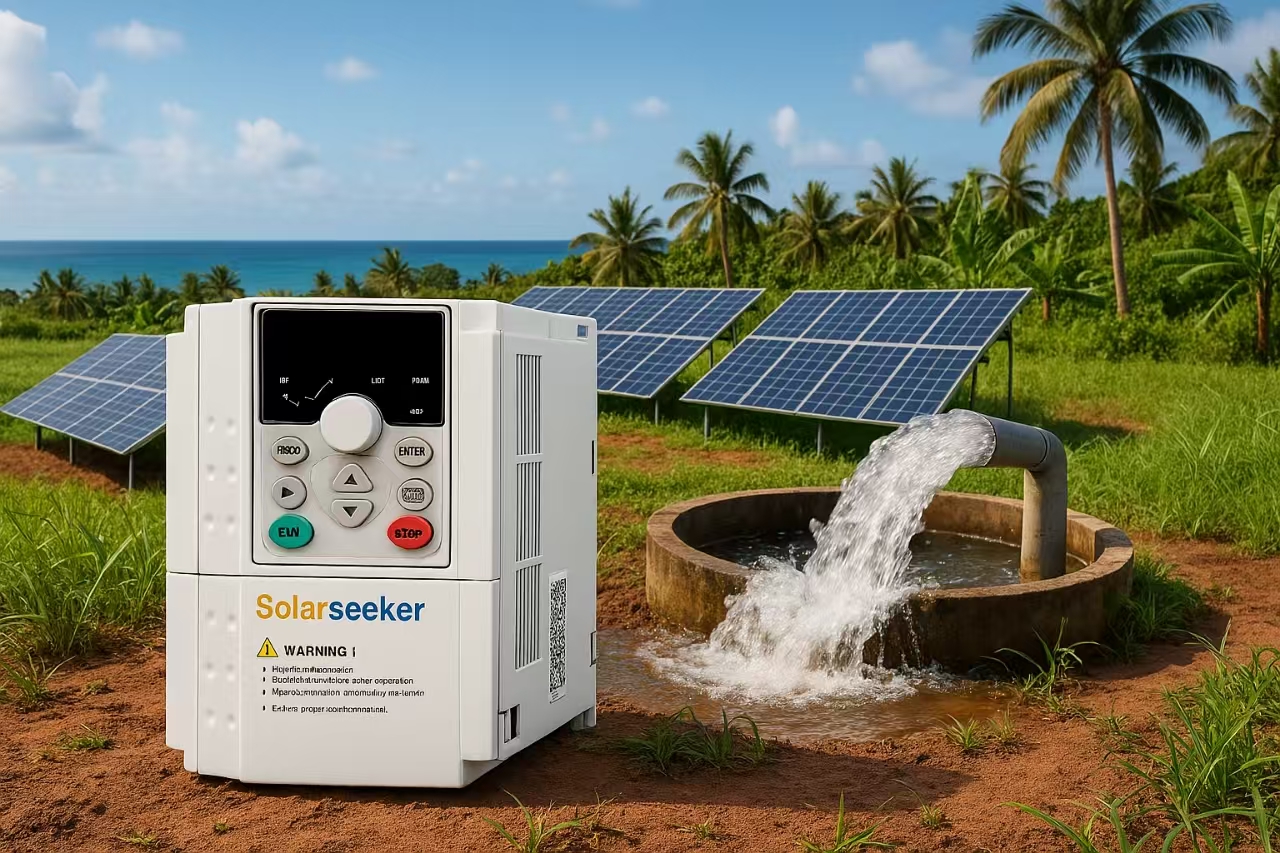
Solar VFD compatibility depends on voltage, phase, motor current, pump curve, PV input, and protection settings working together.
Pairing a solar VFD with an AC water pump is not just matching kilowatts. A 4kW inverter can still be wrong if the pump voltage, phase, rated current, or PV input range does not match the site.
The safest process is to read the pump nameplate first, check the pump curve, then choose the inverter and PV string. This reduces weak flow, overload trips, late starts, and warranty disputes.
In Solarseeker model checks, the fastest way to find a mismatch is to compare the pump nameplate with the inverter output and PV input window. If those basics do not match, nothing else will save the project.
The Nameplate Comes First
Before selecting a solar pump inverter, confirm the motor power, voltage, phase, rated current, frequency, and insulation condition. Rated current is especially important because pump load can exceed what a simple power label suggests.
Compatibility Checklist
| Item | What to confirm | Why it matters |
|---|---|---|
| Voltage | Pump voltage matches inverter output | Prevents wrong equipment selection |
| Phase | Single-phase or three-phase path is correct | Avoids motor and inverter mismatch |
| Current | Inverter capacity covers pump rated current | Reduces overload trips |
| Pump curve | Head and flow fit the site | Protects water output |
| PV input | Vmp and Voc stay in range | Prevents weak running or over-voltage risk |
PV Input Still Matters
| Pump system | PV array power starting rule | Useful Vmp target |
|---|---|---|
| 220V single-phase pump | PV Array Power >= Pump Rated Power x 2.0 | Around 320V DC Vmp |
| 380V three-phase pump | PV Array Power >= Pump Rated Power x 1.3 to 1.5 | Around 540V DC Vmp |
The PV array must support the inverter under real sunlight. Too little Vmp causes late starts and weak output. Too much Voc can damage the DC input in cold weather.
Choose the Product Path by Pump Type
For 220V single-phase pump systems, the SP1 path is usually the starting point. For larger 380V three-phase pumps, review SP4 with the pump nameplate and duty point.
Rated Current Is Not a Small Detail
Many wrong quotations happen because the buyer gives only pump power. Rated current shows the load the inverter must handle. If the pump is old, overloaded, or operating at a difficult duty point, current can be higher than expected.
Always compare motor rated current with inverter capacity before confirming the model.
Pump Curve Protects Water Output
A compatible electrical match does not guarantee good water output. The pump curve must match head and flow. If the pump is wrong for the well or pipeline, the inverter may run normally while the customer still receives poor water delivery.
This is a common source of dispute because the inverter appears to be the visible control device. In reality, the hydraulic match may be the root problem.
Protection Settings Are Part of Compatibility
Dry-run, overload, under-voltage, and restart settings should fit the pump and water source. Wrong settings can create nuisance trips. Loose settings can allow pump damage. Qualified technicians should follow local electrical codes during installation and commissioning.
Common Pairing Mistakes
- Matching only by kilowatt and ignoring rated current.
- Using a pump with the wrong voltage or phase.
- Ignoring cold-weather PV Voc.
- Forgetting long cable voltage drop.
- Assuming the pump curve fits without checking head and flow.
- Changing protection settings to stop alarms without finding the cause.
Commissioning Checks After Pairing
- Confirm pump nameplate against inverter model.
- Check PV voltage before startup and while running.
- Record output frequency and motor current.
- Check flow against expected duty point.
- Test alarm response where safe and applicable.
- Record parameters for future service.
Different Pump Types Create Different Checks
| Pump type | Main compatibility check | Common risk |
|---|---|---|
| Single-phase surface pump | Output type and starting behavior | Wrong inverter path |
| Three-phase submersible pump | Rated current, head, and cable length | Overload or voltage drop |
| Deep-well pump | Pump curve and water level change | Dry-run or weak flow |
| High-flow irrigation pump | Motor current and pipe loss | Current above expectation |
Existing Pumps Need Extra Caution
Many projects want to reuse an existing AC pump. That can work, but the pump condition must be checked. Old insulation, worn bearings, wrong duty point, or unclear nameplate data can create faults after the inverter is installed.
Do not assume reuse is safe because the pump ran on grid power before. Solar operation changes the power source and operating pattern.
PV and Pump Compatibility Must Be Checked Together
The inverter sits between PV and pump. If the PV side is wrong, the pump side will suffer. If the pump side is wrong, the PV side cannot fix it. Compatibility is a full system check, not a single model choice.
This is why Solarseeker asks for both panel data and pump data when checking a project.
Quotation Data Package for Compatibility Checks
A clean quotation starts with complete data. Send pump nameplate, pump curve, desired head and flow, panel datasheet, cable distance, site temperature, and water source notes. If the pump is existing equipment, include photos and any maintenance history.
Missing data creates guesswork. Guesswork creates callbacks.
What Compatibility Looks Like During Commissioning
A compatible system should start within the expected solar window, run without repeated overload alarms, keep motor current within a safe range, and deliver water close to the planned duty point. If one of these conditions fails, review the system before handing it over.
Safety Boundary for Installers
Compatibility guidance is not a wiring manual. PV arrays, inverter terminals, grounding, and pump circuits involve dangerous voltage. Installation should be done by qualified electricians or trained technicians following local codes and the product manual.
How Compatibility Prevents Warranty Disputes
Many warranty disputes start because nobody kept the pump data. The supplier sees overload alarms. The buyer sees a stopped system. Without nameplate, curve, PV string, and current readings, both sides argue from incomplete evidence.
A compatibility record protects the buyer because it proves the system was selected correctly. It protects the supplier because it separates product issues from site conditions.
Parameter Notes Matter
After commissioning, record important settings such as protection thresholds, restart behavior, and any site-specific changes. If a future technician changes parameters without notes, troubleshooting becomes harder.
Good records are boring. They also prevent expensive confusion.
Do Not Hide Unknowns in the Quote
If pump curve, cable distance, or panel data is missing, mark it as an assumption. Clear assumptions are better than quiet guesses.
Check Compatibility Under Load
A model may look compatible on paper and still behave poorly under load. Commissioning readings confirm the match. If current, frequency, or flow looks wrong, review the pump and PV design before declaring the project complete.
FAQ
Can I choose a solar VFD by pump power only?
No. You must also check voltage, phase, rated current, pump curve, PV input range, and site conditions.
Why does a compatible inverter still show overload?
The pump may be drawing high current because of head, pipe blockage, sand, wrong pump selection, or mechanical problems.
Can one inverter model work with different pump brands?
Yes, if the electrical and hydraulic requirements match. The pump nameplate and curve must be checked for each project.
Product Path After Compatibility Checks
After confirming voltage, phase, rated current, PV input range, and pump duty point, connect the result to the product family. Many 220V single-phase pump projects start with SP1. Many 380V three-phase irrigation or deep-well projects start with SP4. If compatibility is still uncertain, use the selection guide and the installation guide before commissioning.
Before You Pair the Equipment
Send pump nameplate, pump curve, PV panel datasheet, head, flow, cable distance, and site temperature to Solarseeker. Compatibility is easier to check on paper than on a hot job site.