
Sizing a solar deep well pump inverter by motor nameplate kilowatts alone is the quickest way to end up with a stalled pump and a burned cable.
In deep well solar pumping, hydraulic head, drawdown dynamics, and motor power factor dictate the electrical load. A submersible motor operating at the bottom of a 120-meter borehole behaves very differently from a surface booster pump. It encounters massive starting inertia, low power factor ($\cos\phi \approx 0.68\text{–}0.78$), and significant cable impedance along the riser pipe.
To ensure steady water output from dawn to dusk, this guide breaks down the true sizing calculations used by field engineers. For high-head deep well installations, review the dedicated Solarseeker SP4 380V three-phase inverter series and our complete solar water pump inverter product path.
Calculate Total Dynamic Head (TDH) Before Touching the Inverter
The first mistake is sizing the inverter before knowing the true hydraulic duty point. Total Dynamic Head (TDH) is not simply the depth of the borehole. It is the sum of four distinct pressure components:
TDH = Static Water Level + Well Drawdown + Surface Elevation Lift + Pipe Friction Losses
- Static Water Level: The distance from the wellhead down to the water surface when the pump is idle.
- Well Drawdown (Dynamic Drop): The additional drop in water level once the pump runs at full capacity. In low-recharge aquifers, drawdown can easily add 20 to 40 meters of extra lift!
- Surface Lift: Vertical elevation from the wellhead up to the storage tank or irrigation reservoir.
- Friction Losses: Pressure drop caused by pipe wall roughness, check valves, elbows, and meters of column pipe.
Size by Full-Load Current (Amps), Never Kilowatts
Standard AC motors running on grid utility can absorb temporary overloads. Solar inverters cannot. An inverter is an electronic semiconductor device whose current limit is absolute. If motor current exceeds the drive’s rated output for even a few seconds, the IGBT switches will trip on overload (OL or OC).
Submersible motors have lower power factors and lower operational efficiencies than surface motors of identical kW. For instance, a 7.5 kW surface motor might draw 15 Amps at 380V, whereas a 7.5 kW deep-well submersible motor often draws 17.5 to 19 Amps.
Field Sizing Rule: Always size the solar inverter so that its continuous rated output current exceeds the motor nameplate Full Load Amps (FLA) by at least 20% to 25%. If your submersible motor plate states 17.5A, choose an inverter rated for at least 21A continuous output. This buffer accounts for elevated summer cabinet temperatures and starting breakaway torque.
Managing Long Cable Voltage Drops Down the Well
A deep borehole requires 80 to 200 meters of submersible drop cable. Electrical resistance in this long cable run causes two severe problems:
- Terminal Voltage Starvation: High current running through undersized copper creates a voltage drop. If the terminal voltage at the submerged motor falls below 90% of nominal voltage during startup, the motor may fail to generate sufficient breakaway torque to lift the water column.
- Harmonic Voltage Spikes (dV/dt): Inverter PWM switching pulses traveling down long cables reflect back at the motor terminals. On cable runs longer than 80 to 100 meters, voltage spikes can double, stressing motor winding insulation and shortening pump life.
For installations with cable runs exceeding 100 meters, consider installing an output AC reactor (choke) between the inverter and the wellhead. Explore real-world field installations on our solar water pump projects page.
Solar PV Array Sizing for Deep Well Systems
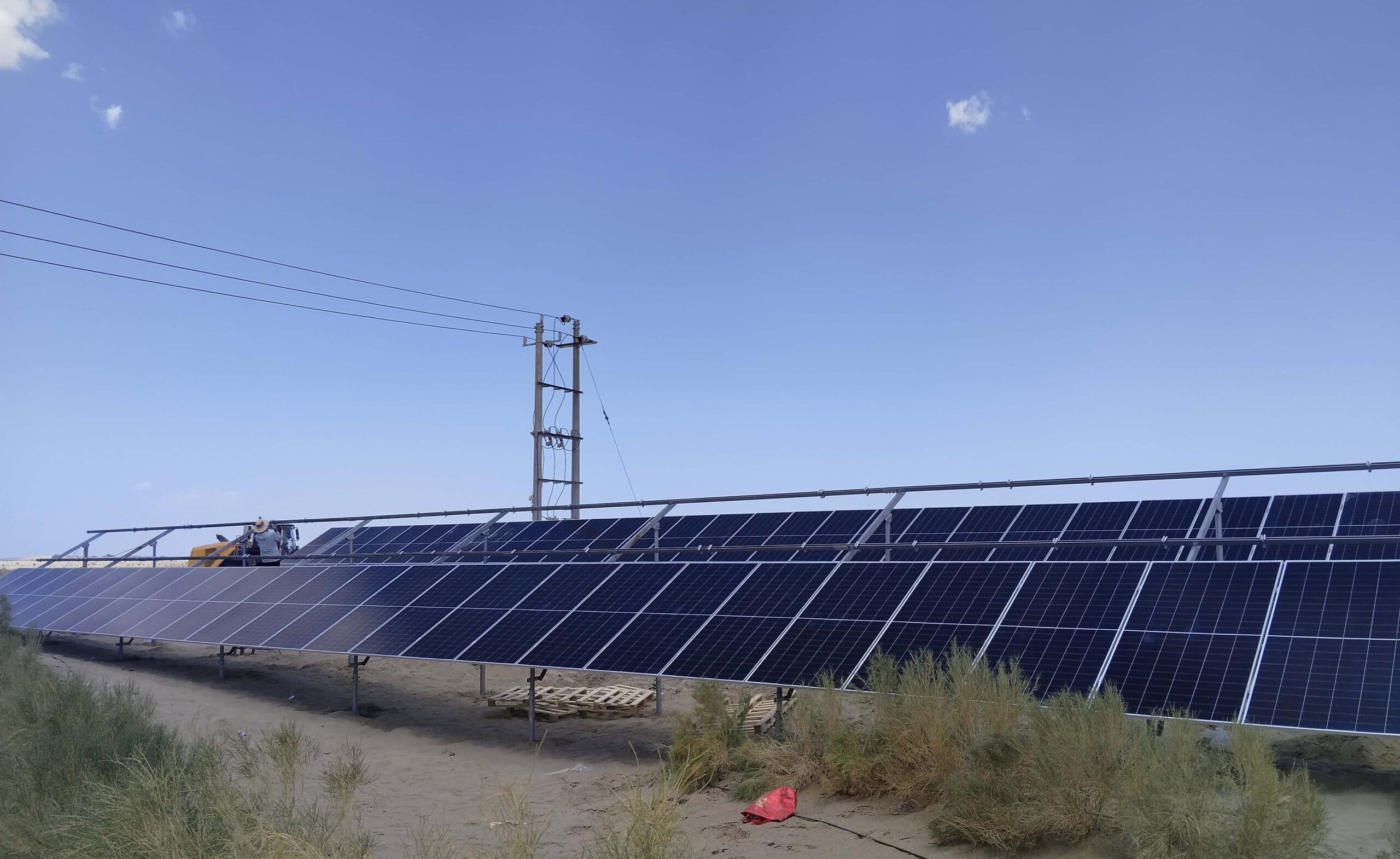
Deep well pumps must start against full static column pressure. Sizing the solar array requires adequate DC bus potential early in the day:
| System Type | PV Array Power Oversizing | Target DC Working Vmp | Critical Safety Threshold |
|---|---|---|---|
| 380V Three-Phase Submersible | Array Power >= Pump kW × 1.35 to 1.5 | Around 540V to 580V DC Vmp | Keep string Voc < 800V DC at lowest winter temp |
| 220V Single-Phase Submersible | Array Power >= Pump kW × 2.0 | Around 320V to 340V DC Vmp | Keep string Voc < 450V DC at lowest winter temp |
Under-sizing the array power causes the inverter to wake up late (e.g. 10:30 AM), cycle frequently on cloud transients, and shut down early in the afternoon.
Frequently Asked Questions
Why does my deep well inverter trip on over-current on cloudy mornings?
In low sunlight, the inverter reduces operating frequency to maintain DC bus voltage. However, centrifugal pumps have a minimum speed (hydraulic floor) below which they cannot generate enough pressure to overcome static head. When frequency drops too low while head remains constant, the pump stops lifting water, motor cooling drops, and current surges, causing an over-current trip.
Can I use a 220V single-phase pump for a 150-meter well?
We strongly discourage it. A 150-meter cable run on a 220V single-phase pump requires extremely thick, expensive copper cable to keep voltage drop below 5%. In almost every case, installing a 380V three-phase pump with an SP4 inverter is significantly cheaper and far more reliable.
Do I need a dry-run sensor inside the borehole?
While Solarseeker inverters feature built-in software underload detection (which detects when the motor runs dry due to drop in load torque), installing physical water level well probes or a float switch is the most foolproof protection against aquifer drawdown.
What to Confirm Before Ordering
Before requesting an engineering sizing check for a deep well project, collect these five essential job-site numbers:
- Motor Nameplate Photo: Rated kW, voltage, full-load amps (FLA), and frequency.
- Total Well Depth & Static Water Level: In meters or feet.
- Anticipated Drawdown / Dynamic Water Level: When pumping at full rate.
- One-way cable distance: From inverter cabinet down to the pump motor.
- Daily Water Demand: Target cubic meters per day (m³/day).
Send these details directly to our engineering team via the Solarseeker contact desk. We will provide a verified pump curve simulation and panel layout before you finalize procurement.