
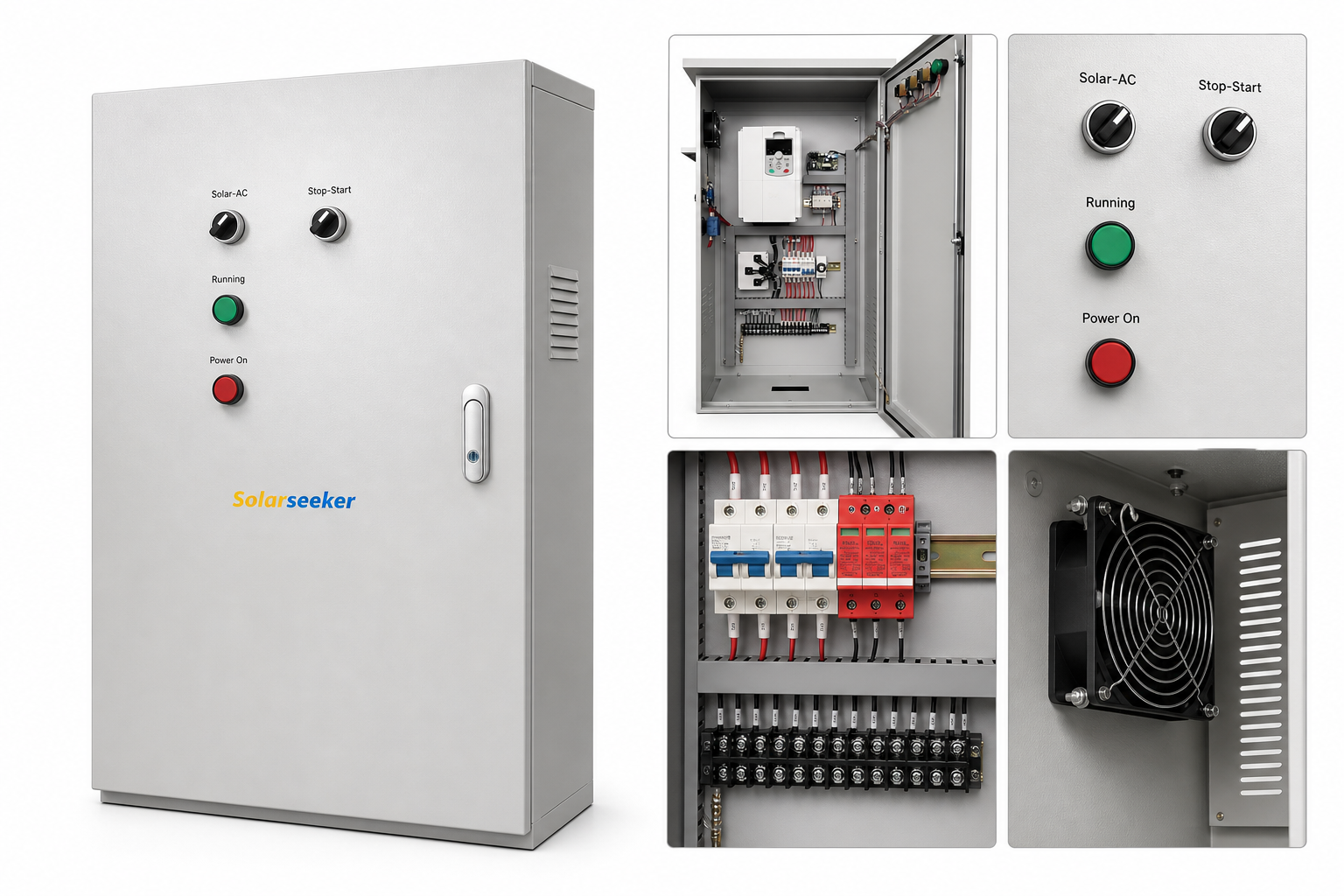
Commercial borehole sizing calculation note for EPC irrigation contractors, electrical panel integrators, and regional pump distributors quoting 380V three-phase solar pumping packages.
Quick Sizing Numbers: 10HP, 15HP, and 20HP Three-Phase Borehole Arrays
When calculating solar panels for 10HP water pump, 15HP, or 20HP three-phase 380V submersible installations, plan PV array wattage at 1.3 to 1.5 times motor rated kilowatts while keeping loaded string voltage inside the 530–800 VDC window (cold open-circuit ceiling strictly below 800 VDC). Specifically, a 10HP (7.5 kW) borehole pump typically needs 11.0–11.5 kWp (19 × 600W low-voltage panels or 26 × 450W–550W panels), a 15HP (11 kW) pump needs 16.0–16.8 kWp (28 × 600W or 30 × 550W panels), and a 20HP (15 kW) pump needs 22.0–23.1 kWp (42 × 550W or 38 × 600W panels).
If your project involves smaller 2.2 kW to 5.5 kW single-phase or three-phase farm wells instead of commercial multi-string boreholes, check our earlier breakdown on how many solar panels you need for a 3HP, 5HP, or 7.5HP water pump.
380V Array & IP65 Control Cabinet Matching Matrix (10HP / 15HP / 20HP)
Once pump power reaches 10HP (7.5 kW) and above, simple panel-count rules of thumb stop being enough for a reliable tender quote. Submersible borehole motors draw higher full-load amperes (FLA) than surface centrifugal motors of the same horsepower because of slim downhole stator geometry and long vertical drop cables.
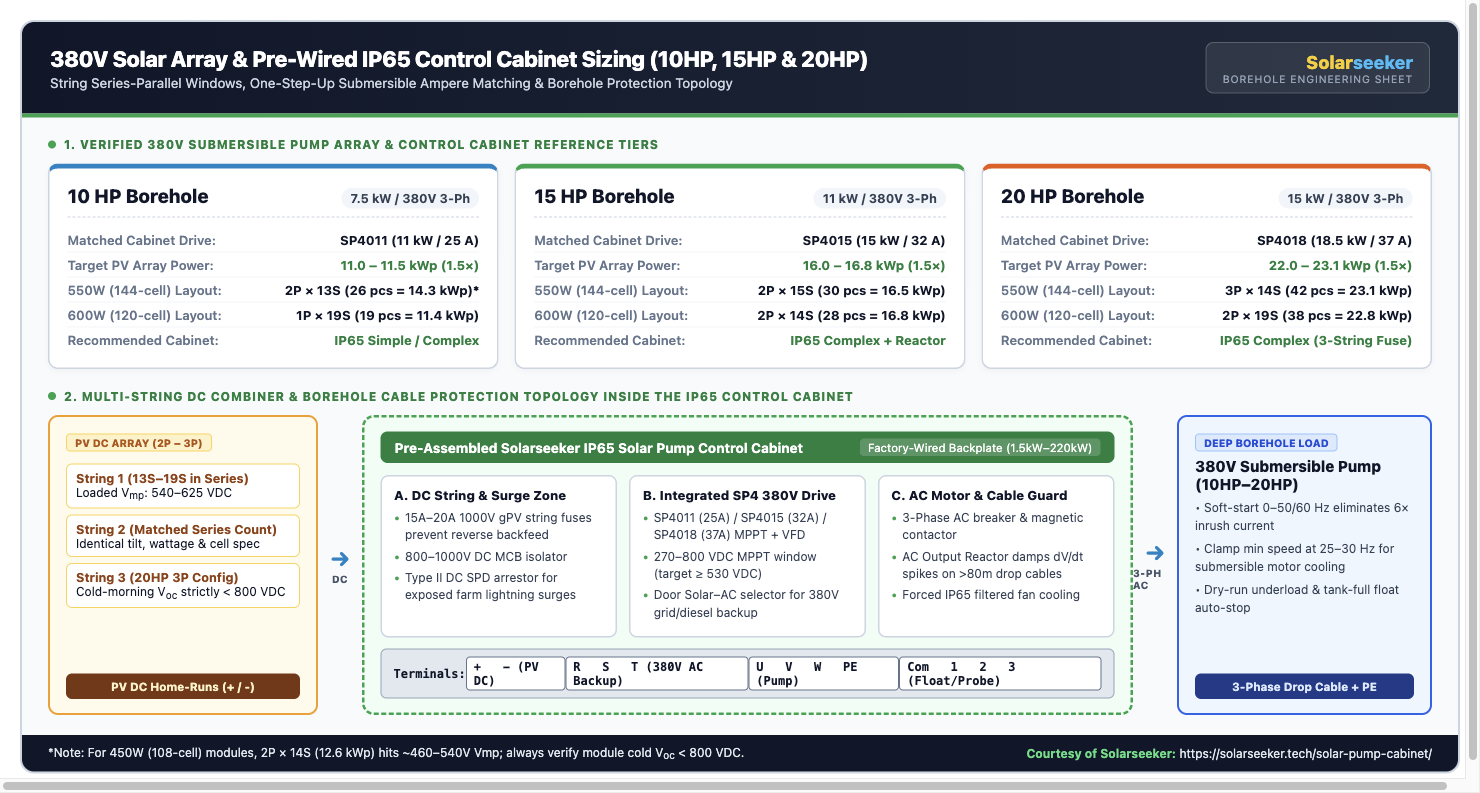
To prevent nuisance overload trips during midday thermal derating, field engineers step up one inverter frame size on deep-well submersible loads and house the multi-string breakers, fuses, and drive inside a pre-wired outdoor enclosure. The table below summarizes verified matching baselines across the 10HP to 20HP three-phase bracket.
| Pump Rating (380V 3-Ph) | One-Step-Up Drive & Rated Amps | Target PV Array Power (1.5×) | 550W (144-Cell) String Plan | 600W (120-Cell) String Plan | Recommended Outdoor Enclosure |
|---|---|---|---|---|---|
| 10HP (7.5 kW) | SP4011 (11 kW / 25 A) | 11.0 – 11.5 kWp | 2P × 13S (26 pcs = 14.3 kWp)* | 1P × 19S (19 pcs = 11.4 kWp)** | IP65 Simple or Complex Cabinet |
| 15HP (11 kW) | SP4015 (15 kW / 32 A) | 16.0 – 16.8 kWp | 2P × 15S (30 pcs = 16.5 kWp) | 2P × 14S (28 pcs = 16.8 kWp) | IP65 Complex Cabinet + Reactor |
| 20HP (15 kW) | SP4018 (18.5 kW / 37 A) | 22.0 – 23.1 kWp | 3P × 14S (42 pcs = 23.1 kWp) | 2P × 19S (38 pcs = 22.8 kWp)** | IP65 Complex Cabinet (3-String Fuse) |
*For 10HP wells using 450W (108-cell) modules, 2P × 15S (30 pcs = 13.5 kWp) hits the 380V voltage target cleanly without over-sizing wattage. **19-in-series (19S) applies only to low-voltage 210mm 120-half-cell 600W modules (Voc ≈ 41.5V) in warm climates where winter morning open-circuit voltage stays below 800 VDC.
String Voltage Math: Hitting the 530–800 VDC Window Without Cold-Morning Trips
The fastest way to ruin a quote on solar panels for 10HP water pump or 15HP irrigation jobs is counting total watts while ignoring module cell voltage. Every three-phase 380–440V solar pump drive needs roughly 530V to 620V DC under load (Vmp) to synthesize full 380V AC motor voltage at 50 Hz or 60 Hz, while its internal bus capacitors and IGBTs enforce a hard 800 VDC open-circuit ceiling.
Two commercial solar panels sitting in the same distributor warehouse can have nearly identical wattages yet completely different cell voltages:
- 182mm 144-Half-Cell Modules (545W–585W): Typical Vmp sits near 41.8V and STC Voc sits near 49.8V. Wiring 13 to 15 modules in series yields 543V–627V loaded Vmp and 647V–747V STC Voc. Wiring 18 of these high-voltage modules in series pushes STC Voc to 896V—destroying the drive input stage on the first clear morning.
- 210mm 120-Half-Cell Modules (590W–610W): Typical Vmp sits lower around 34.6V and STC Voc around 41.7V. Because each panel produces 7 volts less than a 144-cell module, installers must wire 16 to 18 modules in series (up to 19S only in frost-free tropical zones) to hold 554V–623V loaded Vmp.
Always run both voltage equations against the exact module datasheet before signing off on string layout:
Loaded String Vmp = Nseries × Vmp(module) ≥ 530 VDC | Cold Voc = Nseries × Voc(STC) × [1 + |βVoc| × (25°C − Tmin)] < 800 VDC
Notice why an awkward panel count—such as ordering 20 pieces of 550W 144-cell panels for a 10HP pump—creates a wiring trap. Putting all 20 panels in one string (1P × 20S) reaches nearly 1,000V Voc and trips high-voltage protection immediately. Splitting them into two strings of ten (2P × 10S) drops loaded Vmp to ~418V, starving a 380V pump of pressure head all afternoon. Stepping up to 2P × 13S (26 panels) or switching to 18 pieces of 210mm 600W low-voltage modules (1P × 18S) solves both voltage limits cleanly.
Why Multi-String 10HP–20HP Wells Need a Pre-Wired IP65 Control Cabinet
On small 2HP or 3HP single-string jobs, an installer often mounts a drive inside an existing pump shed with a single two-pole DC breaker. At 10HP, 15HP, and 20HP, three electrical realities change at the wellhead:
- Parallel String Fault Currents (2P and 3P Arrays): Once two or three high-voltage strings combine onto one DC bus, a shaded or shorted string can absorb reverse current from adjacent strings. Coordinated 1000V DC gPV fuses and an 800–1000V DC isolator are essential in multi-string arrays under IEC 60269-6 and IEC 60529 protection practices.
- Open-Chassis Drive Ratings (IP20 Hardware Reality): Standard Solarseeker SP4 380V solar pump inverters (such as SP4011, SP4015, and SP4018) are built as IP20 industrial chassis units for clean heat dissipation. Mounting a bare IP20 chassis outdoors exposes control boards and cooling fans to blowing dust, insects, and irrigation spray.
- Long Submersible Drop Cables (>80m–150m): Commercial 10HP–20HP boreholes routinely sit 80 to 180 meters deep. High-frequency IGBT switching pulses reflect along long submersible cables, multiplying peak voltage stress on motor winding insulation unless damped by a matched three-phase AC output reactor.
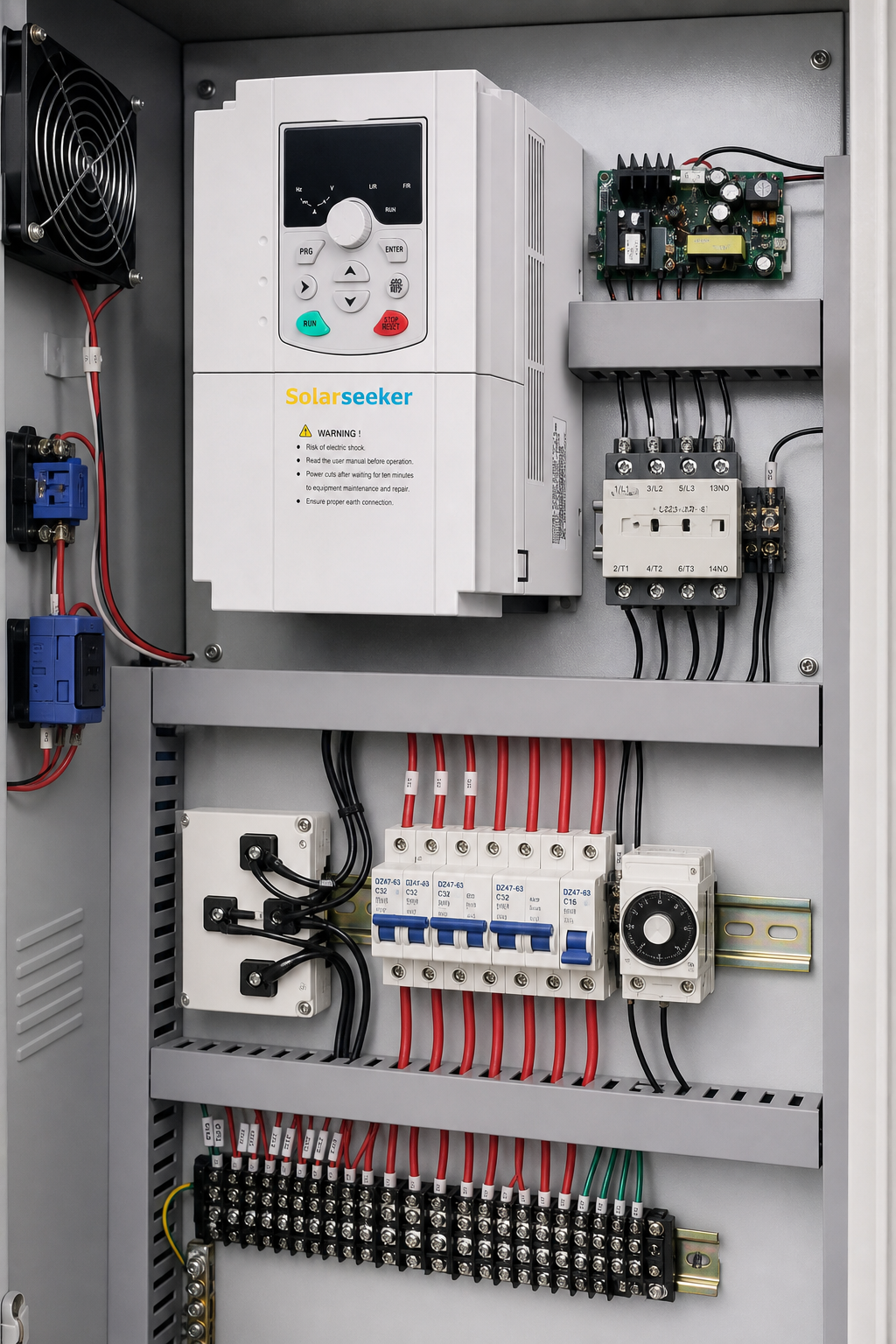
Instead of asking field electricians to drill enclosures and source mismatched breakers, fuses, and chokes locally, EPCs and distributors specify a pre-assembled Solarseeker IP65 Solar Pump Control Cabinet configured in one of two project tiers:
| Cabinet Architecture | Factory-Integrated Components | Best Match Across 10HP–20HP Projects |
|---|---|---|
| Simple IP65 Control Cabinet | SP4 380V drive, DC MCB isolator, string fuse holder, AC breaker, labeled terminal rail, PE ground bar, IP65 metal enclosure | 10HP (7.5 kW) surface transfer pumps or shallow boreholes (<50m cable) in low-lightning zones without generator backup |
| Complex IP65 Control Cabinet | Adds Type II DC SPD surge arrestor, 3-phase AC output reactor, magnetic contactor, 24V control board, filtered cooling fan, and door Solar–AC changeover | 15HP & 20HP deep boreholes (>80m cable), 2P/3P multi-string fields, lightning-exposed farms, and hybrid diesel/grid irrigation sites |
Field Sizing Example: 15HP (11 kW) Submersible Borehole at 120m Dynamic Head
To see how wattage, voltage, amperes, and cabinet hardware come together on a real quotation, walk through this representative 15HP orchard irrigation borehole:
- Step 1 — Read Motor Nameplate Amps First: The submersible motor nameplate lists 11 kW (15HP), 380V three-phase, 50 Hz, and 24.2 A full-load current. Because a standard 11 kW drive is rated at 25 A—leaving almost zero thermal margin at 45°C ambient—we step up one frame to SP4015 (15 kW / 32 A).
- Step 2 — Size PV Array Power (1.5× Multiplier): Multiplying 11 kW × 1.5 gives 16.5 kWp target solar power so the pump reaches full 50 Hz lift by mid-morning and sustains flow through afternoon module heating.
- Step 3 — Verify String Voltage With 550W (144-Cell) Panels: Using 550W modules (Vmp = 41.8V, Voc = 49.8V, Tmin = 5°C), two parallel strings of 15 panels (2P × 15S = 30 panels, 16.5 kWp) produce 627V DC loaded Vmp and ~792V cold-morning Voc. If winter mornings drop below 0°C at that elevation, trimming to 2P × 14S (28 panels of 580W = 16.24 kWp) lowers cold Voc safely to ~752V DC.
- Step 4 — Specify the Enclosure BOM: Because the submersible cable run is 120 meters and the grower wants nighttime diesel generator backup during peak flowering weeks, we select a Complex IP65 Control Cabinet housing the SP4015 drive, 2-string gPV fuses, Type II DC SPD, a 32A AC output reactor, and a door-mounted Solar–AC rotary changeover switch.
Electrical Safety Note: Multi-string 380V solar pump arrays operate at lethal DC voltages up to 800 VDC alongside three-phase AC generator or grid circuits. All string fusing, grounding, and cabinet terminations must be completed by licensed electricians in compliance with local electrical codes after verifying full DC bus discharge.
FAQ: Commercial 10HP–20HP Solar Pump Array & Cabinet Planning
Why do you pair a 10HP (7.5 kW) submersible pump with an 11 kW SP4011 cabinet instead of a 7.5 kW drive?
Deep-well submersible motors have lower power factors and higher full-load current draw than standard surface motors, especially when pushing against high static head through long drop cables. Stepping from a 17 A (7.5 kW) frame up to the 25 A SP4011 (11 kW) frame gives essential starting torque and thermal headroom in hot agricultural climates.
Can I run solar panels for 10HP water pump or 15HP wells on 220V single-phase power?
In almost all commercial boreholes, 10HP to 20HP motors are wound for three-phase power because single-phase starting currents above 5.5 kW (7.5HP) become impractical. If a site only has 220V three-phase pumps, the SP3 220V three-phase cabinet platform (SP3011 / SP3015 / SP3018) supports lower 320V DC string targets, though 380V SP4 systems cut cable copper cost substantially on deep wells.
What if our warehouse has 24 or 32 solar panels ready to ship—can we split uneven strings?
Never wire unequal panel counts in parallel onto the same MPPT input (for example, 13S paralleled with 11S), because the lower-voltage string drags down bus voltage and circulates reverse current. Every parallel string feeding the control cabinet must have the exact same module model, series count, tilt, and azimuth.
Send Your Pump Nameplate & Module Datasheet for a Pre-Wired Cabinet Sheet
Before locking panel quantities on a solar panels for 10HP water pump, 15HP, or 20HP project quote, let our application engineers cross-check your module cold-weather Voc, motor full-load amps, and borehole cable length.
- Pump Nameplate Details: Motor kW/HP, rated voltage (380–440V or 220V 3-phase), full-load amperes (A), and rated Hz.
- Well Depth & Hydraulic Duty: Dynamic pumping head, daily cubic meter target, and drop-cable length from wellhead to cabinet.
- Candidate PV Module Datasheet: Wattage, Vmp, Voc, Isc, and minimum winter morning site temperature.
- Cabinet & Backup Scope: Simple vs. Complex IP65 enclosure, diesel/grid 380V hybrid input, and distributor OEM branding needs.
Share your pump nameplate photo and panel spec sheet via the Solarseeker engineering contact page to receive a matched string wiring diagram, IP65 control cabinet BOM, and formal project quotation.