
When buyers compare a solar pump inverter vs battery storage, the biggest quoting mistake is treating a submersible pump like a household lighting load. For daytime irrigation, livestock troughs, and borehole transfer, a dedicated MPPT solar pump inverter paired with an elevated tank or lined reservoir costs far less to build and maintain than a battery bank—because storing pumped water avoids battery surge oversizing, chemical degradation, and 3-to-5-year cell replacement bills.
That does not mean batteries never belong on a farm. However, once you price the starting current of an inductive pump motor, the economics shift fast.
Why Inductive Pump Motors Punish Off-Grid Battery Inverters
A general off-grid storage inverter is built to charge batteries and hold a fixed 220V or 380V AC output voltage for mixed appliances. When a standard AC water pump starts across a fixed-frequency inverter, locked-rotor inrush current spikes to 3 to 5 times the motor’s rated full-load amps.
Because of this surge, a 1.5kW single-phase borehole pump often forces an installer to quote a 5kW to 7.5kW off-grid storage inverter plus a heavy lithium or lead-acid bank just to survive the first two seconds of shaft breakaway. Every cloud pass or pressure-switch cycle repeats that current shock on the battery BMS and inverter MOSFETs.
A dedicated solar water pump inverter solves the problem differently. Instead of holding a rigid 50Hz output while starving for current, it combines real-time MPPT tracking with variable-frequency soft start. The drive ramps motor frequency smoothly from 0Hz upward, keeping starting current near 1.0 to 1.5 times rated amps. On that same 1.5kW 220V single-phase pump, adding a dedicated solar pump drive removes the battery bank completely and brings the PV array down to roughly 2.0 times the pump’s rated power.
Direct PV-to-pump variable-frequency drive paired with water storage versus battery-buffered off-grid pumping architecture.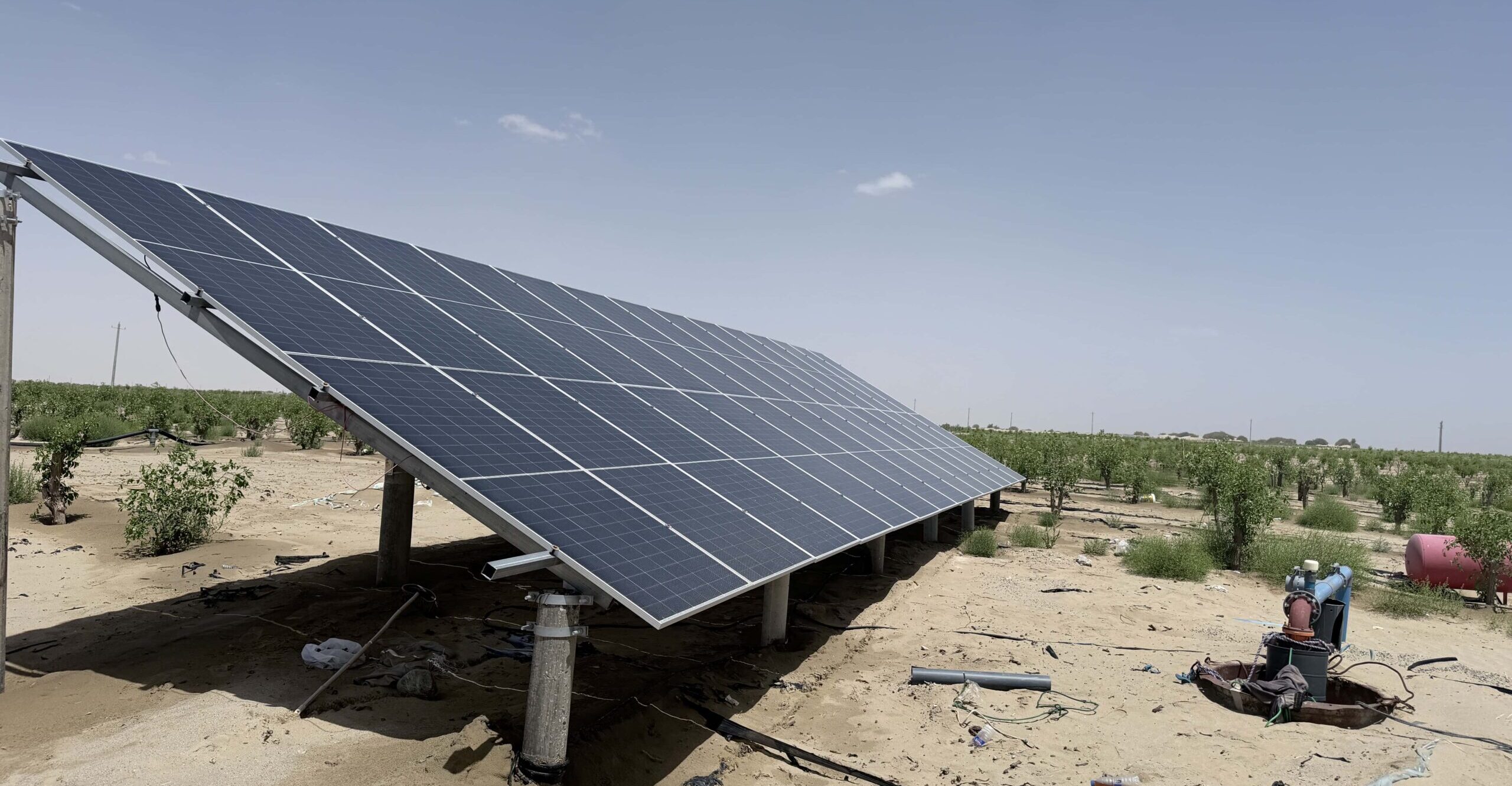
Field Comparison: Direct Solar Pump Drive + Tank vs. Battery Bank
Before locking in a bill of materials, compare how each architecture behaves under heat, dust, and multi-year farm operation:
| Project Criterion | Dedicated Solar Pump Inverter + Water Tank | Off-Grid Storage Inverter + Battery Bank |
|---|---|---|
| Energy Storage Medium | Elevated tank, cistern, or lined irrigation pond | Lithium (LiFePO4) or lead-acid battery cells |
| Motor Starting Behavior | Smooth VFD soft ramp (0Hz to 50/60Hz), low mechanical shock | Hard across-the-line surge unless a separate VFD is added |
| Inverter Sizing Rule | Match motor amps plus one power step when head is deep | Often oversized 3x to 5x pump kW to clear starting surge |
| PV Array Starting Rule | 1.3x to 1.5x (380V 3-phase) or >= 2.0x (220V 1-phase) | Extra PV wattage needed to cover charge/discharge losses |
| High-Heat Sensitivity | Electronics tolerate 45°C–50°C inside shaded cabinets | Battery cycle life drops sharply above 35°C ambient heat |
| Typical Replacement Risk | Minimal moving wear; standard breaker and fan checks | Battery pack replacement, BMS faults, and rural theft risk |
Where Direct PV Pumping Cuts Five-Year Project Cost
Every conversion stage wastes energy and adds failure points. In a battery-buffered pumping station, solar DC charges the battery through a charge controller, chemical storage loses round-trip energy, and an inverter converts battery DC back into AC. In hot agricultural zones across Africa, South America, and the Middle East, wellhead shed temperatures regularly pass 40°C—the exact thermal zone where battery warranties shrink and BMS high-temperature cutoffs stall water delivery.
Storing water instead of electrons flips the maintenance equation. A concrete cistern, galvanized tank, or HDPE-lined pond lasts 15 to 25 years with basic float-switch control. During peak solar hours from 9:00 AM to 3:30 PM, the drive runs near 45Hz–50Hz and fills the reservoir. In late afternoon sun, MPPT adjusts motor speed down to 30Hz–35Hz so the pump keeps lifting water instead of tripping offline. Field guidelines published by the Food and Agriculture Organization (FAO) on solar-powered irrigation consistently favor hydraulic storage over electrochemical batteries for medium and large crop water demand for this exact lifecycle reason.
On high-horsepower schemes—such as the 185HP center-pivot installation documented in our Paraguay 200kW solar irrigation project—sizing a battery bank for hundreds of amps of three-phase motor load would wreck project payback before civil work even started.
What About Farms That Still Need Water After Sunset?
Some sites genuinely cannot rely on daytime sunlight alone. Drip fertigation schedules, livestock feedlots with small buffer tanks, or cloudy monsoon weeks still require guaranteed pumping hours. Even then, batteries are rarely the first answer.
Look at three practical ways EPC teams handle after-hours pumping without building an oversized battery room:
- Oversize the Tank Before Adding Batteries: Increasing tank volume by one extra day of livestock or greenhouse demand almost always costs less than buying lithium cabinets, air-conditioned battery shelters, and theft-proof fencing.
- Use AC/Solar Hybrid Input When Grid or Diesel Exists: Platforms like the Solarseeker SP4 380V solar pump inverter accept both PV DC strings (270V–800V DC, targeting around 540V DC Vmp) and 380V–440V three-phase AC input from a rural utility line or standby generator. Solar carries the daytime load, and AC supply takes over at night or during heavy storms.
- Pair Existing Off-Grid Cabins with a Soft-Start Drive: If a remote ranch already runs a central battery bank for domestic power and must feed a small pump from that AC bus, placing a solar pump VFD ahead of the pump eliminates the 3x–5x starting surge so the cabin inverter does not trip.
Pre-assembled control cabinet layout integrating PV DC breakers, AC backup switching, surge protection, and cooling airflow.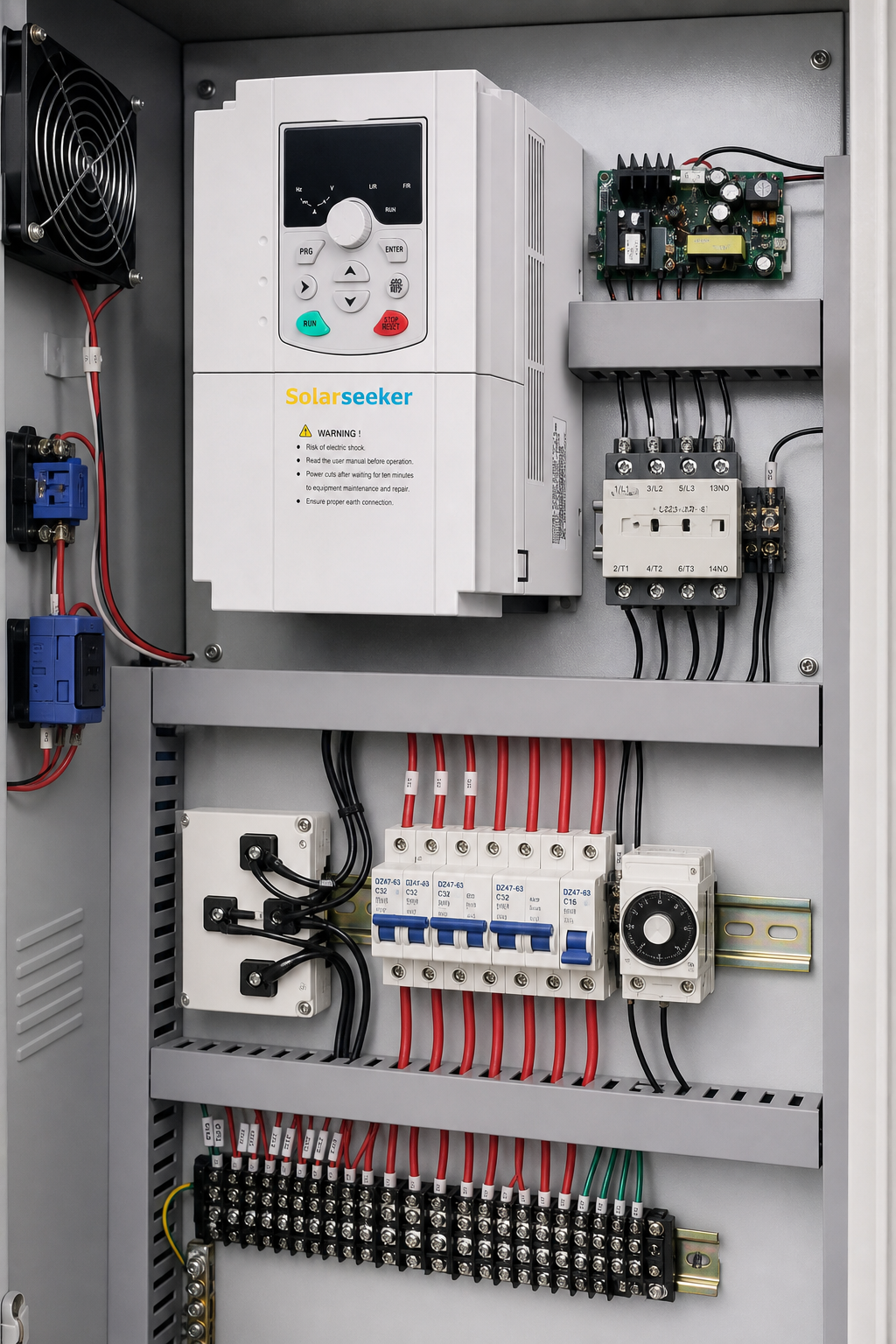
For exposed outdoor boreholes where standard IP20 drives need protection against dust, rain, and wiring errors, contractors typically order a factory-wired Solarseeker IP65 Solar Pump Control Cabinet with pre-mounted DC/AC breakers, surge protection devices (SPD), and terminal blocks. Always use a qualified electrician and follow local electrical codes when wiring dual-source PV and AC hybrid supplies.
How to Quote the Right Architecture for Your Site
Before spending budget on batteries in a solar pump inverter vs battery storage comparison, check three site numbers: daily cubic meters required, available tank elevation or pond footprint, and whether single-phase or three-phase backup AC exists on site.
Whether you are testing a single pilot borehole or quoting a multi-site EPC tender, send your pump nameplate photo, rated kW and amps, total dynamic head, daily water target, and backup power availability through the Solarseeker Engineering Contact Page for a matched inverter or cabinet configuration sheet.