
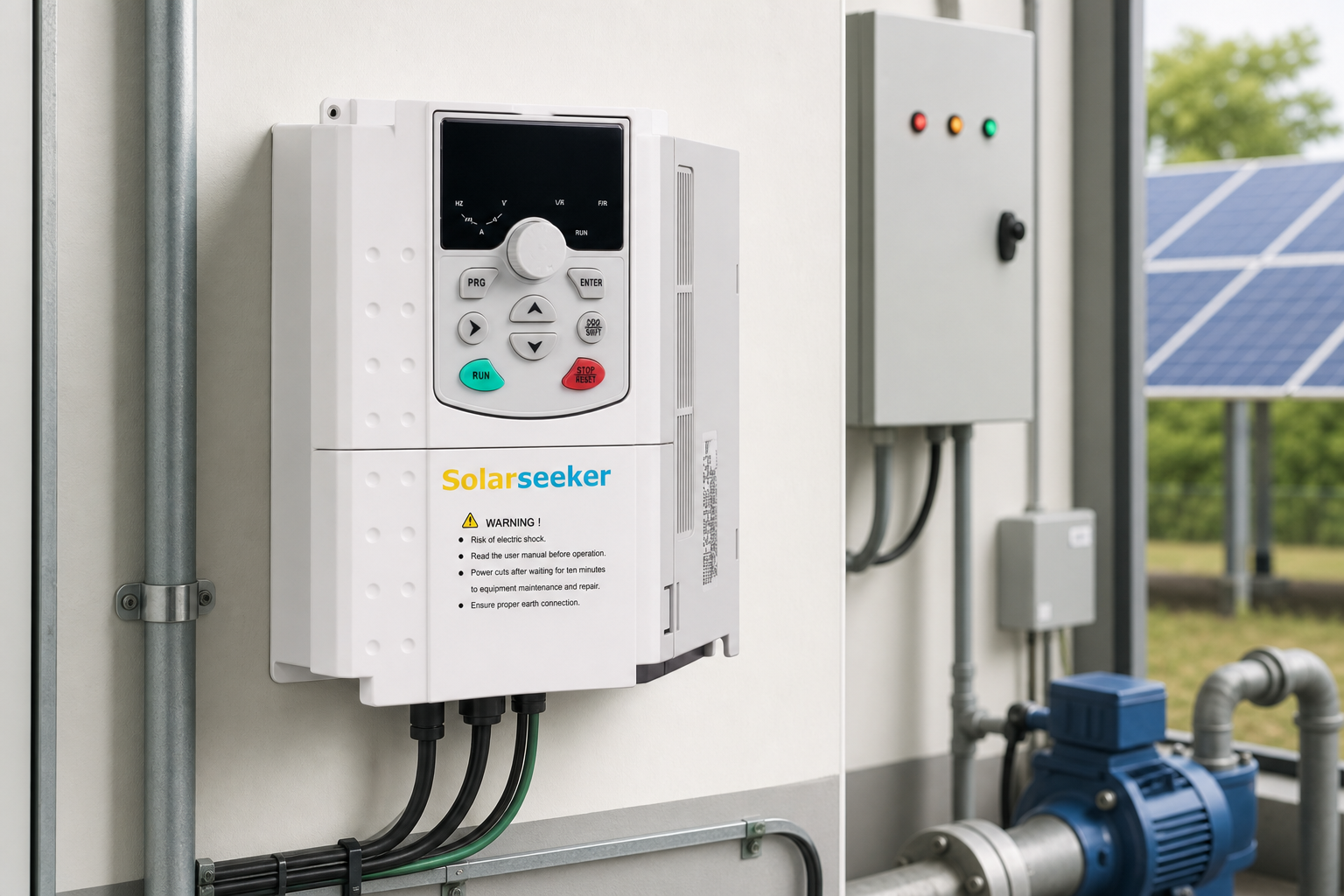
Yes, you can often keep an existing AC water pump and run it from solar. But do not start by counting panels.
Start with the pump nameplate.
If the voltage, phase, rated current, motor condition, head and flow all make sense, a solar pump inverter can sit between the PV array and the existing pump. If those basics do not match, adding more panels will not fix the project.
This is the question we use in Solarseeker retrofit checks:
Can the pump, inverter, PV string and real water duty work together as one system?
That is a better question than simply asking whether solar can make the motor turn.
The basic retrofit layout is simple
A typical direct-solar retrofit looks like this:
PV array → solar pump inverter → existing AC water pump → pipework / tank / irrigation system
The pump can stay where it is if the motor is suitable for inverter operation and the pump can still meet the required head and flow.
This architecture is well established. NREL research on PV water pumping describes a system built around a PV array, variable-frequency inverter, induction motor and water pump.
The practical work is not the block diagram. The practical work is making sure each part matches the next one.
Start with the pump, not the solar panels
A message that only says “3 HP pump” is not enough for us to choose an inverter.
Two 3 HP pumps can have different voltage, phase, rated current and hydraulic behavior. One may be a good retrofit candidate. The other may need a different inverter path or a different pump altogether.
Before selecting anything, collect this data:
| What to collect | Why it matters |
|---|---|
| Pump rated power | Gives the first sizing reference, but never the final answer |
| Rated voltage | Separates 220V-class and 380V-class paths |
| Phase | Single-phase and three-phase pumps need different outputs |
| Rated current | Tells you whether the selected inverter has enough motor-side capacity |
| Rated frequency | Confirms the motor’s normal operating reference |
| Pump type | Submersible, surface and centrifugal arrangements can behave differently |
| Required head | Tells you how much lift and pressure the pump must still produce |
| Required flow | Prevents a motor that “runs” from becoming a system that delivers too little water |
| Cable distance | Affects voltage drop, motor-side design and protection |
| Site conditions | Heat, dust, rain and local electrical practice affect installation choices |
A clear nameplate photo is usually the fastest first step.
Solarseeker’s 60-Second Retrofit Check
When we review an existing AC pump for solar conversion, these six questions quickly tell us whether the job is moving in the right direction.
1. Is the pump still healthy?
Solar does not repair a worn pump.
If the pump was already noisy, drawing abnormal current or delivering weak flow on grid power, solve that problem first. Otherwise the new inverter may get blamed for an old pump problem.
2. What voltage and phase are on the nameplate?
This decides the inverter family.
A 220V single-phase pump and a 380V three-phase pump are not the same job, even if both show the same kW or HP.
3. What is the rated current?
Do not select from kW alone.
The inverter must be able to supply the motor current within the limits of the exact model. This is one of the checks that catches bad quotes early.
4. Can the pump still meet the required head and flow?
A motor can run correctly and still deliver the wrong amount of water.
If the well is deeper than before, the pipe route changed, or the irrigation system now needs more pressure, the old pump may no longer fit the hydraulic duty.
5. What are the cable and site conditions?
Long motor cables, hot pump rooms, outdoor exposure and poor protection can turn a correct inverter selection into a bad installation.
We want to know these conditions before shipment, not after the first callback.
6. Does the PV string fit the inverter?
Check both power and voltage.
A panel array can have enough total watts and still have the wrong string voltage. Too little voltage can cause late starts or weak operation. Too much Voc can create an over-voltage risk.
That six-point check is simple, but it catches most of the questions that matter before a retrofit becomes a real field job.
Match voltage, phase and current before model size
For Solarseeker projects, the motor nameplate normally decides the first product path.
- A 220V single-phase AC pump normally starts with the SP1 220V single-phase inverter path.
- A 380V three-phase pump normally starts with the SP4 380V solar pump inverter path.
- Other voltage, phase-conversion or custom projects need their own check rather than being forced into the closest kW model.
For the full product-family view, use the solar water pump inverter range.
The rule is straightforward: match the motor first, then size the solar side.
Do not size the PV array from pump kW alone
One of the easiest mistakes is this:
“The pump is 5.5 kW, so I need 5.5 kW of panels.”
That looks clean on a quotation. It is not a complete solar design.
The PV side has two jobs. It must provide enough power, and the string voltage must stay inside the working limits of the selected inverter.
Panel Voc also changes with temperature. A string that looks safe at one temperature can move closer to the inverter limit in colder weather.
A better order is:
- confirm pump voltage, phase, rated current, head and flow;
- choose the inverter series and exact model;
- confirm the model’s current technical limits;
- design the PV string for that inverter and site;
- check cable, grounding, protection and installation conditions;
- commission the pump and measure real water output.
The Solar Pump System Design Guide explains this system-level approach in more detail.
The U.S. Department of Energy takes the same system view in its Pump Systems resources, which include guidance on matching pumps to system requirements and adjustable-speed pumping applications.
Keep the pump or replace it?
Keeping the existing pump can save a lot of work, especially when pulling a deep-well pump is expensive. But “already installed” is not a reason by itself to keep it.
| Keep the existing pump when… | Reconsider the pump when… |
|---|---|
| It is mechanically healthy | It is worn, noisy or already underperforming |
| Voltage, phase and current can be matched | Motor configuration does not fit the intended inverter path |
| Pump curve still suits the required head and flow | The pump is badly oversized or cannot meet the new duty |
| Motor is suitable for inverter operation | The motor manufacturer limits or rejects VFD operation |
| Cable and installation condition are acceptable | Existing cable or site condition creates a new reliability problem |
A good retrofit saves the customer from replacing a usable pump. A bad retrofit keeps a pump that should have been changed.
What we look for in a real retrofit conversation
Consider an irrigation buyer who already has an AC borehole pump and wants to reduce daytime grid or generator use.
The first question is not “How many panels?”
We ask for the nameplate, required head, required flow and cable distance. Then we check the inverter path. Only after that do we design the PV string.
During commissioning, the installer checks rotation where applicable, operating current, frequency behavior, water output and fault status.
If the motor runs but the water is weak, do not keep increasing frequency and hope. Check the pump curve, water level, pipe losses and real hydraulic duty.
This is the type of field logic behind the Mozambique well-pumping project. Use a case as proof of application experience, not as a configuration to copy without recalculating your own site.
Weak sunlight changes water output, not just motor speed
A direct-solar system does not receive the same PV power all day.
In the morning, under cloud or late in the afternoon, the inverter may have less solar power available. It can reduce motor operation within the permitted range, but the pump still has to overcome the real head.
That means daily water demand is often a better design target than “full-speed hours.”
If the project must pump outside useful solar hours, treat backup power as a separate design decision. Do not assume a PV-only system will behave like a fixed grid supply.
Commissioning checks before you call the retrofit complete
Before handover, check at least these items:
- nameplate data matches the selected inverter route;
- PV string matches the exact inverter input limits;
- motor rotation is correct where applicable;
- operating current is within the expected range;
- grounding and protection follow the project design and local requirements;
- dry-run and water-level logic, if used, actually work;
- real head and water output are checked on site;
- final settings are recorded for future service work.
Electrical work should be handled by qualified personnel and follow local electrical rules plus the current pump and inverter manuals.
For drive-system safety, IEC 61800-5-1:2022 covers electrical, thermal, mechanical and energy-related safety requirements for adjustable-speed electrical power drive systems.
Engineering references
These references are useful for the engineering principles behind the retrofit:
- NREL — PV Water Pumping with a Peak-Power Tracker Using a Variable-Frequency Inverter
- U.S. Department of Energy — Pump Systems
- IEC 61800-5-1:2022 — Adjustable Speed Electrical Power Drive Systems Safety
Frequently asked questions
Can I connect solar panels directly to my existing AC pump?
Normally, no. An AC motor needs controlled AC power. A compatible solar pump inverter sits between the PV array and the pump motor.
Can every AC water pump be converted to solar?
No. Check motor voltage, phase, rated current, motor suitability, hydraulic duty, cable condition and inverter compatibility first.
Do I need a new pump if I switch from grid power to solar?
Not necessarily. If the existing pump is healthy and still fits the electrical and hydraulic duty, keeping it can be the better option.
How do I choose between a 220V and 380V solar pump inverter?
Read the pump nameplate first. The inverter output voltage and phase must match the motor. Do not choose from horsepower alone.
What should I send for a retrofit check?
Send the pump nameplate, voltage, phase, rated current, required head and flow, cable distance, site country and any planned PV module data.
Check Your Existing Pump Before You Replace It
If the pump is already installed, the fastest next step is to send us the basic project data. We can use it to check whether the existing pump is a good solar-retrofit candidate and which inverter path fits.
Request a Pump Retrofit Check
In the Message field, please include: pump power, voltage, phase, rated current, required head, required flow, cable distance, site country, and any planned PV module information.