
The answer depends on the pump nameplate, not the supply voltage alone.
Yes, a 220V supply can drive a three-phase pump if the solar pump inverter is designed for 220V input and 220V three-phase output, and the pump motor is also rated for 220V three-phase operation. It cannot safely drive a 380V three-phase pump unless the full output path is changed.
The First Check Is the Pump Nameplate
A 220V supply sounds simple until the pump label says “three-phase.”
That wording creates a real technical fork. Some three-phase pumps are rated for 220V three-phase. Others are rated for 380V three-phase. A solar pump inverter can only help when its input, output, current capacity, and motor control mode match the real motor.
This is why the question should not be, “Can 220V run three-phase?”
The better question is, “What voltage does this three-phase pump require?”
If the pump nameplate shows 220V three-phase, a phase-conversion solar pump inverter path can be reviewed. If the nameplate shows 380V three-phase, a 220V-to-220V three-phase inverter is not the right match.
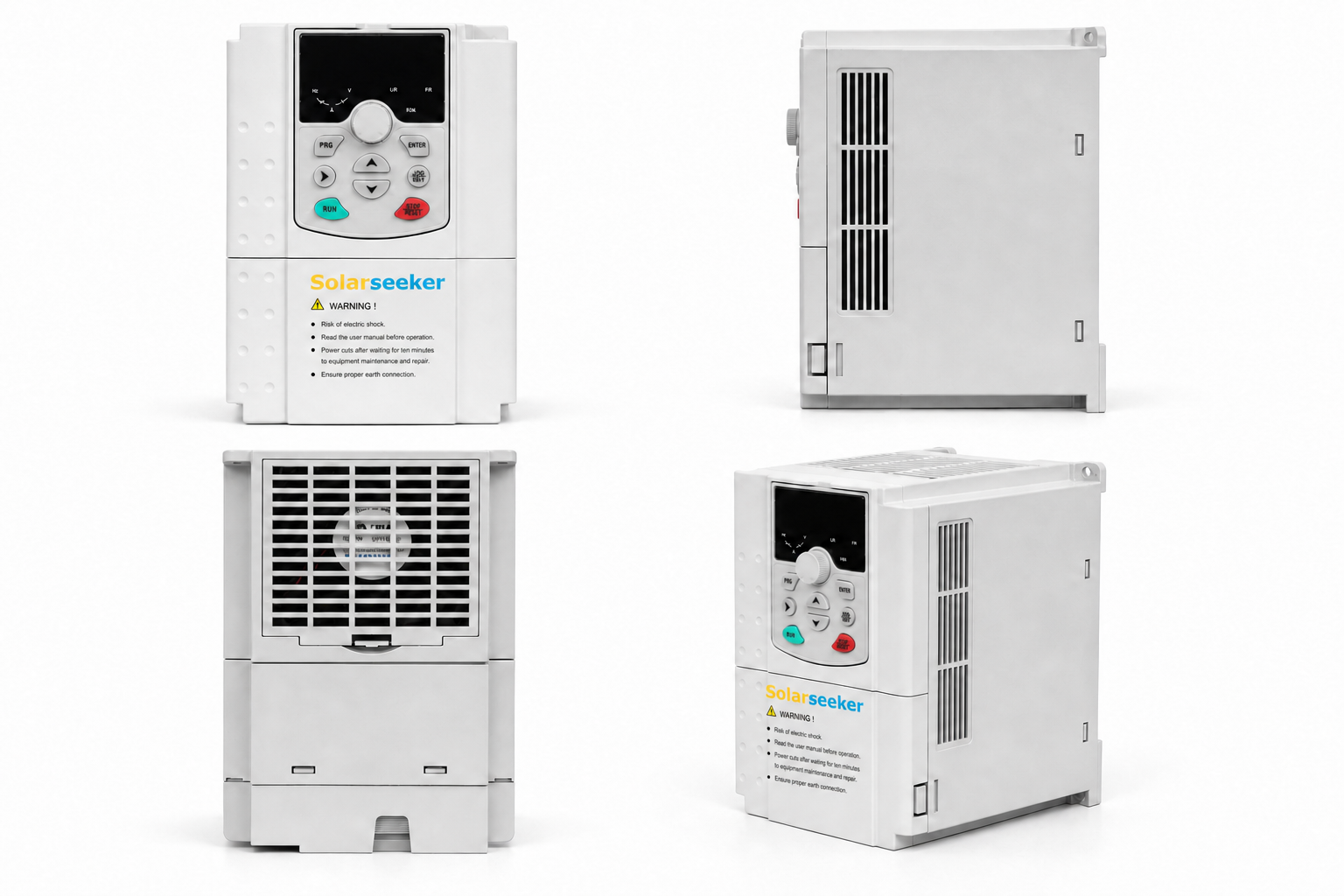
For this topic, Solarseeker’s SP2 solar pump inverter is the product path to check when the site has 220V supply and the pump needs a three-phase output path. The final model still depends on power, rated current, frequency, head, flow, cable length, and input source.
Phase-Conversion Decision Table
Use this table before quoting a 220V to three phase solar pump inverter.
| Site and pump condition | Can a 220V supply drive it? | What to check before selection |
|---|---|---|
| 220V single-phase supply and 220V three-phase pump | Possible with the right inverter | Pump power, rated current, inverter output, and overload margin |
| 220V solar input and 220V three-phase pump | Possible if the DC input window fits | PV module Voc, Vmp, string layout, and inverter DC range |
| 220V supply and 380V three-phase pump | Not with a 220V three-phase output inverter | Confirm whether another inverter path or pump change is needed |
| Pump label only says “three-phase” | Not enough information | Ask for voltage, current, frequency, connection diagram, and nameplate photo |
| Old pump with unclear label | Do not guess | Measure and document data through a qualified technician |
| Long cable distance from inverter to pump | Possible, but check voltage drop | Cable size, motor current, distance, grounding, and installation route |
| High head or heavy-load pump | Possible only after current check | Rated current, pump curve, total head, and overload behavior |
| Buyer wants grid plus solar operation | Needs engineering review | Input source, switching logic, protections, and local electrical code |
This table separates possible from ready. A project can be technically possible and still not ready for ordering.
What Phase Conversion Really Means
Phase conversion does not mean the inverter creates any output voltage the buyer wants.
In this article, the practical meaning is narrower: a suitable inverter can take a 220V-side input and drive a compatible three-phase pump with the correct three-phase output. The motor still sees a controlled three-phase waveform from the inverter.
That is useful when a site has 220V supply but the pump motor needs three-phase operation.
It is also useful when the buyer wants to run an existing AC pump from solar power. In that case, the inverter must handle both sides of the job: the input power source and the output motor requirement.
The solar water pump inverter path explains the broader inverter role. SP2 is the specific route to review when the job involves 220V input and phase-conversion logic.
Why 220V Three-Phase and 380V Three-Phase Are Not the Same
The word “three-phase” only describes the phase structure. It does not tell you the voltage.
A 220V three-phase motor and a 380V three-phase motor are not interchangeable from the inverter’s point of view. The output voltage must match the motor design. If the voltage is wrong, the result can be weak torque, overcurrent, overheating, trips, or motor damage.
This is one of the most common quotation mistakes.
A buyer sends a short message: “I have 220V power and a three-phase pump.” The supplier quotes too quickly. Later, the installer finds that the pump is 380V three-phase, not 220V three-phase. The equipment may arrive on site, but commissioning stops.
That delay is expensive. It affects freight, crew time, replacement planning, and trust with the end user.
Does Solar Input Change the Rule?
Solar input changes the energy source. It does not remove the motor-matching rule.
When the system runs from PV panels, the inverter still needs enough DC voltage and power to create stable output for the pump. Low PV voltage can cause late start, sleep mode, unstable frequency, or weak water output. Too much voltage can create over-voltage risk.
Use the following starting rule when checking PV array size and Vmp target.
| Pump system | PV array power starting rule | Useful Vmp target |
|---|---|---|
| 220V single-phase pump | PV Array Power >= Pump Rated Power x 2.0 | Around 320V DC Vmp |
| 380V three-phase pump | PV Array Power >= Pump Rated Power x 1.3 to 1.5 | Around 540V DC Vmp |
For a 220V three-phase phase-conversion project, do not copy the 380V target blindly. The inverter model and datasheet should decide the real DC input window.
Panel power, Voc, Vmp, local temperature, cable distance, and water schedule all affect the final design. A correct phase-conversion path can still fail if the PV string is poorly matched.
Where SP2 Fits
SP2 is the Solarseeker path to review when the buyer has a 220V-side supply condition and needs a three-phase pump output path.
That does not mean every three-phase pump belongs to SP2. The product route starts with the motor label. After that, the engineer checks rated current, pump duty point, PV input, and protection needs.
SP2 can be relevant in small farm pumping, garden irrigation, livestock water, and remote water supply projects where the available supply is 220V and the pump motor is compatible with a 220V three-phase output path.
It also helps distributors who meet this situation repeatedly. Instead of treating every inquiry as a custom electrical problem, they can ask for the same data each time: nameplate, current, head, flow, cable length, and input source.
Where It Does Not Fit
SP2 should not be used as a shortcut for any three-phase pump.
A 380V three-phase pump needs a different output voltage path. Unclear winding data should be confirmed before selection. High motor current may also exceed the suitable inverter range, even if the voltage looks right.
The hydraulic side matters too.
If the pump is wrong for the head and flow, the inverter cannot repair the pump curve. A heavy-load pump may pull higher current than expected. Long cable distance can add voltage drop. Poor grounding can create service risk.
Some buyers also mix up grid supply and solar supply. A solar pump inverter may support different input modes depending on the model, but the wiring and protection design must be reviewed carefully. Do not assume a field installer can connect sources by habit.
Field Example: 220V Site, Three-Phase Pump
An irrigation contractor receives a pump replacement request.
The site has 220V supply available. The existing pump is described as “three-phase,” so the buyer asks whether a solar pump inverter can make it work.
At first, the answer seems like yes.
Then the contractor sends the pump nameplate. It shows the exact voltage, rated current, frequency, and motor power. The engineer also receives the cable distance, required head, daily water demand, and planned PV module data.
If the motor is 220V three-phase and the current fits, SP2 becomes a serious option. If the motor is 380V three-phase, the project must be redirected before the buyer orders the wrong inverter.
This is the practical lesson: phase conversion is possible only when the output side matches the motor.
What to Send Before Choosing the Phase-Conversion Path
The fastest way to avoid a wrong model is to send a clear pump nameplate photo.
Add the pump power, voltage, phase, rated current, frequency, and motor connection information if available. If the pump is already installed, include photos of the old control box, wiring label, and cable route.
Site data is needed as well. Send total head, required flow, pipe route, water source, and cable distance. These details help check whether the pump will work at the target duty point.
For solar operation, include the PV module datasheet, Voc, Vmp, panel power, and planned series or parallel layout. If the site also has grid input, explain whether the buyer wants solar-only, grid-only, or hybrid operation.
This data lets the supplier decide whether SP2 is the right path, or whether the pump, inverter, or system design should change.
Safety and Installation Notes
Phase conversion involves motor output, input power, grounding, protection devices, and local electrical rules.
Installation should follow the inverter manual and local electrical codes. Use qualified electricians or trained technicians for wiring, grounding, protection selection, and commissioning.
Do not test a three-phase pump by trial and error. Wrong voltage, wrong phase output, missing grounding, or poor source switching can damage equipment and create safety risks.
FAQ
Can a 220V supply run a three-phase pump?
Yes, but only when the inverter is designed for the 220V-side input condition and the pump motor is rated for the matching three-phase output, such as 220V three-phase. A 380V three-phase pump needs a different output path.
What are the limits of 220V to three phase solar pump inverter selection?
The main limits are pump output voltage, rated current, motor power, overload behavior, cable distance, PV input range, and installation protection. The pump nameplate must be checked before choosing the inverter.
Does solar input change the phase-conversion rule?
No. Solar input changes the power source, but the inverter output still has to match the pump motor. PV array voltage and power must also fit the inverter DC input range.
Is SP2 suitable for every three-phase pump?
No. SP2 should be checked when the project needs a 220V-side phase-conversion path and the motor data fits. It should not be assumed suitable for 380V three-phase pumps or unclear motor labels.
What data should I send before choosing SP2?
Send the pump nameplate, pump power, voltage, phase, rated current, frequency, head, flow, cable distance, PV module Voc and Vmp, planned string layout, and site power source details.
Check the Nameplate Before Ordering
Before choosing a 220V to three phase solar pump inverter, confirm the motor label first.
Send Solarseeker the pump nameplate, rated current, voltage, phase, head, flow, cable distance, PV module data, and site power source through the contact page. The engineering team can then check whether SP2 fits the phase-conversion path or whether another solution is safer.