
The fastest way to ruin an off-grid irrigation quote is matching 4kW of solar modules to a 4kW water pump. In real field temperatures, the right solar panels water pump sizing ratio is at least 2.0x pump rated power (targeting around 320V DC Vmp) for 220V single-phase pumps, and 1.3x to 1.5x pump rated power (targeting around 540V DC Vmp) for 380V three-phase pumps, while keeping cold-morning open-circuit voltage (Voc) strictly at or below 800V DC.
You must oversize the PV array. Period. Solar panels only hit their sticker wattage at 25°C cell temperature under laboratory 1,000 W/m² irradiance—conditions that vanish by 10:30 AM on a hot farm.
Starting Rules: 220V Single-Phase vs. 380V Three-Phase Pump Arrays
Single-phase and three-phase motors do not share the same starting torque curve, which is why applying a three-phase sizing rule to a small 220V borehole pump leaves the system asleep half the morning. Use this baseline table before counting modules for any solar water pump inverter:
| Pump Motor System | PV Array Power Starting Ratio | Target String Vmp (STC) | Hard Max DC Input (Cold Voc) | Typical Solarseeker Path |
|---|---|---|---|---|
| 220V Single-Phase AC Pump | PV Power >= Pump kW x 2.0 |
Around 320V DC | <= 800V DC | SP1 Series (170V–800V DC range) |
| 380V Three-Phase AC Pump | PV Power = Pump kW x 1.3 to 1.5 |
Around 540V DC | <= 800V DC | SP4 Series (270V–800V DC range) |
Why does a 220V single-phase pump demand a 2.0x array multiplier? Capacitor-run single-phase motors have lower starting efficiency and higher current draw per kilowatt than balanced three-phase induction motors. Without that 2.0x solar cushion, cloud edges drop motor speed below the centrifugal pump’s minimum lift frequency—the motor spins down in the well, heats the water around the shroud, and pushes zero liters out of the discharge pipe.
Matching pump nameplate kW and full-load amps to PV string Vmp, Voc ceiling, and inverter frame rating.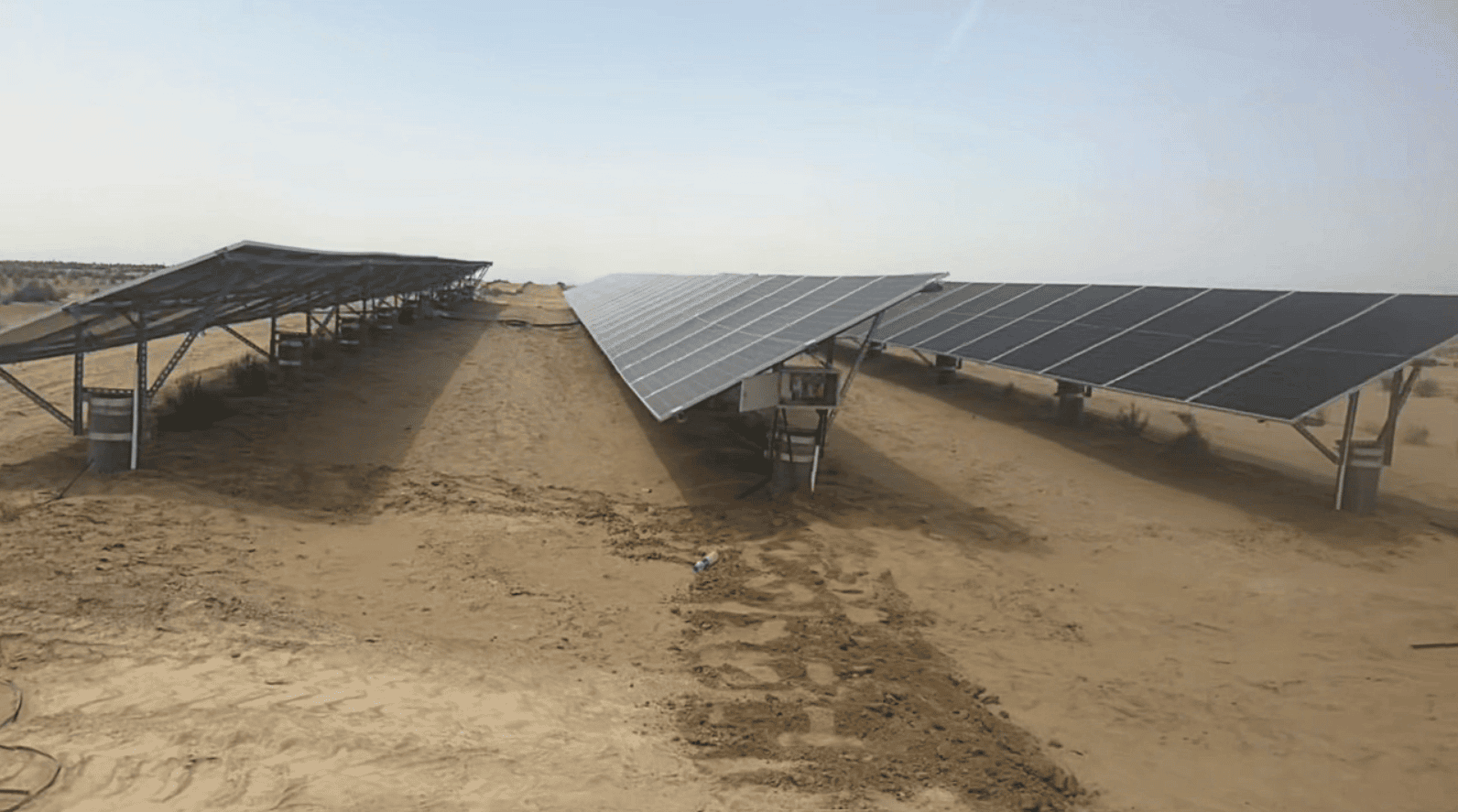
Why Total Panel Wattage Still Fails Without the Right String Voltage
Getting total array kilowatts right is only half of the solar panels water pump sizing ratio. How you wire those panels in series versus parallel decides whether the pump actually reaches 50Hz at midday.
Crystalline silicon modules tested under IEC 61215 terrestrial PV standards typically lose 0.30% to 0.35% of operating voltage (Vmp) per degree Celsius above 25°C. When air temperature hits 38°C–42°C, dark glass cells mounted over dry soil reach 65°C–70°C, shaving 12% to 15% off string voltage right at solar noon:
- Too Few Panels in Series (
VmpToo Low): If a 380V pump string is wired right on the edge at 490V STCVmp, afternoon heat drags actual loaded DC voltage down near 420V. The inverter cannot synthesize full 380V AC at 50Hz, so frequency clips around 38Hz–41Hz and borehole water flow drops by a third. Aiming around 540V to 600V DC STCVmpgives hot-weather headroom. - Too Many Panels in Series (
VocOver 800V): Cold winter dawn flips the math. Module open-circuit voltage rises in freezing air before the pump wakes up. Exceeding the 800V DC maximum input rating risks over-voltage lockouts or blown DC bus capacitors.
Cell temperature derating reduces loaded PV string Vmp during peak midday heat; proper series string count keeps voltage inside the 540V DC target zone.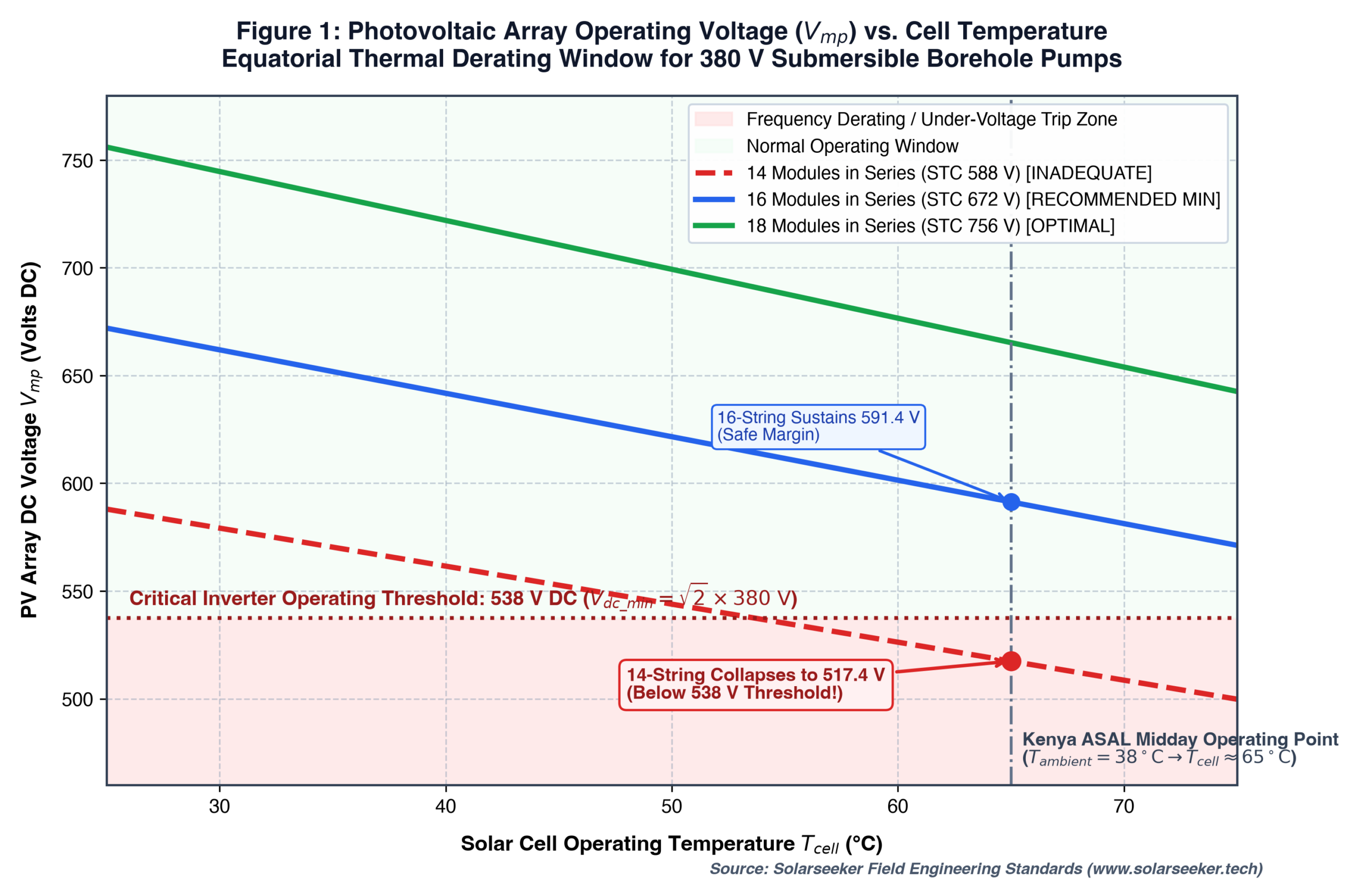
Worked Field Check: Sizing a 4kW Pump Without Thermal Clipping
Look at how experienced dealers put both inverter headroom and PV ratio together on a 4kW borehole pump:
- Step Up the Inverter Frame by One Tier When Needed: Submersible motors often carry higher service-factor amps than standard surface motors. Pairing a 4kW pump with a 5.5kW-rated inverter (such as
SP4005for 380V three-phase, orSP1005for 220V single-phase) gives continuous current margin inside hot enclosures. - Apply the Voltage-Specific Array Multiplier:
- On a 4kW 380V three-phase pump,
4.0 kW x 1.35 = 5.4 kWminimum PV array (for instance, one string of 13 to 14 bifacial/monocrystalline 580W modules = 7.5kW if long pumping hours are needed, or 14 x 450W = 6.3kW, checking exact moduleVmp~41V so 14 in series hits ~574VVmpand coldVocstays well below 800V DC). - On a 4kW 220V single-phase pump,
4.0 kW x 2.0 = 8.0 kWPV array (for example, 14 x 580W = 8.12kW wired in one or two parallel strings depending on moduleVoc, targetingVmp >= 320V DCandVoc <= 800V DC).
Hidden Balance-of-System Costs When Picking Cheap Low-Wattage Panels
Distributors sometimes grab clearance 330W polycrystalline pallets instead of modern 550W–600W modules to trim panel cost per watt. Watch the job-site math: hitting a 15kW array with 330W panels takes 46 modules instead of 26 modules. Those 20 extra panels mean extra aluminum rails, mid-clamps, MC4 crimps, combiner fuse holders, trench footprint, and another day of crew labor under the sun.
When parallel string count climbs above two strings, integrate proper PV string fuses, DC isolate breakers, and lightning surge arresters inside a factory-wired Solarseeker IP65 Solar Pump Control Cabinet rather than cobbling loose plastic combiner boxes onto the mounting pole. All high-voltage DC string work must be completed by trained technicians under local electrical codes.
Send Your Panel Datasheet and Pump Nameplate for a String Check
Before buying modules or locking in a solar panels water pump sizing ratio for a tender, check module Vmp and Voc against your motor amps and borehole head. Send your pump nameplate photo, well depth, daily water demand, and exact solar panel datasheet (Wp, Vmp, Voc, Imp) through the Solarseeker Engineering Contact Page to get a verified series-parallel string plan.