

High head and high flow projects should be sized from the duty point, not from the controller price.
High head and high flow expose weak pump selection fast. A system that works in a shallow well can fail badly when water must move higher, farther, or in larger volume.
DC solar pump systems often reach practical limits in these projects because power range, pump curve, controller capacity, and service path become constrained. AC VFD systems can drive standard three-phase pumps across a wider range, which makes them a stronger fit for deep wells, large irrigation blocks, and commercial transfer work.
Find the Duty Point First
The duty point is the flow required at the real total head. Without it, the quote is only a guess.
- Static and dynamic water level
- Vertical lift
- Pipe length and diameter
- Friction loss
- Target daily water volume
- Pump curve at the required point
Where DC Starts to Struggle
| Project pressure | Why DC struggles | AC VFD advantage |
|---|---|---|
| Deep well | Higher lift needs more motor power | Standard three-phase pump options |
| Large irrigation | Flow demand exceeds small package range | Scalable inverter and pump selection |
| Long pipe run | Friction loss raises required head | Better pump curve choices |
| Remote service | Proprietary parts slow repair | Local AC motor service path |
For a project-style reference, the Mozambique well-pump project shows a well-water application using SP4011 380V three-phase solar pump inverter equipment. That is the type of service path high-lift projects often need.
Pipe Loss Can Steal the Project
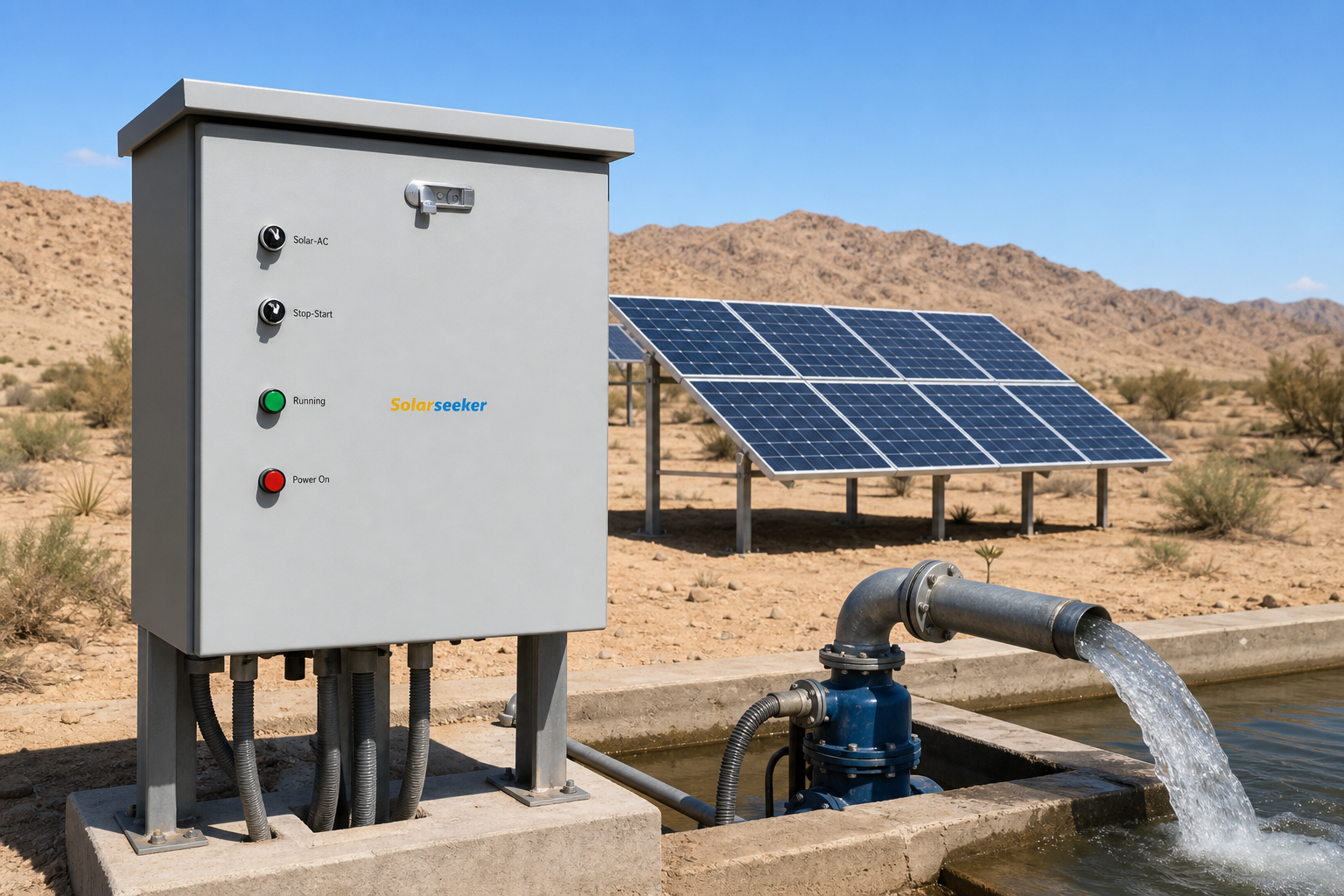
A high-flow system can lose performance through long pipe runs, elbows, small pipe diameter, and elevation changes. If the quote ignores pipe loss, the pump may run but still miss the water target.
This is where a standard solar pump inverter and a proper pump curve matter more than a neat controller package.
When AC Should Be the Default Shortlist
If the job needs high lift, high daily water volume, or a three-phase pump, treat AC solar pumping as the default shortlist. Then check whether a DC package can honestly meet the duty point. Do not reverse that order.
For 380V three-phase deep-well or irrigation pumps, check the SP4 inverter range against pump voltage, current, head, and flow.
Why Pump Curve Evidence Matters
High head and high flow cannot be judged from pump power alone. A pump curve shows whether the pump can deliver the target flow at the real head. Without that curve, an EPC team may quote a system that runs but never reaches the required water output.
Pipe loss is often the hidden problem. Long pipe runs, small diameter, elbows, and elevation change all increase head. The buyer may describe the well depth, but the system still fails because the pipe route was not counted.
Useful Field Data for High-Lift Projects
| Data | Why it matters |
|---|---|
| Dynamic water level | Shows real lift during pumping |
| Pipe length and diameter | Defines friction loss |
| Target flow | Defines the duty point |
| Pump curve | Confirms whether the pump can do the job |
Fluid Dynamics at High Lift: Overcoming DC Head and Flow Ceilings
Centrifugal and progressive cavity DC pumps operate effectively for low-volume drinking water points (1 to 3 m³/h at 30 to 50 meters head). However, when an agricultural project requires 20, 50, or 100 m³/h for commercial pivot irrigation or orchard drip lines, DC pump architecture hits an inescapable physical limit.
Lifting high volumes against substantial pressure requires high electrical power (P = ρ · g · Q · H / η). Above 3 kW, supplying this power at low DC voltage requires hundreds of amperes of current, causing extreme line resistance losses. High-voltage 380V AC three-phase solar inverters easily scale from 5.5 kW up to 110 kW, delivering massive flow rates at depths exceeding 200 meters.
Pressure, Pipe Head, and Static Elevation Physics
In high-lift projects exceeding 80 to 200 meters of total dynamic head, water pressure inside the delivery column rises past 8 to 20 bar (115 to 290 psi). At these pressures, centrifugal impellers must spin at full speed to maintain positive head pressure.
Centrifugal affinity laws dictate that shutoff head varies with the square of motor speed: H ∝ N². If a low-voltage DC pump experiences a 15% voltage drop down the riser pipe, its speed drops by 15%, causing developed head pressure to collapse by nearly 28%. The pump suddenly ceases to lift water past the wellhead.
High-voltage AC solar inverters provide precise vector-oriented frequency control, ensuring motor speed remains stiff and stable even when cloud transients cause sunlight fluctuations.
Before You Quote the System
Send the pump curve, well depth, pipe route, elevation, target flow, and PV plan to Solarseeker. If the duty point is not proven, the system is not ready to quote.