
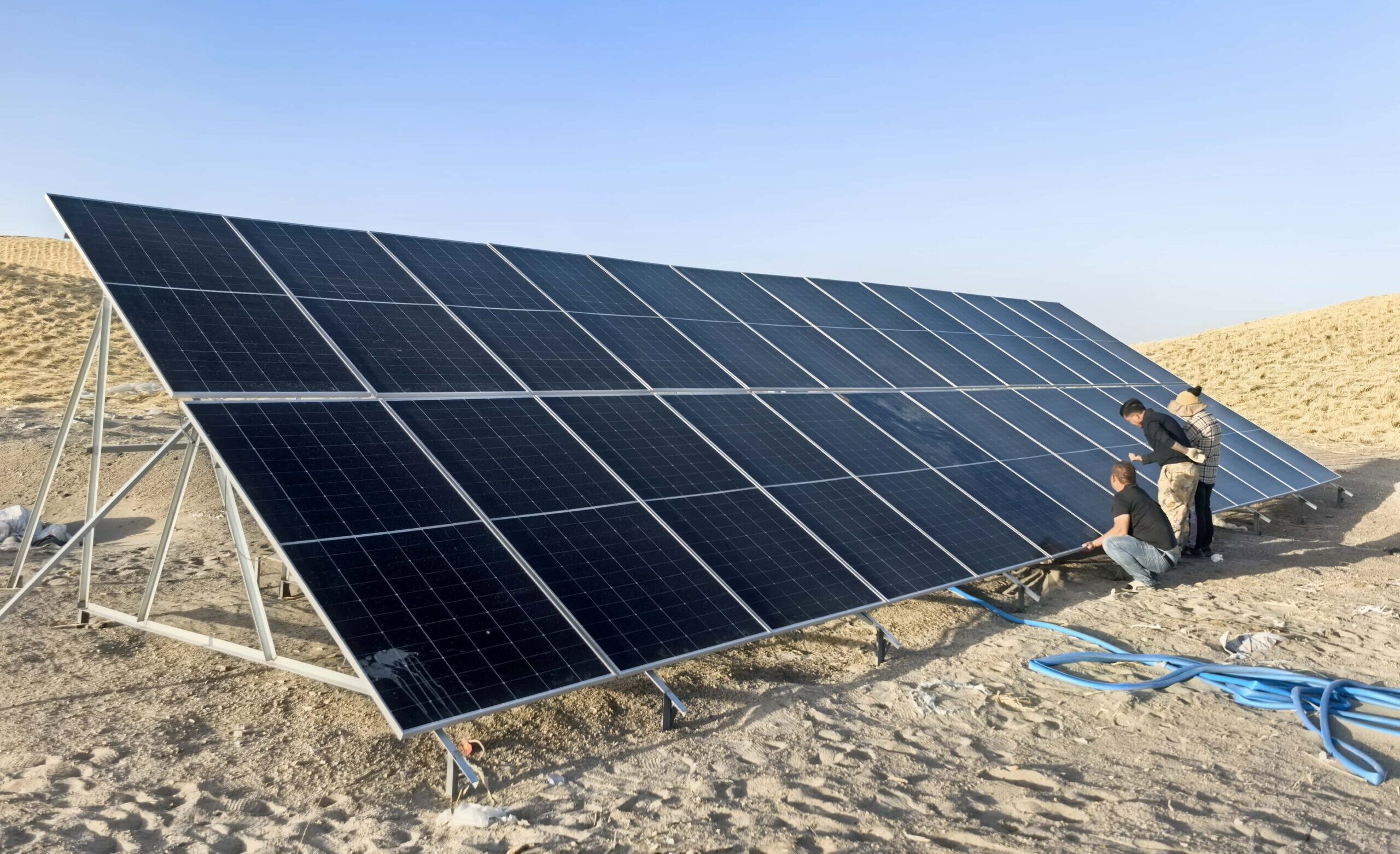
On a deep well site, the real question is not “How many kilowatts is the inverter?” The first question is whether the pump can lift enough water from the real water level to the discharge point, at the flow the buyer needs.
Sizing a solar water pump for a deep well starts with head and flow. After that, select the pump, confirm voltage and phase, match the solar pump inverter, then size the PV array and cable. If you start with inverter power first, you can choose a system that looks strong but fails to deliver water.
Deep wells punish shortcuts.
Start With Total Head
Head is the lifting pressure the pump must overcome. For deep wells, it is not only the depth printed in the drilling report.
A practical head estimate should include:
- Static water level
- Drawdown when the pump is running
- Height from wellhead to tank or discharge point
- Pipe friction loss
- Filter, valve, and elbow losses
- Safety margin for seasonal water-level changes
If the water level drops during dry season, the pump sees more head. That can reduce flow and raise motor load.
Flow Decides Daily Water Output
Flow is how much water the project needs per hour or per day. A farm may need steady irrigation volume. A livestock project may need reliable tank filling. A remote water supply project may need predictable daily output.
Do not select only by maximum flow on a brochure. Match the pump curve to the head.
| Planning item | Question to answer |
|---|---|
| Daily water demand | How many cubic meters per day are needed? |
| Operating hours | How many sunlight hours can the system realistically run? |
| Required flow | What m3/h flow is needed at the real head? |
| Seasonal change | Does the water level drop in dry season? |
| Storage tank | Can water be stored to reduce peak pumping pressure? |
The pump should be selected at the expected head and flow point, not at a no-load condition.
Choose the Pump Before the Inverter
Once head and flow are clear, choose the pump. Then use the pump nameplate to select the inverter.
Check:
- Pump power
- Voltage
- Phase
- Rated current
- Frequency
- Cable distance
- Submersible motor requirements
For many deep well and larger irrigation projects, the pump is a 380V three-phase AC pump. In that case, a product path such as Solarseeker SP4 is often relevant. For smaller 220V single-phase pump systems, Solarseeker SP1 may be the closer path.
The main category page is Solarseeker solar water pump inverter.
Match the Solar Pump Inverter
The inverter must match the pump’s voltage, phase, current, and power. It also needs enough protection logic for a deep well site.
Important features include:
- Dry-run protection
- Overload protection
- Over-voltage and under-voltage protection
- Soft start and frequency control
- Sensor or float switch compatibility
- Clear parameters for commissioning
Deep wells often have long motor cables. That means cable sizing, voltage drop, and grounding need careful attention. Use qualified electricians and follow local electrical codes.
Cable Distance Can Change the Result
Deep well pumps often sit far below the surface. The motor cable may run down the well, then across the site to the inverter cabinet. That distance matters.
Long cable runs can create voltage drop and heating. If the cable is too small, the motor may receive poor voltage under load. The inverter may show abnormal current, reduced output, or protection trips.
Before final selection, record:
- Cable distance from inverter to pump
- Pump rated current
- Cable material and size
- Installation environment
- Local electrical code requirements
Do not treat cable as an afterthought. A correct pump and inverter can still perform badly with poor cable sizing.
Storage Tank Planning Helps the Solar System
A storage tank can make a deep well solar system easier to operate. Instead of forcing the pump to meet peak irrigation demand at one moment, the system can pump during useful sunlight and store water.
This can help in several ways:
- Reduces pressure to run at full flow all day
- Gives water reserve during cloudy periods
- Helps farms irrigate outside peak sunlight hours
- Reduces start/stop stress if controls are designed well
Tank planning does not replace correct pump sizing. It simply gives the system more room to work with natural sunlight variation.
Size the PV Array After the Pump Is Known
After the pump and inverter path are clear, size the PV array.
| Pump system | PV array power starting rule | Useful Vmp target |
|---|---|---|
| 220V single-phase pump | PV Array Power >= Pump Rated Power x 2.0 | Around 320V DC Vmp |
| 380V three-phase pump | PV Array Power >= Pump Rated Power x 1.3 to 1.5 | Around 540V DC Vmp |
For deep wells, weak PV design can show up as low water output, late starting, or poor performance under clouds. The system may run during a noon test but fail to meet daily water demand.
Also check cold-weather Voc and hot-weather Vmp. Cold weather raises Voc. High heat lowers Vmp. Both affect the inverter’s working window.
Deep Well Sizing Sequence
Use this order for EPC planning:
- Confirm static water level and running water level.
- Estimate total head, including friction loss.
- Confirm daily water demand.
- Choose a pump curve that meets flow at that head.
- Read the pump nameplate.
- Select a solar pump inverter that matches voltage, phase, current, and power.
- Size PV power and string voltage.
- Check cable distance, protection, and grounding.
- Plan commissioning and dry-run protection.
This sequence prevents the common mistake of buying the inverter before the water problem is understood.
A Simple Deep Well Planning Example
Imagine a farm buyer says the well is 80 meters deep. That number alone is not enough.
The static water level may be 35 meters. When the pump runs, drawdown may move the working water level to 50 meters. The tank may sit 8 meters above the wellhead. Pipe friction may add another several meters depending on pipe length, diameter, elbows, and flow rate.
In that case, the pump is not simply lifting from 80 meters. It is working against the real operating head. If the selected pump curve cannot deliver the required flow at that head, the system will disappoint the buyer even if the inverter and panels are sized well.
This is why deep well quoting should request water level and flow data before hardware selection. The pump curve comes before the inverter quote.
Deep Well Project Checklist
Before quoting, collect:
| Data | Why it matters |
|---|---|
| Well depth | Helps frame the site, but not enough by itself |
| Static water level | Starting point for head calculation |
| Drawdown level | Real running lift point |
| Tank height or discharge elevation | Adds to total head |
| Pipe length and diameter | Affects friction loss |
| Required daily water | Decides flow and runtime |
| Pump nameplate | Drives inverter selection |
| Local temperature | Affects PV voltage design |
Protection Settings Matter More in Deep Wells
Deep wells are harder to inspect than surface pumps. If the pump runs dry, overloads, or cycles badly, the problem may not be noticed until water output drops or the motor is damaged.
Pay attention to:
- Dry-run detection
- Tank level control
- Well level control if available
- Overload protection
- Restart delay
- Minimum and maximum frequency settings
- Alarm records during commissioning
Do not treat protection settings as optional. They are part of keeping the system stable after the EPC team leaves the site.
For project examples, see the Solarseeker solar pump project cases. Use visible case data only; do not assume another site’s flow or head will match your well.
FAQ
Can I choose a deep well solar pump by well depth only?
No. Well depth is not enough. You need static water level, drawdown, discharge height, pipe loss, and required flow.
Is a larger inverter enough to increase deep well water output?
Not by itself. If the pump curve, head, PV array, or cable design is wrong, a larger inverter may not solve the water problem.
Why does my deep well pump run but produce weak flow?
Common causes include too much head, low PV voltage, undersized panels, wrong pump curve, long cable voltage drop, or blocked pipe/filter conditions.
Final Sizing Checklist
For deep wells, size from water demand backward. Head and flow come first. Pump selection comes second. Inverter and PV matching come after that.
If you are preparing a deep well project, send the well data, target flow, pump nameplate, panel model, and cable distance. Solarseeker can help check the inverter path and PV matching before equipment is ordered.