
A practical checklist for EPC teams, distributors, and pump buyers who need an accurate solar pump inverter recommendation before ordering.
A pump nameplate gives the basic electrical data needed to choose a solar pump inverter, but it is not enough by itself. For accurate model selection, send the nameplate photo plus pump power, voltage, phase, rated current, head, flow, cable distance, water source, and site conditions. Missing data usually creates wrong quotes.
The Costly Mistake: Sending Only Pump Power
If you only send pump power, you can still choose the wrong inverter.
This happens often in irrigation and deep-well projects. A buyer sends “7.5 kW pump” and asks for a solar pump inverter price. That sounds useful, but it is only the first number.
The supplier still does not know the pump voltage. They do not know whether the motor is single-phase or three-phase. They do not know rated current, head, flow, cable distance, or whether the pump curve can meet the real duty point.
The quote may look fast. The field result may not be.
Wrong voltage means the inverter path is wrong. Wrong phase means the motor may not be driven correctly. Missing head and flow means the pump may run, but still fail to deliver enough water. Missing cable distance can hide voltage drop and heating risk.
That is why Solarseeker’s solar pump selection guide starts with pump and site data, not only inverter power.
Start With the Nameplate, Then Add Site Data
The pump nameplate is the first photo to send.
It usually shows power, voltage, phase, current, frequency, speed, insulation class, and sometimes model or pump type. This tells the supplier what kind of motor the inverter must drive.
However, the nameplate cannot tell the whole water problem.
It does not show the real well depth. It does not show pipe length, friction loss, tank height, irrigation schedule, or daily water demand. It also may not show the panel plan if the PV array has already been purchased.
For this reason, a good model check combines two groups of data:
- Motor data from the pump nameplate
- Hydraulic and site data from the project
When both are available, the supplier can check the inverter path, motor load, protection settings, and PV matching direction with fewer assumptions.
Pump Data Checklist for Model Selection
| Data to send | Where to find it | Why it matters for selection |
|---|---|---|
| Pump nameplate photo | On the motor or pump body | Lets the supplier verify the real motor data instead of relying on copied text |
| Rated power | Nameplate, usually kW or HP | Gives the first size range, but it is not enough alone |
| Rated voltage | Nameplate | Decides the inverter voltage path and avoids wrong product selection |
| Phase | Nameplate or motor wiring label | Separates single-phase and three-phase selection paths |
| Rated current | Nameplate | Helps confirm whether the inverter can carry the motor load |
| Frequency | Nameplate, often 50 Hz or 60 Hz | Helps set the output frequency range correctly |
| Pump type | Pump body, datasheet, or buyer note | Submersible, surface, centrifugal, and borehole pumps have different field checks |
| Required head | Well data, pipe route, tank height, or project design | Confirms whether the pump can lift water to the required point |
| Required flow | Irrigation or water demand plan | Confirms whether the selected system can deliver enough water |
| Cable distance | Site measurement | Helps check voltage drop, cable heating, and installation risk |
| Water source | Well, river, pond, tank, or borehole | Affects protection settings and dry-run risk |
| PV module data | Panel label or datasheet | Needed when the panel plan already exists or must be matched |
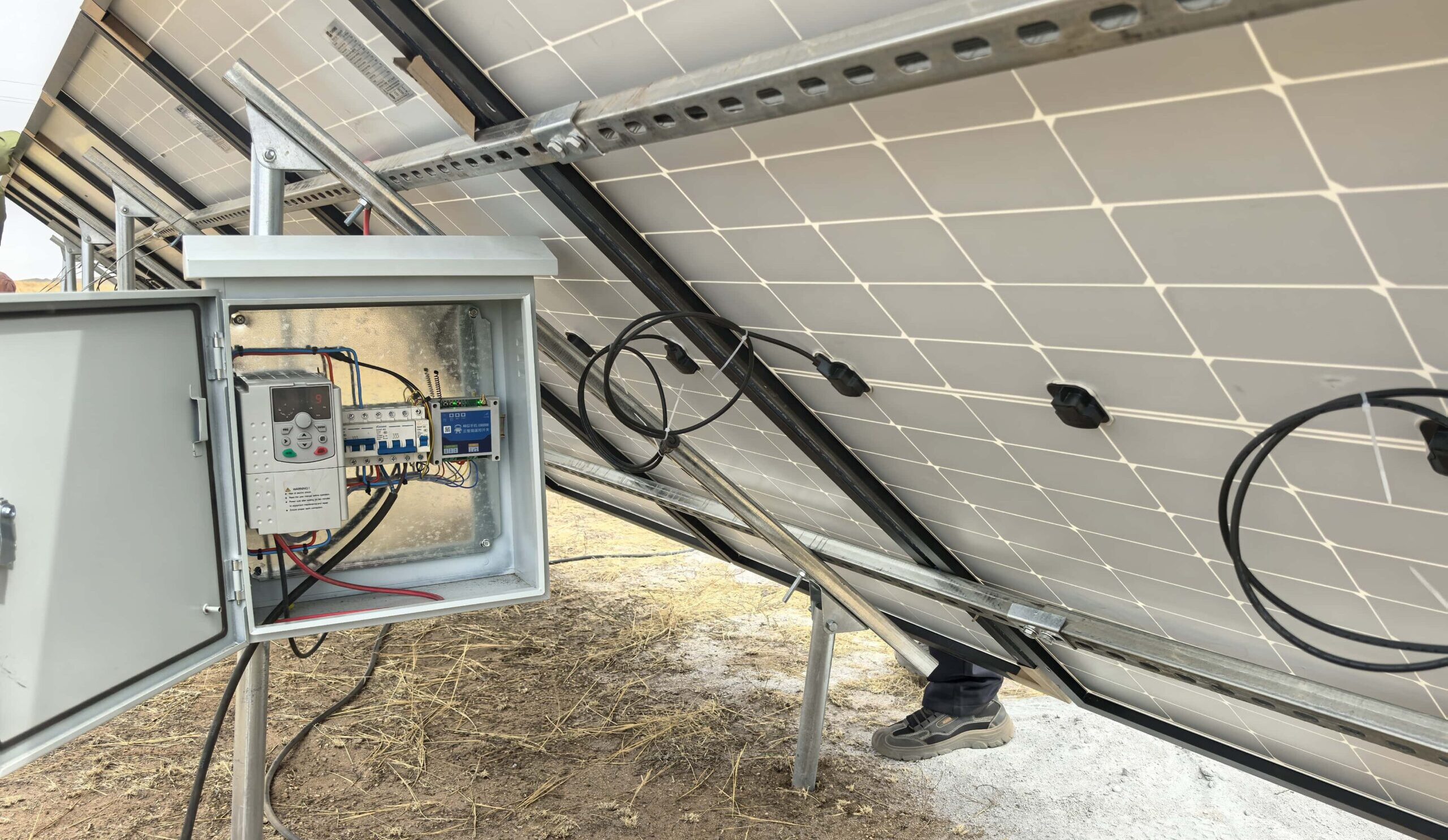
| Site conditions | Buyer note or photos | Helps identify dust, heat, shade, cabinet location, and service access |
This table is the minimum useful package for a serious quotation.
If the buyer has only three items, send them first. But the final recommendation should not be locked until voltage, phase, current, head, and flow are confirmed.
What Is Usually on a Pump Nameplate?
Most pump nameplates are small, dirty, or half-hidden after years in the field. Still, they usually carry the most important motor information.
Look for these items first:
- kW or HP
- Voltage
- Phase
- Rated current
- Frequency
- Speed
- Motor model
- Pump model
- Manufacturer
Take a clear photo straight on. Avoid flash glare if the plate is reflective. If the pump is already installed in a well, ask the installer for the original pump label, invoice, manual, or motor datasheet.
Do not rewrite the numbers by hand unless you must. A photo prevents mistakes like reading 380V as 220V, missing the phase mark, or confusing current with power.
Why Head and Flow Still Matter
Electrical matching is only half of the job.
A solar pump inverter can drive a motor correctly and still fail the water requirement if the pump is not right for the site. Head and flow tell the supplier what the pump must do hydraulically.
Head is not only well depth. It includes lift height, pressure requirement, pipe losses, and the route to the tank or irrigation line. Flow is the water volume the project needs within a useful working window.
If head is too high for the pump, water output will disappoint the buyer. If flow demand is too high, the system may run but never fill the tank fast enough. If the pipe route is long, friction loss may eat into the real duty point.
This is why the solar pump system design guide is useful when the project is more than a simple pump replacement.
PV Data Is Needed When Panels Are Already Planned
Sometimes the pump is not the only fixed item.
The buyer may already have solar panels in stock. An EPC team may already have a PV string plan. A distributor may be trying to match an inverter to panels purchased for another project.
In that case, send the PV module label or datasheet. The most useful values are panel power, Voc, Vmp, Imp, and planned series or parallel layout.
This step matters because solar pump inverters have DC input voltage windows. A panel plan that looks acceptable by total wattage can still be wrong by voltage. Too low, and the inverter may start late or run weakly. Too high, and the system may hit over-voltage faults.
Do not finalize the inverter model before the pump data and panel string direction are checked together.
Field Example: The EPC Sends Only kW
Here is a common project conversation.
An EPC team sends a message: “We need a solar pump inverter for a 5.5 kW pump.” They need a fast quote because the irrigation project is moving.
But the missing details change the answer.
Is the motor 220V or 380V? Is it single-phase or three-phase? What is the rated current? Is the pump in a shallow surface application or a deep well? What head and flow are required? How far is the inverter from the pump? Has the PV array already been designed?
If the supplier guesses, the quotation may be quick but fragile.
A better reply is to ask for the pump nameplate, head, flow, cable distance, water source, and panel data. With those details, the supplier can recommend a solar pump inverter path that fits the real motor and the real site.
This small delay before quoting can prevent a larger delay after equipment arrives.
What If the Pump Nameplate Is Missing?
A missing nameplate does not stop the project, but it does increase risk.
Start by collecting other proof:
- Pump invoice or purchase record
- Pump manual or datasheet
- Motor model photo
- Control cabinet label
- Existing VFD or contactor rating
- Installer notes
- Measured voltage and current, checked by a qualified technician
If none of these are available, the recommendation becomes less certain. The supplier may need to suggest a safer inspection path before locking the inverter model.
This is especially important for old wells, mixed equipment, or pumps bought from different suppliers over time.
Safety Note Before Site Checks
Do not open electrical cabinets or measure live circuits unless you are qualified to do so.
Pump systems may involve AC power, PV DC voltage, grounding, and stored energy in drives or capacitors. Use trained technicians, follow local electrical codes, and check the pump manual before any inspection or wiring work.
FAQ
What is on a pump nameplate?
A pump nameplate usually shows rated power, voltage, phase, current, frequency, speed, model, and manufacturer. Some plates also show insulation class, protection rating, or pump type. Send a clear photo so the supplier can verify the data.
Is pump power enough for solar pump inverter selection?
No. Pump power only gives the first size range. The supplier also needs voltage, phase, rated current, head, flow, cable distance, water source, and site conditions before making a reliable model recommendation.
What if the pump nameplate is missing?
Send the pump invoice, manual, datasheet, motor model photo, cabinet label, or existing drive information. If possible, ask a qualified technician to confirm voltage and current. Without proof, model selection carries more risk.
What photos should I send before model selection?
Send the pump nameplate, pump body, motor label, control cabinet, existing inverter or starter, well or water source, pipe route, and solar panel label if panels are already available. Clear photos reduce wrong assumptions.
Do I need to send solar panel data too?
Yes, if the panels are already purchased or the PV string plan is fixed. Send panel power, Voc, Vmp, Imp, and series or parallel layout so the inverter’s DC input range can be checked.
Before You Ask for a Quote
Send the pump nameplate first, then add the water and site data.
For a Solarseeker model check, send pump power, voltage, phase, rated current, head, flow, cable distance, water source, and any existing PV panel data through the contact page. That gives the engineer enough information to recommend a safer inverter path before the project reaches the site.